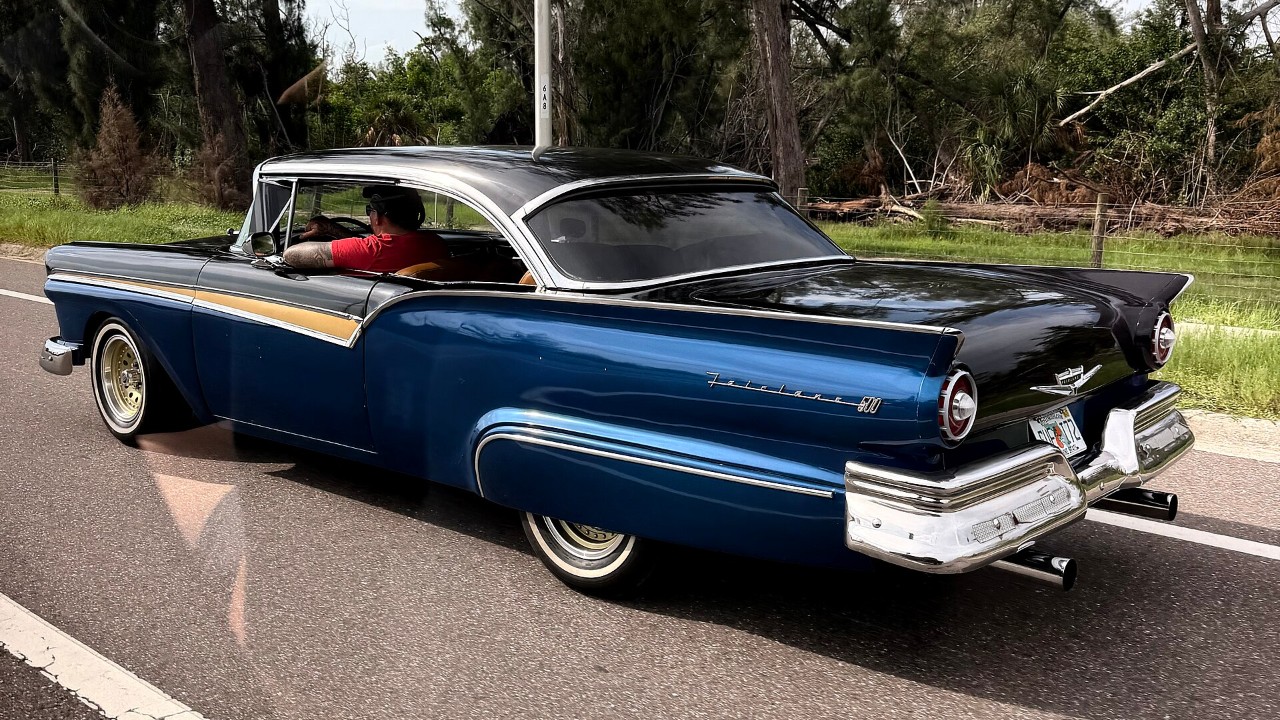
Ford’s 1957 Fairlane 500 Skyliner had a steel roof that disappeared at the push of a button. Ford did it without hydraulics. Instead, the Skyliner retractable hardtop relied on seven electric motors and 610 feet of wire to fold the roof and tuck it into the trunk.
That made it a hardtop and a convertible in the same car. It also made it one of the most complicated things a Ford dealer had ever sold.
The car ran for only three model years. Even so, the way it worked still draws a crowd every time an owner opens the trunk.
How the Skyliner retractable hardtop moved
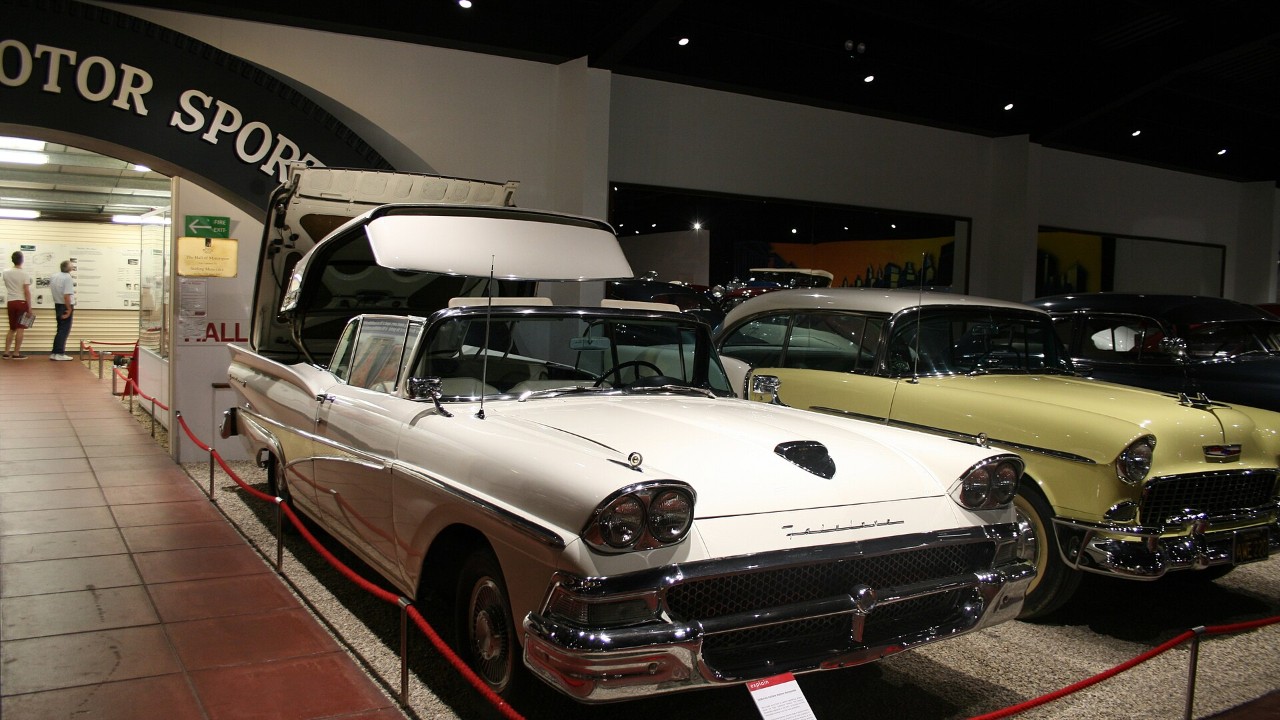
The basic idea was simple, even if the hardware was not. According to the Lang Collections, the front section of the roof folded, and then the whole top retracted under the rear deck lid. The collection notes that “no hydraulic mechanisms” were used, as they were on ordinary convertibles.
The Lang Collections, citing Hemmings, describes the order of events. First, a rear-hinged deck panel rose. Next, the roof slid into the deep well behind the rear seat. Finally, the deck closed over it. Hagerty says a switch on the steering column started the trunk lid, and the stowed roof left a smooth surface behind the rear seat. Hagerty also notes that the system would not run unless the car was stopped.
Folding the front edge was the key trick. Curbside Classic explains that the windshield sat far enough forward that a one-piece roof would not fit in the trunk. As a result, Ford hinged the front section so it tucked under before the top went down.
Seven motors and 610 feet of wire
The parts count tells the story. The Lang Collections lists seven reversible electric motors and four lift jacks. It also counts a series of relays, ten limit switches, ten solenoids and 610 feet of wiring. Four locks held the roof, and two more held the trunk lid.
The Martin Auto Museum gives the same core numbers. However, it adds one change: the 1959 cars used six motors instead of seven.
Other writers counted the electrics a little differently. For example, Hagerty describes “more than 610 feet” of wire tying together seven motors, ten power relays and eight circuit breakers. Curbside Classic lists seven motors, eight breakers, ten relays and thirteen switches. In other words, everyone agrees on the motors and the wire, while the switch counts depend on what each source includes.
Timing estimates also vary. The Lang Collections, citing Hemmings, puts a full cycle at about 40 seconds. By comparison, Hagerty says the whole process takes “about a minute.”
Born for a Continental
The roof was not first meant for a Ford at all. Hagerty says a 30-year-old draftsman named Ben Smith led the project at the Continental division from 1953. Back then, the target was the Continental Mark II.
Curbside Classic dates the work to 1952 and agrees it was aimed at the 1956 Mark II. When Continental passed on the idea, the program moved over to Ford. Curbside says Robert McNamara saw the prototype in November 1954 and approved it for production.
Development took time. In fact, Hagerty says Smith’s team spent about three years refining the mechanism before it reached customers.
The launch came in stages. Curbside Classic says Ford introduced the car in February 1957 and started sales in April. The first Skyliner retractable hardtop went to President Eisenhower on April 14, according to the same source.
What the roof cost buyers
The convenience came with trade-offs. Curbside Classic says the Skyliner’s starting price was $2,942, which was $603 more than a Fairlane 500 hardtop coupe. Compared with the Sunliner convertible, it also added 380 pounds, according to the same source.
Space was the bigger problem. The Martin Auto Museum says the stowed top “largely consumed” the trunk. That’s why Ford moved the fuel tank to stand upright behind the rear seat, per the Lang Collections and the Martin museum.
Owners also learned the mechanism’s habits. Hagerty notes that the relays sit behind the rear seat, so an owner can reset them to free a stuck top. Meanwhile, Curbside Classic calls the system “a fairly robust contraption” but says ground faults are common.
Three years and out
Sales started strong and then faded. The Lang Collections and the Martin Auto Museum both give 1957 production as 20,766 cars. Curbside Classic, by contrast, lists 20,760 sales for that year.
The Martin museum then records 14,713 cars for 1958 and 12,915 for 1959. After that, Ford dropped the retractable for 1960, and Hagerty says cost was the reason.
The engineering lived on in pieces. Curbside Classic says parts of the system were reused on the 1961 Lincoln Continental and Thunderbird convertibles. Hagerty has estimated that about 2,500 Skyliners survive.
Added up, the Martin Auto Museum’s yearly figures come to 48,394 Ford Skyliner retractables built from 1957 through 1959, by our math.
More from Fast Lane Only