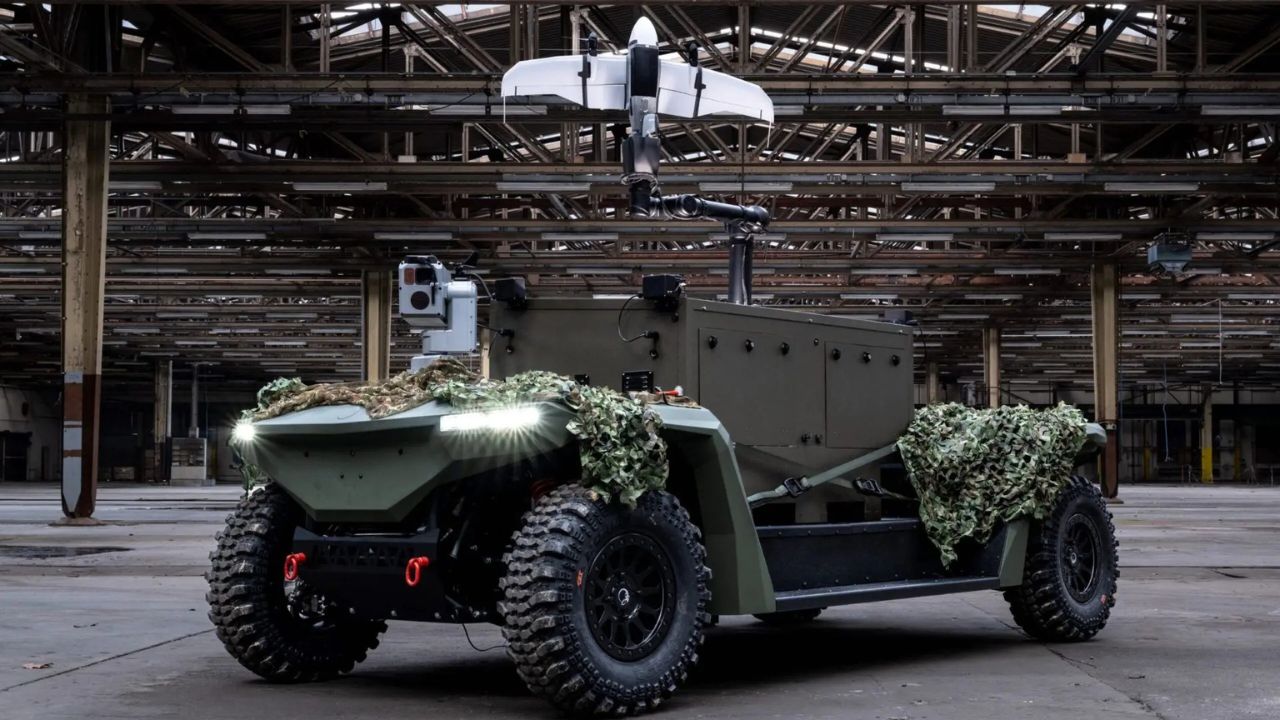
You are watching Germany push battlefield robotics into a new gear with a driverless truck that can sprint at highway speeds and haul a full squad’s worth of gear or casualties out of danger. The Mandrill unmanned ground vehicle is built to hit roughly 62 mph while carrying up to 1,653 pounds, turning what used to be a slow, exposed evacuation into a rapid, remote-controlled dash. This is not just another drone; it is a ground platform designed to move as fast as the threats you face.
At its core, the Mandrill is meant to give you options when every second on the battlefield counts, from resupplying scattered teams to dragging wounded soldiers away from fire. Instead of choosing between speed and payload, you get both in a single modular chassis that can be reconfigured for missions ranging from logistics to medical evacuation.
How Mandrill turns speed into a survival tool
If you operate near the front line, you know that the distance between safety and catastrophe is often measured in seconds and meters. The Mandrill is engineered to close that gap, with a top speed of around 100 km per hour that translates to roughly 62 mph, so you can push a rescue or resupply run at the same pace as a light tactical vehicle without putting a driver in the cab. Official descriptions of the platform highlight that this 100 km per hour performance is delivered in a fully unmanned format, which means you can stay under cover while the vehicle races across open ground toward a casualty or a cut-off unit.
Speed alone would be a stunt if the truck could not carry anything useful, which is why the Mandrill pairs its sprint capability with a rated payload of 750 kg, or about 1,653 pounds, on its flatbed. That combination allows you to load multiple wounded soldiers on stretchers, stack ammunition pallets, or mount heavier mission kits such as electronic warfare masts and still move at a pace that traditional unmanned ground vehicles rarely reach. When you compare it with older systems that top out around 20 km per hour for a similar 750 kg payload, you can see how this new German design shifts the tradeoff in your favor, giving up neither cargo nor tempo.
What Quantum Systems is really building with Mandrill
Look behind the hardware and you see that German defense technology firm Quantum Systems is not just rolling out a one-off robot truck; it is standing up an entire Ground Robotics domain anchored on this UGV. The company describes Mandrill as the first platform in a broader family of unmanned systems that can operate as part of a networked architecture, which means you can plug it into the same digital ecosystem as your reconnaissance drones and command posts. By framing Mandrill as a core product within Ground Robotics, Quantum Systems signals that you should expect software updates, payload integrations, and spin-off variants rather than a static piece of kit.
For you as a user, that strategy matters because it determines how the vehicle will evolve over its service life. If Mandrill sits inside a portfolio that includes aerial systems, you can start to think about coordinated missions where a UGV moves along a route that has already been scanned by a small unmanned aircraft, or where both share targeting and navigation data through the same control interface. Quantum Systems has already positioned Mandrill as a UGV that slots into a larger digital backbone, so you are not buying a single-purpose robot; you are buying into an ecosystem that is meant to grow.
Payload, power, and the MOSAIC UXS brain
From your perspective on the ground, the real value of Mandrill comes from what you can bolt onto it and how easily you can control those add-ons. The New MANDRILL platform is built around a modular layout that accepts a wide range of payloads on its 750 kg deck, and it pairs that hardware flexibility with the MOSAIC UXS software environment. With MOSAIC UXS, you can plug in different mission kits, from casualty evacuation modules to sensor masts or remote weapon stations, and manage them through a unified interface instead of juggling separate control units for each add-on.
The software backbone is what lets you treat Mandrill as more than a remote-controlled truck. Once you connect the vehicle through MOSAIC UXS, you can integrate it into multi-domain operations that include air and ground assets, plan routes, monitor health data from the platform, and potentially supervise several unmanned systems at once. For a medic team leader, that might mean dispatching a configured evacuation Mandrill while you focus on triage, trusting the vehicle to navigate a preplanned path. For a logistics officer, it could mean scheduling autonomous resupply runs to distributed teams and their electronics without tying up scarce drivers.
From Enforce Tac floor to your field kit
You first saw Mandrill in public when Quantum Systems introduced the UGV at Enforce Tac in Nuremberg, a trade show that focuses on law enforcement and military users. That debut was not just a static display; the company presented Mandrill as a 100 km per hour, 750 kg payload vehicle built specifically for resupply and medical evacuation missions, which are exactly the scenarios where you feel the pressure of time and exposure. By anchoring the launch at Enforce Tac, Quantum Systems put the vehicle directly in front of the European procurement officers, trainers, and operators who will decide how quickly it finds its way into your unit’s inventory.
Coverage of the event emphasized how Mandrill is optimized for speed in support of distributed teams and their electronics, a phrase that mirrors how you now operate with scattered squads, battery-hungry sensors, and mobile command posts. In practical terms, that means you can use the truck to shuttle batteries, radios, and computing gear out to teams that are spread across a wide area, then flip the configuration and bring casualties back along the same routes. The Enforce Tac rollout also showed that Quantum Systems is comfortable putting Mandrill side by side with its aerial systems, which reinforces the idea that you will eventually manage both from a shared control environment rather than through isolated consoles.
How Mandrill stacks up against other UGVs you might know
If you have worked with earlier unmanned ground vehicles such as TheMIS, you are used to a tradeoff between payload and speed. TheMIS offers a comparable rated payload of 750 kg but at a much lower speed of around 20 km per hour, which forces you to choose between carrying heavy loads and moving quickly under fire. Mandrill is designed to break that compromise by giving you the same 750 kg capacity while reaching 100 km per hour, so your resupply and medevac runs can match the tempo of manned vehicles without exposing crews to the same risks.
Speed and payload are not the only metrics you care about, though. You also look at how easily a system integrates with your existing command tools, how many roles it can play, and whether it can keep up with your shift toward networked operations. Reports on Mandrill describe it as a next-generation UGV that comes in two sizes and is configured for extended operations without frequent recharging, which means you can tailor the platform to different mission profiles and sustain it over longer patrol cycles. When you combine that with the German focus on modularity, Ground Robotics as a domain, and the MOSAIC UXS software environment, you end up with a vehicle that is less a single-purpose robot truck and more a fast, adaptable workhorse that can move with you from resupply to recovery missions across the same contested ground.
More from Fast Lane Only