
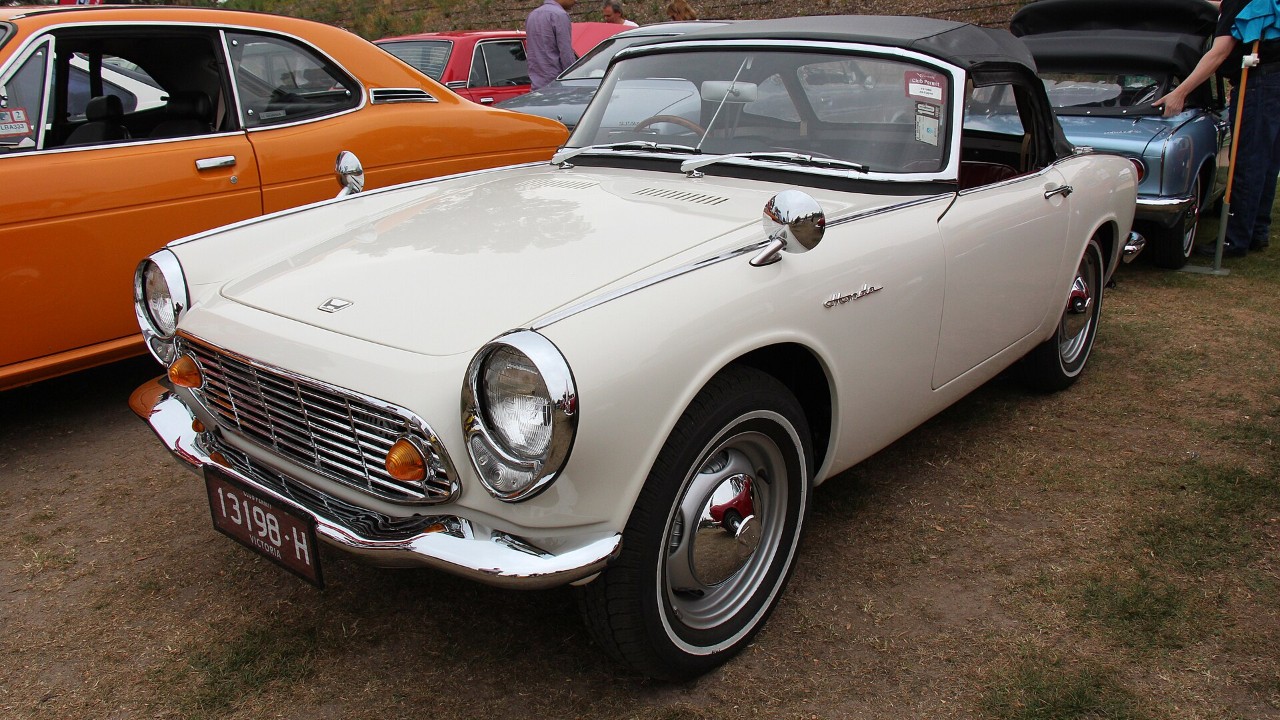
The Honda S600 sent power to each rear wheel through its own roller chain, much like a motorcycle sends power to its back tire. That Honda S600 chain drive was no gimmick. It came straight from the company’s two-wheel roots, and it also did double duty as part of the rear suspension.
Honda launched the S600 in 1964 as a tiny roadster with a high-revving engine. It was also the first production car Honda exported. Even so, its mechanical layout earned it a reputation as more motorcycle than car, a label Hagerty says even a fictional TV script used.
To understand why Honda built it this way, it helps to remember where the company came from. Before it built cars, Honda built motorcycles, and its engineers solved problems the way motorcycle engineers did.
How the Honda S600 chain drive worked
On a typical car of the 1960s, a rigid axle tube carried the drive out to both rear wheels. The S600 did it differently. Its drive reached the rear wheels through short “axle” stubs, each with a sprocket on its outboard end, as Road & Track’s April 1965 road test described it. From each sprocket, a chain ran back to its wheel.
In addition, each chain lived inside its own case. Hagerty sums up the layout as “twin chain drives, one for each independently sprung rear wheel.” In other words, the left and right wheels each had a separate chain, rather than sharing one.
That, in short, is the motorcycle part. A bike’s rear wheel sits on a swingarm and takes its power from a chain. Honda simply built two of those arrangements, one on each side of the car.
A chain case that doubled as suspension
The clever bit was what the chain cases did besides hold the chains. Road & Track explained that each chain case served as the lower member of what was essentially a trailing-link independent rear suspension. So the same piece of metal carried the drive and located the wheel.
The idea went back to the S600’s predecessor. The earlier S500 used cast aluminum cases containing the chain drive for each wheel, and those cases also worked as swing arms in motorcycle fashion, according to Shannons’ history of the S-series.
As a result, the S600 had independent suspension at all four corners, Hagerty notes. Because each rear wheel had its own chain case, each one could rise and fall on its own over bumps.
Why use chains at all?
Chains sound crude in a car, but Road & Track defended them. The magazine wrote that a properly aligned and properly lubricated roller chain results in less power loss than even straight-cut gears. For a car with a small engine, saving power mattered.
And the S600’s engine was very small. Hagerty describes it as an all-aluminum, 606cc four-cylinder with a redline of 9,500 rpm. It made 57 hp, a bored-out version of the S500’s engine. That works out to nearly 100 hp per liter, a figure Hagerty highlights.
Road & Track listed double overhead camshafts and four single-throat carburetors. The magazine also noted that peak power arrived at 8,500 rpm. Meanwhile, the tachometer read all the way to 11,000. That is motorcycle thinking again: small displacement, high revs and light weight.
Weight was the other half of the formula. Hagerty puts the curb weight at under 1,600 pounds, close to a Lotus Elan. Stopping relied on drum brakes at all four corners.
What replaced the chains
The chain drive did not last forever. Honda followed the S600 with the S800, which went on sale in February 1966, according to Shannons. Within four months of that launch, Honda swapped the chain-case rear end for a rigid rear axle with four links and a Panhard rod.
Hagerty agrees that later models ditched the rear chains for a more conventional axle. Still, the S600 kept its chains for its whole production run. In our view, that makes it the purest expression of Honda’s motorcycle-style car.
How many S600s Honda built
Hagerty says Honda built roughly 11,000 S600s between 1964 and 1966. Production figures vary between histories, so treat that as Hagerty’s estimate rather than a registry count. Either way, the S600 was never a mass-market hit.
It also never reached American showrooms through official channels. Road & Track’s road test noted that Honda did not officially export the S600 to the U.S. The magazine did report that a U.S. serviceman paid the equivalent of $1,600 for his S600 in Japan. In Canada, Hagerty says, Honda sold the cars through motorcycle dealers.
That detail fits the car perfectly. Hagerty calls the S600 the bridge between Honda’s early motorcycle success and its rise as an automaker, and the twin rear chains are the clearest proof of that link.
More from Fast Lane Only


