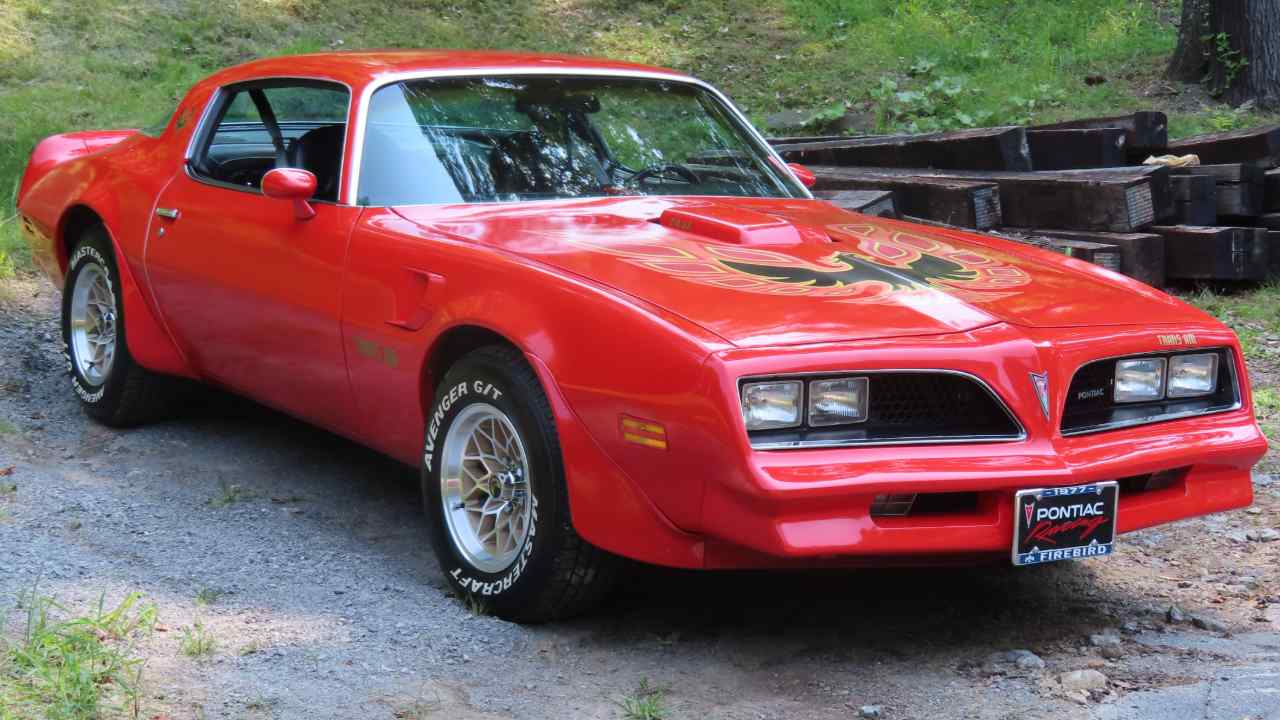
Most automobiles are remembered for what they accomplished on the road.
Some earn fame through racing victories. Others become known for groundbreaking engineering, impressive sales figures, or innovative design. Even the most successful cars typically remain confined to the automotive world, admired primarily by enthusiasts and collectors who appreciate their specific qualities.
The 1977 Pontiac Trans Am followed a different path.
While it was certainly an important performance car, the Trans Am’s significance eventually extended far beyond horsepower ratings and quarter-mile times. By the late 1970s, it had become a cultural symbol, a movie star, a fashion statement, and a representation of American automotive personality at a time when the industry was undergoing dramatic change.
In many ways, the Trans Am became bigger than the machine itself.
People who knew little about cars recognized it instantly. Children had posters of it on their bedroom walls. Its image appeared on everything from toy models to T-shirts. The car transcended its role as transportation and entered popular culture in a way few vehicles ever achieve.
The remarkable part is that this happened during a period when traditional muscle cars were struggling.
The 1977 Trans Am succeeded not merely because of what it was, but because of what it represented.
The Muscle Car Era Had Changed
By 1977, the automotive landscape looked very different from the one that had produced the great muscle cars of the late 1960s.
Emissions regulations, rising insurance costs, and fuel economy concerns had transformed the industry. Many legendary performance models had disappeared entirely, while others survived in significantly altered forms. Horsepower figures generally declined, and manufacturers increasingly focused on efficiency and compliance rather than outright performance.
For enthusiasts, the changes were difficult to ignore.
Many people viewed the classic muscle car era as effectively over. The giant engines and escalating horsepower wars that once dominated headlines seemed increasingly distant.
Yet buyers still wanted excitement.
They still wanted cars that looked special, sounded distinctive, and offered a sense of personality. Pontiac understood this better than most manufacturers.
The Trans Am became one of the company’s answers.
Pontiac Had Built a Strong Foundation
The Trans Am’s success in 1977 did not emerge overnight.
The model had spent years establishing its reputation as the high-performance version of the Pontiac Firebird. Through a combination of aggressive styling, performance-oriented engineering, and effective marketing, Pontiac gradually transformed the Trans Am into one of the most recognizable names in American performance.
By the mid-1970s, the car already possessed substantial credibility.
Enthusiasts respected it, and buyers associated the Trans Am name with excitement. Pontiac’s challenge involved maintaining that reputation despite changing industry conditions.
The company responded by focusing on identity.
If raw performance was becoming harder to deliver, personality could become even more important.
The 1977 model reflected that strategy perfectly.
The Styling Was Impossible to Ignore
One of the biggest reasons the Trans Am became a cultural icon was its appearance.
The car looked dramatic in a way few competitors could match. Its aggressive front end, flared fenders, shaker hood scoop, and bold graphics created a visual identity that was instantly recognizable.
The famous hood bird became particularly important.
Large, colorful, and unapologetically bold, the graphic transformed the hood into a statement piece. Some people loved it. Others thought it was excessive. Either way, everyone noticed it.
That visibility mattered.
The Trans Am stood out in traffic, in advertisements, and on movie screens. At a time when many cars were becoming increasingly conservative, Pontiac embraced visual confidence.
The result was unforgettable.
It Arrived at the Perfect Cultural Moment
Timing played a major role in the Trans Am’s rise.
The late 1970s were marked by uncertainty within the automotive industry. Enthusiasts worried about the future of performance cars, while manufacturers searched for new ways to attract buyers. The market was hungry for something exciting.
The Trans Am delivered.
It represented a connection to the spirit of the muscle car era without pretending that nothing had changed. The car maintained an aggressive personality even as the broader industry moved in different directions.
Buyers responded emotionally.
The Trans Am felt rebellious, confident, and distinctly American. Those qualities resonated with people who missed the excitement of earlier performance cars.
The car arrived at exactly the right moment to capture that sentiment.
Hollywood Changed Everything
The Trans Am’s transformation from popular performance car to cultural phenomenon accelerated dramatically because of one movie.
In 1977, the release of Smokey and the Bandit introduced millions of people to a black-and-gold Trans Am driven by Burt Reynolds. The film became a massive success, and the car quickly became one of its biggest stars.
The impact was enormous.
Audiences didn’t simply watch the Trans Am. They remembered it. The car’s appearance, sound, and attitude became inseparable from the movie’s identity.
Suddenly, people who had never considered owning a Pontiac wanted one.
The Trans Am was no longer just a vehicle.
It had become a celebrity.
The Car Became a Symbol of Freedom
Part of the movie’s success stemmed from what the Trans Am represented.
The character’s adventures emphasized freedom, independence, and rebellion against authority. The car became a visual extension of those themes, serving as a symbol rather than merely a mode of transportation.
This symbolism resonated strongly with audiences.
People saw the Trans Am as more than sheet metal and mechanical components. It embodied a certain attitude and outlook that appealed to a broad range of consumers.
Very few cars achieve that status.
Most remain products.
The Trans Am became an idea.
That distinction helped elevate it beyond the automotive world.
Sales Reflected the Popularity
The cultural impact translated directly into dealership traffic.
Demand for the Trans Am increased dramatically following its rise in popularity, and Pontiac benefited enormously from the attention. Buyers wanted the car not only because of its specifications but because of the image associated with it.
This represented a significant shift.
Traditionally, performance cars sold themselves through engineering and capability. The Trans Am still offered those qualities, but its cultural identity became equally important.
Customers were buying into a lifestyle and a story.
Pontiac had successfully created one of the strongest automotive brands of the decade.
The results were impossible to ignore.
Performance Became Secondary to Personality
Ironically, one of the most fascinating aspects of the 1977 Trans Am is that its reputation often exceeded its actual performance.
Compared with the most powerful muscle cars of the late 1960s, the Trans Am’s numbers were more modest. Yet many buyers didn’t seem to care.
The car delivered something different.
It offered presence, character, and confidence. Owners enjoyed the experience of driving it, looking at it, and being seen in it. The emotional appeal often mattered more than objective performance statistics.
This demonstrated an important truth about automobiles.
People don’t always fall in love with numbers.
They fall in love with personalities.
The Trans Am had plenty of personality.
It Became an Icon of the 1970s
Today, it’s difficult to discuss 1970s automotive culture without mentioning the Trans Am.
The car became one of the defining symbols of its era, representing both the changing performance landscape and the enduring appeal of exciting automobiles. Its image remains instantly recognizable decades later.
The Trans Am succeeded where many vehicles fail.
It became part of popular memory.
Even people who know little about automotive history often recognize the black-and-gold color scheme, the hood bird, and the general silhouette.
That level of recognition is rare.
Collectors Value the Story
Modern collectors appreciate the 1977 Trans Am for many reasons.
The styling remains distinctive, the movie connections are undeniable, and the car occupies a unique place in automotive history. Enthusiasts recognize that its significance extends beyond traditional performance metrics.
The Trans Am tells a story.
It represents a moment when personality became just as important as horsepower. It demonstrates how culture, entertainment, and marketing can transform a vehicle into something larger.
That story continues attracting interest.
Its appeal remains remarkably strong.
The Car That Became a Cultural Phenomenon
Looking back, the 1977 Trans Am achieved something extraordinary.
It survived a challenging period for performance cars and emerged as one of the most recognizable vehicles of its generation. Through styling, timing, media exposure, and strong branding, Pontiac created a car that connected with people on an emotional level.
The Trans Am became more than transportation.
It became a symbol.
Bigger Than Pontiac Ever Imagined
The 1977 Pontiac Trans Am became bigger than the car itself because it transcended the automotive world and entered popular culture.
Its bold styling, memorable movie appearances, strong personality, and connection to themes of freedom and individuality transformed it into an icon recognized far beyond enthusiast circles. While many cars are remembered for their specifications, the Trans Am is remembered for the way it made people feel.
More than forty years later, its influence remains visible.
Not because it was the fastest car of its time.
But because it became something far more powerful.
A cultural legend.More from Fast Lane Only
Police notice this before you even roll window down
Unboxing the WWII Jeep in a Crate