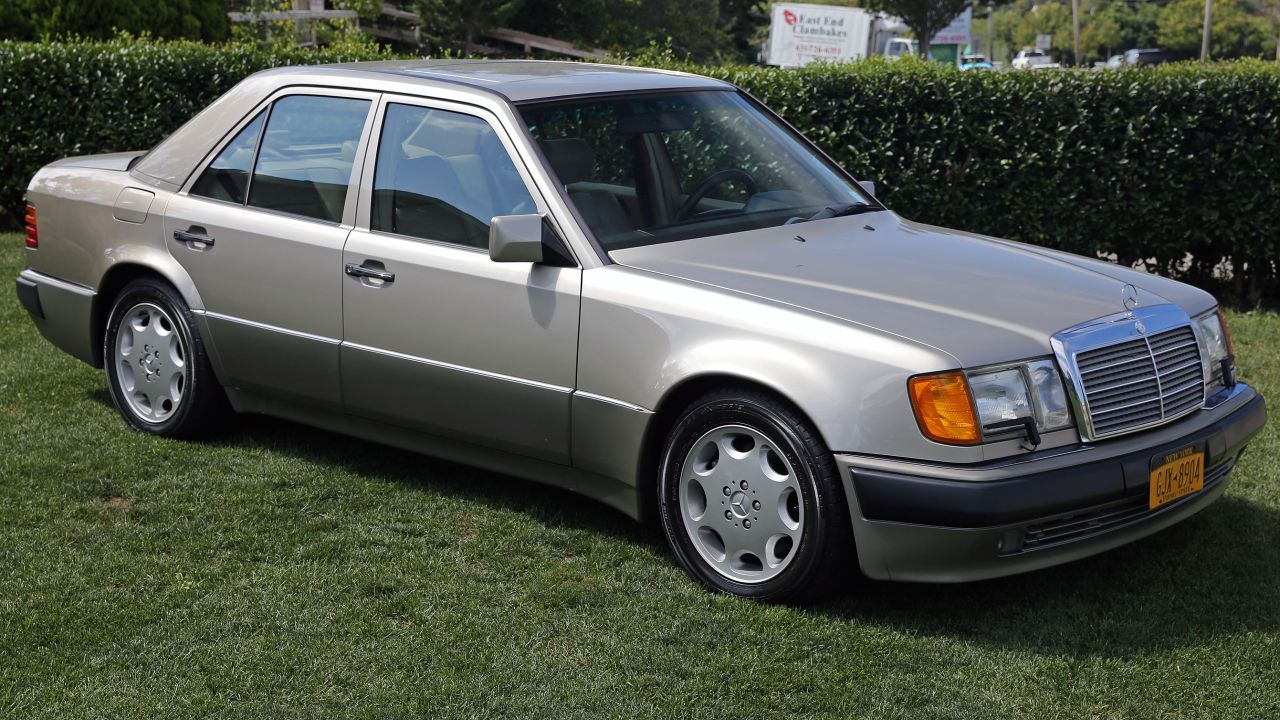
The Mercedes-Benz 500E arrived at the start of the 1990s as a car that should not have existed, a big V8 muscle sedan hiding inside one of Stuttgart’s most conservative shapes. It bent the rules of corporate hierarchy, factory logistics, and even inter-brand rivalry, yet the result was a four-door that could run with contemporary sports cars while looking like a discreet executive shuttle. Three decades later, its mix of understatement and overengineering still feels like a quiet rebellion against the way performance cars are usually built and sold.
A secret super sedan hiding in plain sight
On paper, the 500E was just another W124, the sensible mid-size Mercedes that defined German business-class transport. In reality, it was a low-volume hot rod with a 5.0 litre V8 from the SL roadster squeezed into a chassis designed for straight-six engines, a combination that turned the car into what one guide calls the ultimate German sport sedan. The project began at the end of the 1980s, with Mercedes and Benz engineers deciding to drop the big 500 engine into a saloon and launch it under the name 500 E, a badge that later evolved to E 500 after the facelift models in 1993, but the core idea never changed: take a conservative shell and give it sports-car pace.
Production numbers underline how far this sat from the mainstream. Just under 10,000 500Es were built between 1990 and 1995, and only 1,528 of those cars reached American buyers, a tiny fraction of overall W124 output and a clue to why the model now feels more like a cult object than a mass-market product. Contemporary observers in America already saw the 500 E as one of the most revered Mercedes of the past 30 years, a car that deserved its own profile rather than being lumped in with ordinary E-Class sedans, and that reverence has only grown as surviving examples remain incredibly well maintained and increasingly collectible.
When Mercedes needed Porsche to build its own sedan
The 500E did not just stretch the W124 platform, it broke the company’s own manufacturing template. The car was so wide that it would not fit down the standard Mercedes production line in Sindelf, a practical problem that forced the brand to look outside its own walls for help. The solution was as unconventional as the car itself: Mercedes turned to its Stuttgart neighbour and traditional sports-car rival, Porsche, to handle the complex assembly work that its own facilities could not easily accommodate.
That cooperation went far beyond a simple contract build. The 500 E was completely built by Porsche in its factory, with Mercedes supplying the parts and the two companies effectively sharing responsibility for a sedan that carried only the three-pointed star on its nose. Each example was largely hand-built and took eighteen days to complete, shuttling back and forth between the Sindelfingen plant and Porsche’s factory at Zuffenhausen as different stages of the process were finished. The result was a car that enthusiasts still describe as the Porsche Merc, a super saloon created in the mid-1990s by one German giant for another, and a rare case of direct collaboration between two brands that usually competed for the same customers.
Engineering excess in an era of bean counters
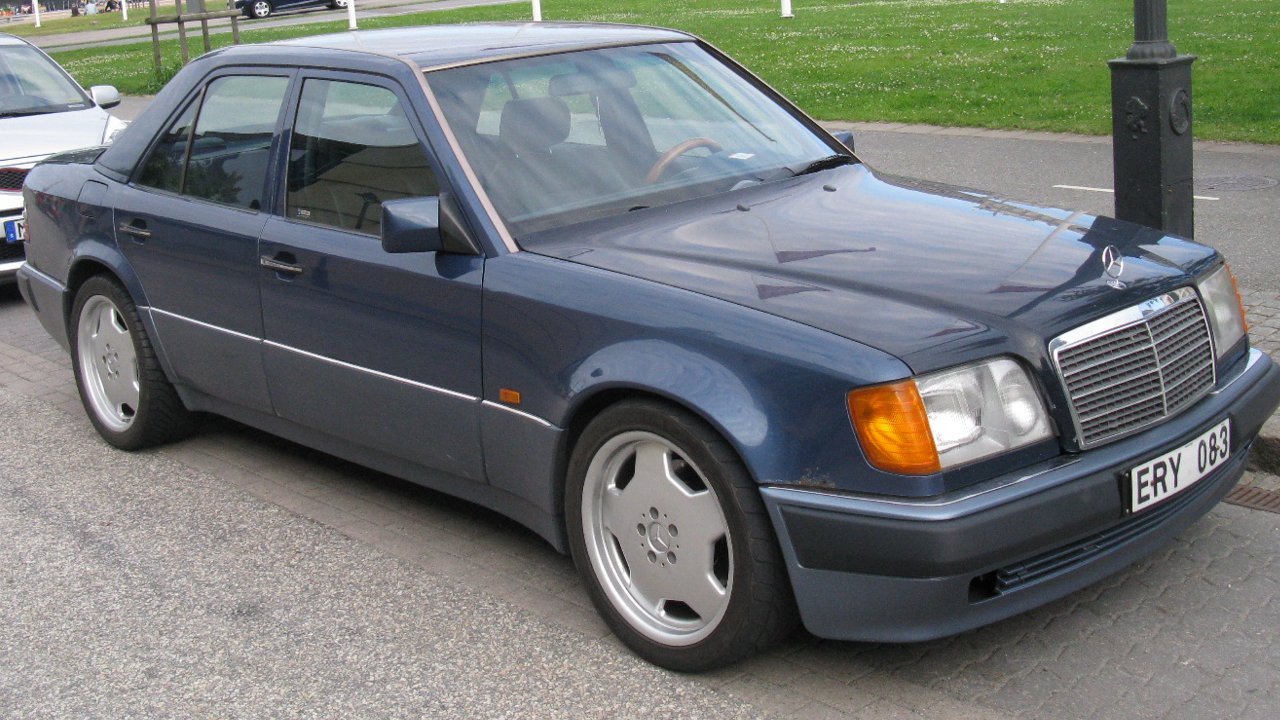
Technically, the 500E reads like a list of decisions made by engineers who were allowed to ignore the accountants. The car used the 5.0 litre V8 from the SL, a powerplant that required extensive reworking of the W124 body, including pronounced wheelarch flares on all four fenders to accommodate wider wheels and tyres. Those flared steel fenders, subtle to casual observers but obvious to anyone who knows the standard car, are the visual tell that this is not a normal W124, and they sit over a chassis tuned with uprated suspension, bigger brakes, and a stance that sits lower and wider than the regular sedan.
Inside, the upgrades were just as focused. Deep, heavily bolstered seats were fitted up front to keep occupants in place when the big V8 pushed the car to speeds that would have embarrassed many sports coupes of the period, and the cabin mixed traditional Mercedes materials with a level of standard equipment that was advanced for an early 1990s saloon. One enthusiast video captures the experience from a first-person point of view, highlighting how the 500E still feels overbuilt and solid, with a power delivery that is smooth but relentless. Another owner, reflecting on the car years later, summed up the philosophy with a line that has become shorthand for the model: this is a car from back when Mercedes engineers outranked Mercedes accountants, a sentiment that resonates strongly with automotive engineers who see in the 500E a kind of lost freedom.
Driving character: calm exterior, violent intent
On the road, the 500E’s personality is defined by contrast. From the outside it remains understated, especially in darker colours, with only the slightly flared arches and wider track hinting at what lies beneath. Behind the wheel, however, the car behaves like a muscle sedan, its 5.0 litre V8 delivering a deep, muted surge of torque that builds speed with little drama but startling effectiveness. First-person driving footage shows how the car gathers pace with a long-legged, almost lazy character, the automatic gearbox working with the engine rather than against it, and the chassis staying composed even when the driver leans hard on the throttle.
That duality is part of why the 500E has aged so well. It is not a peaky, high-strung performance car that demands constant attention, but a relaxed cruiser that can suddenly compress distance when asked, a trait that modern reviewers still praise when they get seat time in well-preserved examples. A recent revival story about a forgotten 500 E that spent 20 years in storage describes the car as a rediscovered artifact of early 1990s automotive excellence, a phrase that captures how its blend of comfort, speed, and subtlety feels like a time capsule from a period when German sedans were engineered to a standard rather than a price. Even a cheap, project-grade 500E that has been continuously broken in one owner’s hands still inspires affection once it is as close to finished as a project car can be, because the underlying driving experience remains so compelling.
Legacy, rarity and the cult of the 500E
Three decades on, the 500E’s rule-bending origins have become central to its legend. The Mercedes and Benz Museum itself has leaned into that story, calling the 500 E/E 500 the raddest German super sedan of the 1990s and celebrating the way it unleashed a 5 litre V8 powered muscle car with the help of Porsche. Auction catalogues now highlight how the model first broke cover in October of 1990 at the Paris Motor Show, emphasising the engineering relationship with the Stuttgart-based neighbour that built the cars, and listing details down to the Chassis No and Engine No to reassure collectors that they are looking at a genuine example of a low-volume icon.
Values and interest have followed that narrative. A 1991 car with around 105,000 kilometres on the odometer can still be described as ready for many more, thanks to its powerful and well-engineered mechanics, and dealers proudly note full Mercedes-Benz service histories and original paint as badges of honour. Social media posts about the model routinely attract hundreds of interactions, with one museum post drawing 287 likes as fans celebrate the car’s status as a 500 powered super sedan. At the same time, guides for prospective buyers stress that the 500E was largely hand-built, that each example took eighteen days to complete, and that its width kept it off the standard production line, all of which reinforces the sense that this was never just another E-Class. It was a rule breaker that slipped through corporate and logistical constraints, and in doing so created a template for the discreet, high-performance luxury sedan that modern brands are still trying to match.
More from Fast Lane Only: