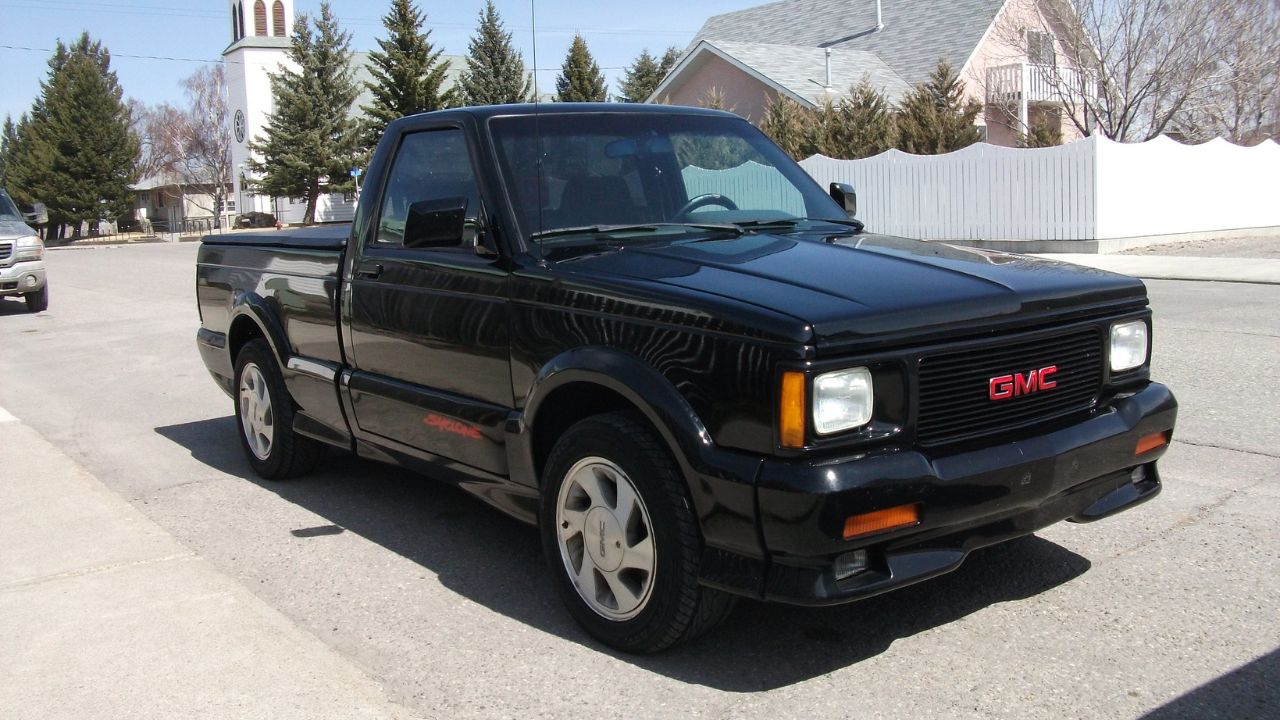
When the 1991 GMC Syclone debuted, few people expected a compact pickup to challenge some of the world’s fastest sports cars. Built in limited numbers and powered by a turbocharged V6, the Syclone shattered assumptions about what a pickup truck could do. Although GMC never intended to launch an entirely new vehicle segment, the Syclone helped establish the blueprint for today’s high-performance trucks.
GMC Set Out to Build a Halo Vehicle
By the late 1980s, pickup trucks were primarily viewed as practical work vehicles. While some manufacturers offered appearance packages or larger engines, outright performance was rarely the focus. GMC wanted to create a truck that would generate excitement and demonstrate the company’s engineering capabilities.
Using the compact Sonoma pickup as its foundation, engineers equipped the Syclone with a turbocharged 4.3-liter V6, an automatic transmission, and a full-time all-wheel-drive system. These components worked together to deliver remarkable traction and acceleration that few trucks could match.
The project was never intended to become a high-volume seller. Instead, it served as a limited-production halo vehicle designed to attract attention and strengthen GMC’s performance image.
What followed exceeded almost everyone’s expectations.
Its Performance Redefined What a Pickup Could Be
The Syclone’s acceleration stunned the automotive world. Thanks to its turbocharged engine and all-wheel-drive system, the truck launched with exceptional grip, allowing it to sprint from a standstill faster than many contemporary sports cars.
Road tests published in 1991 recorded 0–60 mph times of around five seconds, placing the Syclone among the quickest production vehicles available at the time. Its performance surprised journalists and enthusiasts alike, especially considering its relatively modest horsepower rating compared with some V8-powered rivals.
Unlike traditional muscle trucks that relied mainly on large-displacement engines, the Syclone demonstrated the effectiveness of forced induction, intelligent drivetrain engineering, and lightweight construction.
It proved that engineering innovation could outperform brute engine size.
The Truck Changed Industry Thinking
Although production lasted only a single model year, the Syclone left a lasting impression on both manufacturers and enthusiasts. It showed that buyers would enthusiastically embrace pickups built primarily for speed rather than towing or hauling.
In the years that followed, more manufacturers introduced factory-built performance trucks with increasingly powerful engines, upgraded suspensions, and specialized drivetrains. Vehicles such as the Ford SVT Lightning, Dodge Ram SRT-10, and later high-performance trucks from Ford, Ram, and Chevrolet all reflected growing confidence that pickups could successfully combine utility with sports-car-level acceleration.
While each followed its own engineering path, the Syclone had already demonstrated that the market existed for such vehicles.
Its influence extended far beyond its modest production numbers.
A Legacy That Continues Today
Only about 3,000 GMC Syclones were built, making surviving examples highly desirable among collectors. Their rarity, combined with groundbreaking performance, has elevated them to iconic status within the performance truck community.
Modern high-performance pickups now produce hundreds of horsepower and incorporate sophisticated electronics, advanced suspension systems, and cutting-edge all-wheel-drive technology. Yet the basic formula remains familiar: combine everyday pickup practicality with acceleration capable of surprising sports cars.
The Syclone helped prove that trucks could deliver excitement without sacrificing their practical identity. Rather than creating a novelty, GMC introduced an entirely new way of thinking about pickup performance.
Looking back, the 1991 GMC Syclone accidentally created the modern performance truck because it challenged long-standing assumptions about what a pickup could be. Intended as a limited-production showcase, it ultimately inspired a generation of manufacturers to build trucks that were not only capable on the job but also genuinely thrilling to drive.
More from Fast Lane Only
- Unboxing the WWII Jeep in a Crate
- 15 rare Chevys collectors are quietly buying
- 10 underrated V8s still worth hunting down
- Police notice this before you even roll window down
*Research for this article included AI assistance, with all final content reviewed by human editors