The 2001 Honda S2000 arrived as a compact roadster with numbers that looked almost implausible on paper, then backed them up on the road and track. With a screaming four cylinder that spun to 9,000 rpm and a chassis tuned for precision rather than comfort, it quickly became the reference point for how a modern, relatively attainable sports car should feel.
What set that early AP1 generation apart was not a single headline figure but the way its engine, layout, and structure worked together to deliver balance and feedback that rivals still chase. Two decades on, owners, reviewers, and engineers continue to treat the 2001 S2000 as a benchmark for driver engagement rather than raw speed.
The high revving heart that redefined expectations
The centerpiece of the 2001 Honda S2000’s reputation is its F20C engine, a 2.0 liter four cylinder that made its power at stratospheric revs. Instead of relying on turbocharging or displacement, Honda used its VTEC system and a race bred valvetrain to create an engine that stayed docile at low rpm, then surged toward a 9,000 rpm redline with a ferocity that felt closer to a superbike than a typical road car. Commenters dissecting the car’s engineering have highlighted that this unit delivered an exceptional power to weight ratio for a naturally aspirated production engine, which is why enthusiasts still single it out for its ability to rev cleanly and aggressively to the top of the tach.
That character is not just a spec sheet curiosity, it shapes every drive. In a detailed on road review of a 2001 example in Michigan, presenter Tedward spends much of his time exploring how the engine’s willingness to spin transforms ordinary highway merges and back road pulls into events, especially as the needle sweeps past the VTEC crossover and races toward 9,000 rpm. Owners and fans discussing why the Honda S2000 is so special often point to this combination of high revs and linear response as the core of the car’s appeal, noting that it encourages drivers to work through the gears and stay engaged rather than relying on low end torque.
VTEC heritage and Honda’s engineering statement
The S2000’s powertrain did not appear in a vacuum, it was the culmination of Honda’s VTEC development that had already transformed models like the Acura NSX and high performance Civics. In North America, drivers first experienced VTEC in the Acura NSX, where a 3.0 liter DOHC V6 used variable valve timing and lift to blend tractability with a soaring top end. By the time Honda turned its attention to a dedicated two seat roadster, the company had the confidence to push that technology even further, shrinking displacement to 2.0 liters while chasing specific output figures that rivaled racing engines.
Honda also framed the S2000 as a celebration of its own history. The car was launched to mark Honda’s 50th anniversary, with the “S” badge reviving the company’s classic sports car lineage and the “2000” explicitly referencing the engine’s displacement. That context matters, because it explains why engineers were willing to prioritize purity and innovation over mass market compromise. The front mid engine layout, the focus on a naturally aspirated DOHC VTEC four cylinder, and the obsessive pursuit of balance were all part of a statement that Honda could still build a driver focused machine at a time when many rivals were moving toward heavier, more insulated performance cars.
A chassis built to turn engine drama into control
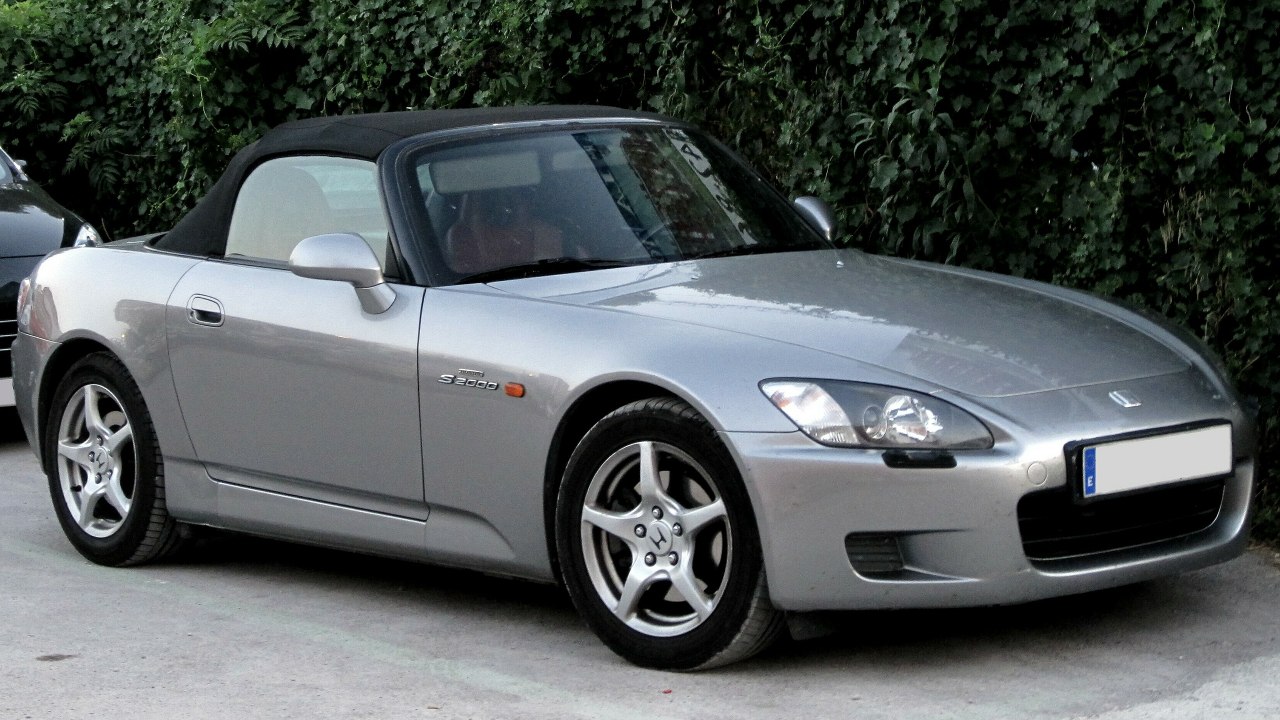
For the 2001 S2000 to become a benchmark, its chassis had to be as serious as its powertrain. Honda’s own technical material on the S2000’s development emphasizes that the car’s performance capability demanded a structure capable of harnessing and exploiting that potential across all speed ranges. The result was a rigid open top body with a front mid engine layout and near 50/50 weight distribution, designed so that the car would respond faithfully to steering and throttle inputs rather than flexing or rolling its way through corners.
Enthusiast engineers who have bought and torn down S2000s describe the underlying structure in detail, highlighting the so called x bone frame design. In their breakdowns, they note that there are substantial side members and that one of the keys to the x bone concept is how the front frame rails and cross members work together to resist twisting forces. That stiffness allows the suspension to do its job, which is why owners and reviewers consistently praise the S2000’s precise steering and neutral balance. Consumer reviews of 2001 models echo this, describing exceptional handling and an exhilarating driving experience that feels both predictable and rewarding when pushed.
On road feel and the instant benchmark effect
What turns those engineering choices into an instant benchmark is the way the S2000 feels from behind the wheel. In the Michigan road test of a 2001 AP1, Tedward repeatedly returns to how the car communicates grip and weight transfer, noting that the steering is light yet accurate and that the chassis gives clear feedback as the driver leans on the rear tires. The high revving engine, short throw manual gearbox, and tightly controlled suspension combine to create a sense of connection that many modern sports cars, with their drive modes and electronic filters, struggle to match.
Owners comparing the S2000 to newer rivals reinforce that impression. In one discussion, a driver who had owned an AP2 S2000 and later a GR86 concluded that the Honda was the more fun car to drive, despite the Toyota’s modern tuning and technology. Another long term owner who spent 18 years with an S2000 and also logged time in a Cayman S and other sports cars argued that the Honda delivered a kind of immediacy and involvement that is hard to find in contemporary machines. When enthusiasts on broader car forums talk about engines with standout power to weight ratios and the ability to rev to extreme levels, the S2000’s F20C is still held up as a reference point, which shows how deeply its character has imprinted on the community.
Enduring reputation and collector appeal
Two decades after the 2001 model year, the S2000’s reputation has not faded, it has solidified. Analyses of the car’s legacy describe it as a sports car that has stood the test of time, earning a loyal fanbase among driving enthusiasts and collectors. The combination of a front mid engine layout, open top body, and 50/50 weight distribution is often cited as close to an ideal formula for a driver’s car, and the S2000’s execution of that formula is what keeps it relevant in conversations about the best analog sports cars.
That enduring appeal shows up in owner sentiment as much as in market values. Consumer reviews of 2001 S2000s on mainstream platforms describe the car as one of the most fun and rewarding vehicles drivers have experienced, praising its high revving engine, precise steering, and agile handling. Enthusiast videos that ask why the Honda S2000 is great tend to arrive at similar conclusions, often comparing it favorably with icons like the NSX while stressing that the roadster’s compact size and focused mission make it uniquely engaging. When I look across these perspectives, the pattern is clear: the 2001 S2000 did not just impress at launch, it set a standard for how a lightweight, naturally aspirated sports car should feel, and that standard still shapes how enthusiasts judge new contenders.
More from Fast Lane Only: