
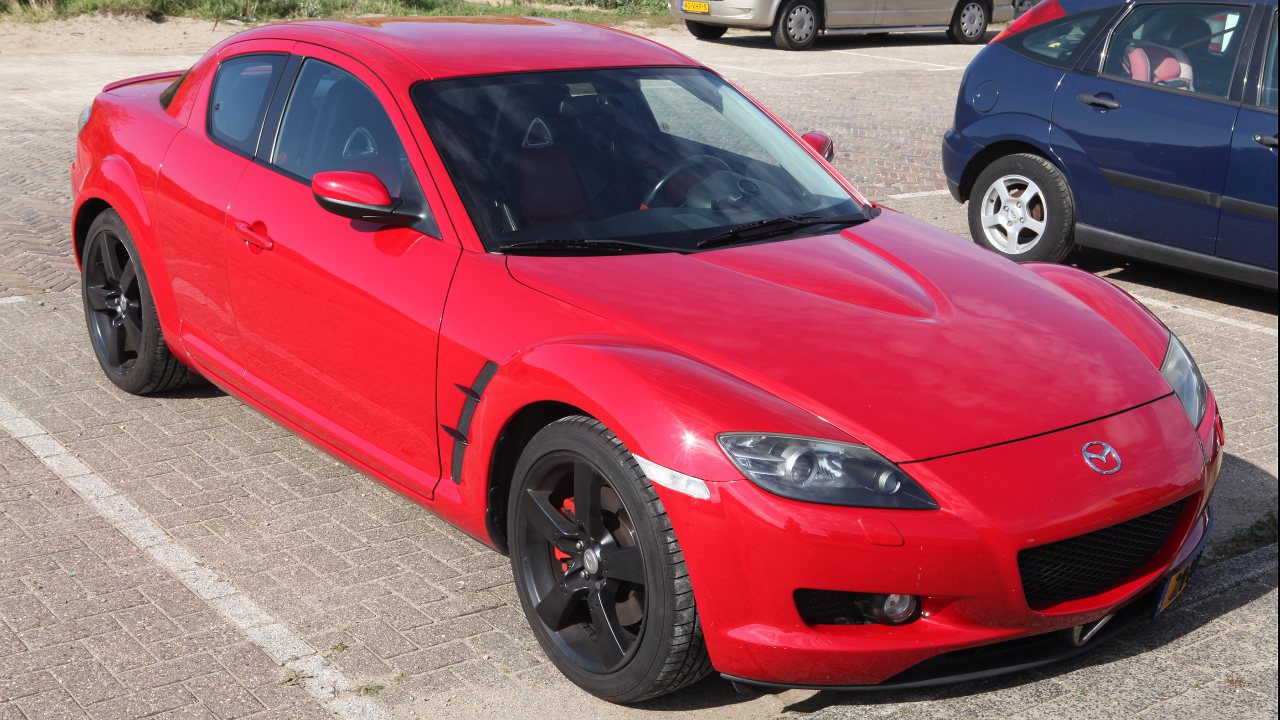
The 2004 Mazda RX-8 arrived as a high-stakes bet that sports car buyers would still embrace a rotary engine in an era tightening around emissions, reliability and practicality. Mazda wrapped its compact RENESIS powerplant in a four-door coupe body, promising everyday usability without sacrificing the high-revving character that had defined the RX line. Two decades on, the car’s mixed legacy shows how far that gamble stretched, and how fiercely a core of rotary loyalists still defends it.
At launch, the RX-8 was framed as the spiritual successor to the RX-7, but also as a clean-sheet rethink of what a rotary sports car could be. It targeted drivers who wanted the drama of a 9,000 rpm redline and the civility of real rear seats, a combination that set it apart from rivals and underlined Mazda’s determination to keep the rotary alive even as most manufacturers walked away from the concept.
The last big swing for the rotary
Mazda built the RX-8 around the RENESIS rotary engine, treating it as the core technology that made the car possible rather than just another powerplant option. The company highlighted the engine’s small size and low weight, which allowed engineers to push it far back in the chassis and achieve the kind of front midship balance usually reserved for more exotic machines, a layout that underpinned the car’s sharp turn-in and neutral handling. By reworking the intake and exhaust ports, the RENESIS design also aimed to address some of the emissions and efficiency issues that had dogged earlier rotary efforts, a critical step if the concept was going to survive into the 2000s.
For the RX8 (Mazda RX8), Mazda designed the naturally aspirated 13B-MSP RENESIS engine specifically to reduce exhaust emissions compared with the FD RX7, a move that reflected regulatory pressure as much as engineering ambition. Technical explainers on rotary engines note that the layout’s inherent tendency toward incomplete combustion creates emissions problems, which is one reason the format has seen Limited Success, But Not Dead Yet status in the broader market. By trying to tame those weaknesses while preserving the smooth, rev-hungry character that enthusiasts loved, Mazda was effectively wagering that a more refined rotary could still earn a place in modern showrooms.
A four-door sports car that bent the rules
Where the RX-7 had been a focused two-seat coupe, the RX-8 tried to broaden the rotary’s appeal with a genuinely unusual body layout. One of its signature features was a four-door configuration with rear-hinged “freestyle” rear half doors that made it easier to access the car’s tiny back seats without resorting to a full sedan profile. This packaging trick let Mazda market the RX-8 as a sports car that could handle school runs and commuting, not just weekend blasts, and it helped justify the car to buyers who needed more practicality than a traditional coupe could offer.
On the road, the RX-8’s chassis delivered on that promise of dual-purpose usability. Larger and heavier than the Honda S2000, the RX-8 still produced a near identical 238 hp with a 9000 rpm redline from a very different engine concept, and it paired that output with a cabin where adults could actually fit in the rear seat as well. Contemporary and modern driving impressions describe a car that feels light on its feet, with steering precision and balance that rivaled more conventional sports cars, a result of the compact RENESIS sitting low and rearward in the bay. In practice, the RX-8 drove like a purist’s machine even as its layout tried to court buyers who might otherwise have chosen a more practical coupe or compact sedan.
Reliability myths, realities and the 2004 problem

The RX-8’s reputation has long been dominated by talk of fragility, and the 2004 model year sits at the center of that narrative. Data compiled from owner complaints identifies the 2004 Mazda RX-8 as Is The Least Reliable Model Year, with multiple reports of engine failures and related issues that have colored perceptions of the entire range. Enthusiast discussions point to early factory settings, including an oil injection rate that was too low, which Caused engine failure due to lack of lubrication in some 2004 and 2005 cars before Mazda issued revisions and updated parts. Those early failures, combined with unfamiliar maintenance needs, created a feedback loop in which the car was labeled a nightmare to own.
Owners with long-term experience push back on the idea that every RX-8 is a ticking time bomb, arguing that the platform can be very reliable if you know and follow the specific service requirements. One eight-year daily driver notes that many of the horror stories trace back to neglect, incorrect warm-up and shut-down habits, or simple issues like a bad O2 sensor that were allowed to snowball. Community advice often starts with a blunt warning to Avoid the 2004-2006 cars if possible, then focuses on buying examples with healthy compression, updated ignition components and proof that the car has been maintained by someone who understands rotary quirks. In that light, the RX-8’s reliability story looks less like a fundamental design failure and more like a specialized machine that was sold as if it were a normal car with normal service intervals.
Living with a rotary in the real world
For owners who accept its demands, the RX-8 can be a rewarding daily companion, but the trade-offs are real. One driver who covered about 14,000 miles in a year with a 2004 car lists Rotary engine Cons that include high fuel and oil consumption for the power levels and a sense that the engine is a bit underpowered for the chassis without much low-end torque. That experience aligns with broader rotary explanations that highlight how the design’s combustion characteristics hurt efficiency, which in turn creates emissions problems and makes it harder to meet modern standards. In practice, RX-8 owners learn to live with frequent fuel stops, regular oil checks and the need to keep revs up to access the engine’s best performance.
Buying advice videos and guides stress that success with an RX-8 starts before the keys change hands. Prospective owners are told to listen for knocks or bangs that might indicate rusty or worn chassis components, to verify that the metering pump has not been disconnected, and to consider upgrades that make the car More Reliable without compromising its character. Another detailed overview of 2004-2012 cars walks through 10 Ways To Make Your Mazda more robust, from ignition system refreshes to cooling and lubrication tweaks, while also warning that skipping these basics can turn a bargain coupe into an expensive project. The pattern is clear: the RX-8 can serve as a commute car, track toy or both, but only for drivers willing to treat its rotary heart as a piece of specialist hardware rather than an ordinary four-cylinder.
From misunderstood outlier to modern bargain
Two decades after its debut at the North American International Auto Show, the RX-8 has settled into a curious place in the used market. The Mazda RX-8 is now widely recognized among enthusiasts for its unique role as Mazda’s last mass-produced rotary sports car, and when it was discontinued it effectively closed a chapter in automotive history. That status, combined with the car’s rather unusual layout in the automotive world, has helped it gain cult appeal even as mainstream buyers remain wary of its quirks. Recent market analysis describes it as a bargain in 2025, with prices that reflect its reputation more than its capability, which is why some rotary fans see it as the most accessible way to experience the format.
Not all years are equal in that bargain hunt, and the 2004 cars in particular carry a discount that mirrors their Is The Least Reliable Model Year label. Later updates, including changes to components like the catalytic converter to reduce clogging that had contributed to overheating and some RX-8 engine failures, make post-facelift examples more attractive to cautious shoppers. At the same time, Mazda is publicly wrestling with whether and how to bring a new rotary sports car to market, with executives describing the company as racing against time to develop a successor that can meet modern emissions and efficiency demands. That tension captures the legacy of the 2004 RX-8: a bold attempt to keep the rotary flame alive by blending innovation, practicality and tradition, whose mixed reliability record scared off casual buyers but cemented a fiercely loyal following that still believes the gamble was worth taking.
More from Fast Lane Only:



Leave a Reply