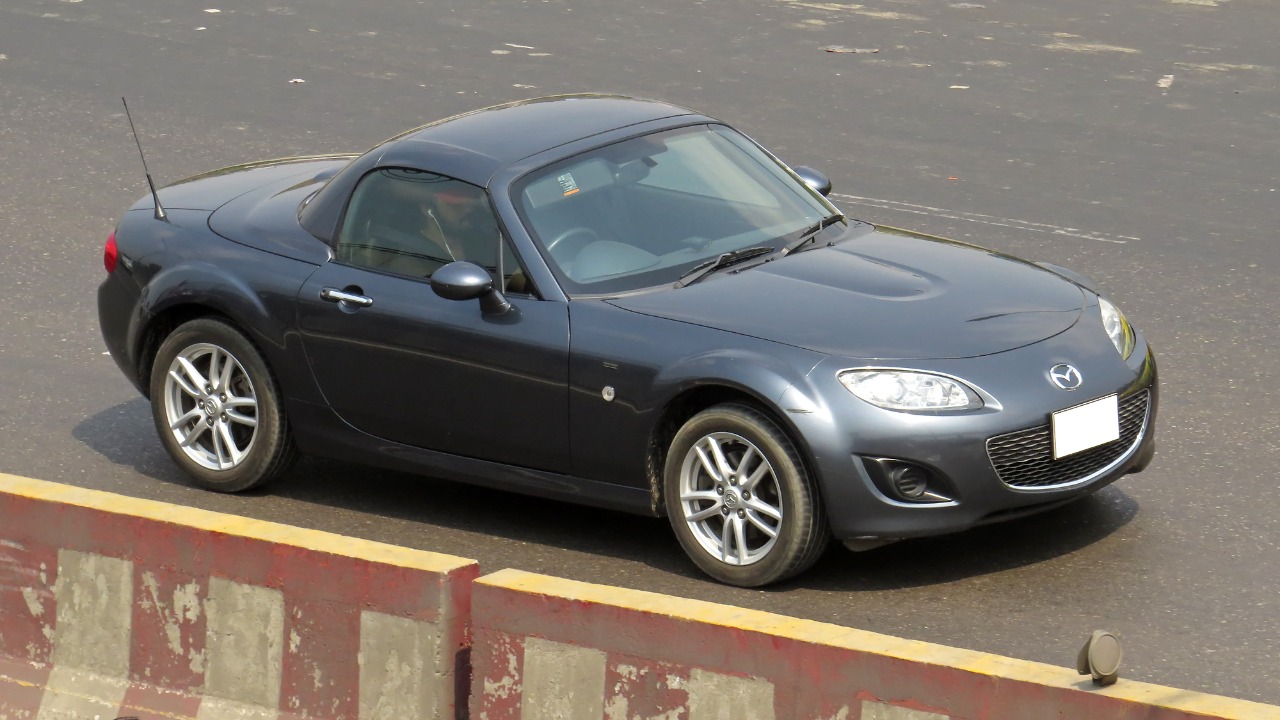
The 2016 Mazda MX-5 Miata arrived at a moment when small roadsters were supposed to be an endangered species, yet it managed to feel instantly familiar to anyone who loved the original. Instead of chasing headline power figures or luxury gimmicks, it doubled down on lightness, balance, and a kind of mechanical honesty that had defined the Miata from the start. I see that car as proof that a modern sports car can evolve, meet new expectations, and still feel like the same playful companion it has always been.
Lightness as a non‑negotiable value
From the beginning, Mazda treated weight as the enemy, and the 2016 MX-5 shows how far the company was willing to go to keep the Miata’s core intact. The fourth-generation car is listed as 105 mm shorter and 100 kg lighter than its predecessor, with that 100 kg equating to 220 lb of mass removed from a platform that was already compact. Those numbers are not marketing fluff, they are the result of a deliberate program where One of the guiding principles was to make every gram count, a philosophy that Mazda had already formalized in its earlier Gram Strategy for the MX-5. When I look at the 2016 car’s spec sheet, I see that same obsession carried forward, not as a nostalgic gesture but as a hard engineering choice.
That focus on mass paid off in the curb-weight figures that enthusiasts pored over long before cars hit showrooms. Early technical breakdowns highlighted that the 2016 Mazda MX-5 Miata Curb Weight Figures Revealed were dramatically lower than the outgoing model, with the 2.0 liter engine rated at 155 horsepower and 110 lb-ft of torque, a combination that made sense only because the car was so light. Owners later compared those numbers with real-world measurements, noting that At 2,332 lbs, or 2,381 lbs with the six-speed automatic transmission, the 2016 Mazda MX-5 Miata Weight & Chassis package was remarkably close to the original NA car, despite modern safety and comfort equipment. When I drive or ride in one, that low mass is not an abstract figure, it is the reason the car feels eager in a way most contemporary sports cars simply do not.
Balance and feel over brute force

Lightness alone would not have kept the Miata’s character intact if the chassis had not been tuned with the same restraint. Mazda’s engineers targeted a perfect 50 / 50 weight distribution, and the 2016 Mazda MX-5 Miata shows off perfect 50 / 50 weight balance in a way you can sense the moment you turn the wheel. That even split front to rear is not just a bragging point, it is what lets the car rotate predictably when you trail the brakes into a corner or feed in power on exit. I find that this balance, more than any single spec, is what makes the ND feel like a spiritual match to the first-generation car, which also prized neutrality over raw grip.
On the road, that philosophy translates into a driving experience that rewards finesse rather than aggression. Reviewers who spent time with the 2016 Mazda MX-5 Miata noted that The Good included excellent driving dynamics and a level of engagement that embarrassed more powerful, more expensive sports cars, even if the Miata’s straight-line numbers looked modest on paper. Others pointed out that the heavier third-generation MX-5 had used a 2.0 liter engine with 167 horsepower and 140 pound-feet of torque, yet the newer car felt more alive despite its lower output, precisely because of its lighter structure and more focused tuning. When I compare those generations back to back, the ND’s steering, body control, and willingness to dance at sane speeds make clear that Mazda chose feel over force, and that choice is what kept the car’s soul intact.
Design that looks forward without forgetting the past
The styling of the 2016 Miata was a bigger gamble than the numbers, because it had to modernize a beloved shape without losing its friendliness. When Mazda unveiled the ND Miata in 2014, it electrified the automotive world with its streamlined simplicity, a look that stripped away visual clutter in favor of tight proportions and crisp surfacing that still read as Miata from across a parking lot. In design interviews, the lead stylist was reminded that you just sir designed actually you and the team just designed the brand new Mazda MX5 Miata, and the questions centered on how much of the original’s approachable character could survive in a sharper, more aggressive body. Watching those conversations, I am struck by how often the team returned to the idea of compactness and lightness as visual cues, not just engineering targets.
That approach fits neatly with Mazda’s broader human-centric design philosophy. Yamamoto’s Car Culture Theory, which drew on Kansei engineering, framed driving as a psychological action caused through sensations like unity, driveability, and directness, and the 2016 car’s cockpit reflects that mindset. Mazda says that their designs are all human-centric, but they have also added a minimalist approach that keeps distractions low and controls intuitive, a theme that shows up in other models like the Mazda 3 Skyactiv-X and carries into the ND’s simple, driver-focused cabin. When I sit in a 2016 Miata, the low cowl, thin pillars, and unfussy dashboard feel like a conscious rejection of the tech-heavy, screen-dominated interiors that were becoming the norm, and that restraint is part of how the car stays true to its roots.
Engineering choices that favor drivers, not spec sheets
Under the skin, the 2016 MX-5 is full of decisions that make sense from the driver’s seat even if they do not light up a brochure. The 2016 model year car was designed with an emphasis on saving weight, and Mazda called this the Gram Strategy, a continuation of the earlier One of the gram-by-gram audits that had trimmed even small components to keep mass down. That same mindset shaped the drivetrain, where the 2.0 liter engine was paired with a close-ratio six-speed manual that encouraged drivers to explore the rev range rather than rely on torque. The 2016 Mazda MX-5 Miata Features A New Standard Transmission, a six-speed manual that replaced the older five-speed in base cars, and that change alone transformed the way the car felt on a back road, with shorter throws and a more precise gate that invited constant interaction.
Chassis tuning followed the same driver-first logic. Road-test impressions of the 2016 Mazda MX-5 noted that When it comes to cone work, the first thing you notice is the new electric power steering, and that Turn in is still razor sharp despite the switch from hydraulic assist. That is not a trivial achievement, because electric systems often numb feedback, yet in the Miata the rack still communicates surface changes and grip levels in a way that feels old-school. At the same time, the suspension was tuned to be compliant enough for daily use, which meant the car could still be a friendly commuter rather than a track-only toy. I appreciate that balance, because it shows Mazda resisting the temptation to chase lap times at the expense of the everyday joy that has always defined the Miata.
A legacy that guides the future
What makes the 2016 MX-5 especially interesting to me now is how clearly it has become a reference point for Mazda’s own engineers as they look ahead. Keeping the Miata true to its roots has been a stated goal inside the company, and Mazda leadership has emphasized that the principles behind the ND will continue to guide its development, with Mazda’s chief technical officer, Ryuichi, describing how the team checks in with old-school owners to ensure the next MX-5 does not drift away from its core. That continuity is visible in the way the ND’s architecture has been refined rather than replaced, and in how later updates have focused on incremental improvements instead of wholesale reinvention. The fourth-generation MX-5 is 105 m shorter and 100 kg lighter than its predecessor, and those figures have become a kind of internal benchmark for what a modern Miata should be.
The 2016 car’s influence also shows up in how people still talk about it and how it is positioned today. Enthusiast guides describe how the all-new 2016 Mazda MX-5 Miata Weighs Only Two Pounds More than ’90s Model, a comparison that instantly connects the ND to the original Model that started it all, while buyer’s guides for the 2016-current Mazda MX-5 Miata ND explain how Some of the early decisions, including the Gram Strategy and the transmission choices, continue to shape reliability and driving character. Even lifestyle pieces frame the 2016 Mazda Miata as a car that still turns heads, noting that at the core of the 2016 Mazda Miata’s allure lies its design language and that on the safety front, Mazda’s ethos has been reimagined for contemporary drivers. When I watch long-term owners on video saying that in Oct many Miata buyers have chosen to hold on to their older Miatas rather than trade up, or see deep dives that explain how in Feb Mazda unveiled the ND Miata and reset expectations for what a lightweight sports car could be, I am reminded that the 2016 MX-5 did more than update a nameplate. It proved that a car built on simple pleasures could survive in a complex era, and that staying true to itself was not a nostalgic pose but a viable path forward.
More from Fast Lane Only: