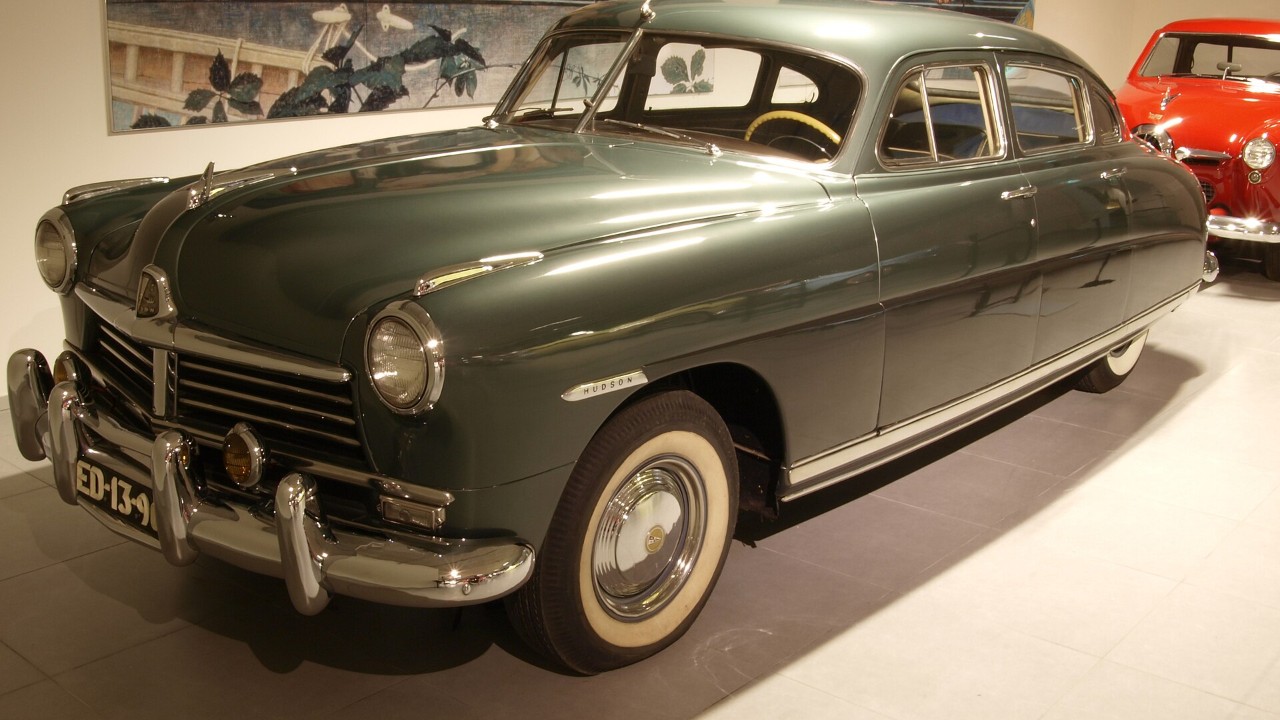
Most cars of the late 1940s put the floor on top of the frame, so passengers climbed up and in. Hudson flipped that. The Hudson step-down design hung the floor pan from the bottom of the structure, so you stepped down into the car, and the whole body sat lower on the road.
Hudson showed it before the biggest Detroit makers had their own new postwar cars ready. For a small independent, it was a bold move.
It also shaped the company’s fortunes for the next seven years, for better and then for worse.
A new Hudson in December 1947
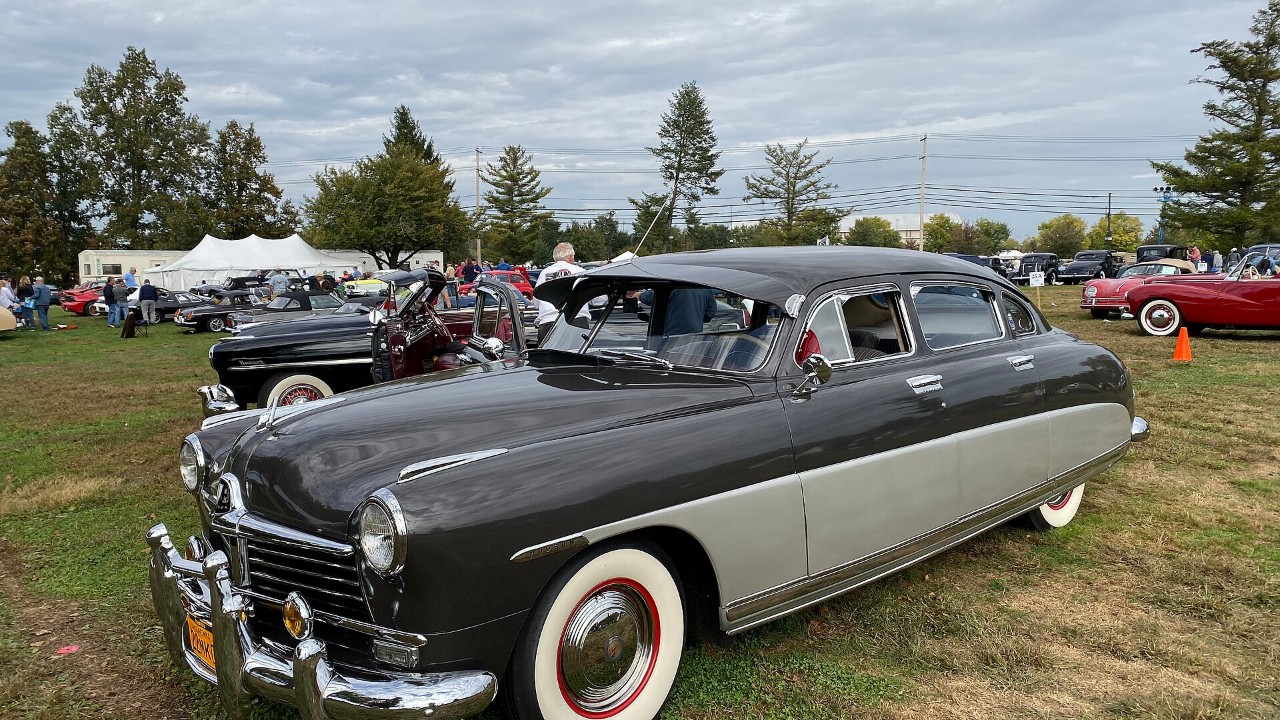
Hudson unveiled the step-down cars in December 1947 at the Masonic Temple in Detroit, according to Mac’s Motor City Garage. The site says that put Hudson ahead of Ford, General Motors and Chrysler with an all-new postwar design. The series then ran for seven model years, through 1954.
Several names sit behind the shape. Mac’s credits chief engineer Millard H. Toncray with the engineering and Art Kibiger with the styling, working under design chief Frank Spring. Meanwhile, the Louwman Museum names Spring as chief stylist and Sam Frahm as engineering director.
Toncray’s goal, Mac’s says, was “roadability.” In practice, that meant ride, grip and comfort on ordinary two-lane roads. The Audrain museum also credits designer Betty Thatcher with helping shape these third-generation cars.
How the Hudson step-down design worked
Hudson called its structure “Monobilt,” a unit body and frame. On a conventional car, the floor sat on top of the frame rails. On the Hudson, by contrast, Mac’s says the floor pan attached to the bottom of the structure instead.
That simple change did two jobs at once. First, it gave passengers more headroom. Second, it let Hudson drop the roofline without cramping the cabin. The Louwman Museum puts it plainly: the floor sits much lower than the sills.
The frame also wrapped around the people inside. According to the Louwman Museum, the chassis frame largely surrounds the passenger compartment. Similarly, the Audrain Automobile Museum describes a semi-unit body with a perimeter frame that “runs around it entirely.”
Historians label the structure in slightly different ways. However, they agree on the result, because the occupants sat inside the frame rather than on top of it.
Lower, and it handled
The numbers show how low the car sat. Mac’s says the 1948 Hudson stood just over 60 inches tall. That made it 4 to 7 inches lower than rival Buicks, Chryslers and Packards, per the same source. In addition, the Audrain museum lists its 1948 Commodore Eight at 60.4 inches high.
Less height meant a lower center of gravity. As a result, the cars gripped and handled better than their size suggested, according to both Mac’s and the Louwman Museum. Mechanix Illustrated writer Tom McCahill called the Hudson “America’s best road car by far,” Mac’s reports.
Rivals noticed too. The Louwman Museum says General Motors got hold of a couple of the cars to test them. Mac’s adds that Cadillac studied Monobilt and judged it too complicated and costly for its own use.
The engines underneath
The Audrain museum’s 1948 Commodore Eight uses a 254.5-cubic-inch inline-eight rated at 128 horsepower. It rides on a 124-inch wheelbase and weighs 3,825 pounds, per the museum’s listing.
Later, the chassis carried something stronger. Mac’s says the 308-cubic-inch Hornet six arrived for 1951. With it, step-down Hudsons became regular winners in early 1950s stock car racing, earning the “Fabulous Hudson Hornet” name.
The cost of a fixed shape
Buyers responded at first. The Audrain museum says Hudson sales rose 50 percent in 1948. Mac’s puts the peak at 151,000 cars in 1949, followed by a slide to 80,000 in 1952.
The design that made the car special also boxed Hudson in. Because the frame rails ran outside the rear wheels, Mac’s says, the cars had a wide back seat but a narrow trunk. Hudson never built a production step-down wagon. Moreover, so many hard points were fixed in the body that yearly changes stayed limited to facelifts.
Hudson worked around it where it could. Mac’s says convertibles began as Club Coupes pulled off the line, with the roofs cut off and 230 pounds of bracing added underneath. A pillarless Hollywood hardtop followed in 1951. Still, unit construction also kept Hudson out of light trucks, a market where it had sold modestly well.
A full redesign needed money Hudson no longer had, Mac’s says. After a loss of more than $10 million for 1953, Hudson merged with Nash-Kelvinator on May 5, 1954, to form American Motors.
Where the step-down story ends
Hudson-badged cars from 1955 to 1957 were reworked Nash models, according to Mac’s. The last Hudson rolled off the line on June 25, 1957.
Original step-down cars still survive. The Audrain Automobile Museum displays a 1948 Hudson Commodore Eight in Quartermaster Grey. It has had one repaint but no restoration. The museum says it has covered about 27,000 miles since 1948.
More from Fast Lane Only
- Unboxing the WWII Jeep in a Crate
- 15 rare Chevys collectors are quietly buying
- 10 underrated V8s still worth hunting down
- Police notice this before you even roll window down
This article was created with the help of AI and was reviewed and edited by Fast Lane Only editors before publication.