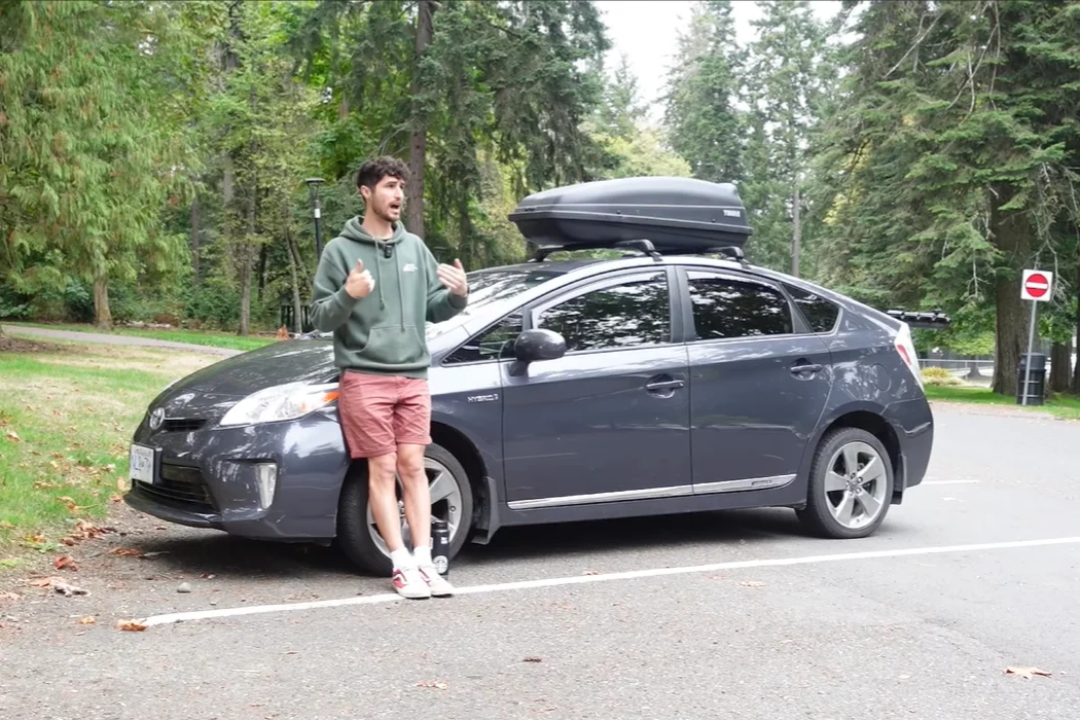
A car he’s owned for five years is not the vehicle most people picture when they imagine upgrading for a growing family. But Levi, who runs the channel Levi & Leah with his wife, spent two months convinced he needed to trade it in anyway, right up until he sat down and actually wrote out the math. What came out the other side was a video explaining why he kept the car everyone assumed he’d replace.
The Prius has a history that makes the attachment easier to understand. Levi and his wife bought it specifically to spend a full year road-tripping across North America, removing the rear seats to build a sleeping platform they lived out of for months at a time, eating meals and sleeping in the car nearly every day of that trip. Somewhere along the way, as Levi puts it bluntly on camera, their first son was conceived in it. It’s not the kind of car most people trade in lightly, sentiment aside, and with a second child on the way, he found himself assuming a minivan was simply the next required step.
The purchase that felt automatic until it wasn’t
Levi is upfront about naming the phenomenon driving his initial instinct: lifestyle creep, the pattern where major life milestones, a promotion, a move, a second child, seem to automatically demand a matching consumer purchase. Having two kids, in his words, “usually necessitates a new vehicle purchase, probably a minivan,” and he decided almost immediately that buying new was the obvious next move. Months of research followed, narrowing his search to a shortlist that included a 2021-or-newer Toyota Sienna Hybrid, a Highlander Hybrid, a Honda CR-V Hybrid, a Tesla Model Y, and a Mitsubishi Outlander, with the Sienna emerging as his clear favorite.
Somewhere in that research process, the decision started generating enough stress that it began leaking into conversations with people who had no reason to be hearing about his minivan deliberations. That was the point he decided to do what he describes as the obvious move before any major purchase: sit down and actually write out a pro and con list. He calls the result humbling.
Space, the problem that solved itself for fifty dollars
The first item on his pros list was the original reason he’d started considering an upgrade at all: space. At six feet tall, Levi found the Prius’s interior genuinely cramped for himself, and adding two car seats for two kids seemed like it would demand more room than the car could reasonably offer.
That assumption fell apart almost immediately once he actually tested it. A set of roof racks found on Facebook Marketplace for $50, paired with a cargo box mounted on top, gave the Prius enough capacity to handle a two-week summer road trip carrying Levi, his wife, their toddler, two cousins, and two grandparents, seven people total plus all their gear. Not only did the car handle it, they finished the trip with unused space left in the cargo box. The single biggest justification for a new vehicle had been solved for the price of a used bike rack.
What the features list doesn’t tell you
Levi doesn’t pretend the newer options offered nothing real. Heated seats, better summer air conditioning, a sunroof, improved headlights, and more modern airbag systems all made his pros list honestly, along with a third pro he labeled simply “swag,” the appeal of feeling cool in a new car or looking a certain way to other parents. He’s candid that this last one barely qualifies as a real benefit, admitting it has more to do with image than anything that would actually improve his day-to-day life.
Weighed against that were five cons that, once written out, dominated the list. The most straightforward was cost: matching the Prius’s reliability and fuel efficiency in a larger, newer package meant spending at least $40,000, on top of higher insurance premiums and repair costs that a paid-off, already-inexpensive car simply doesn’t carry. A second con he hadn’t anticipated going in was the mental load of owning something expensive. Right now, a dog cover protects the Prius’s back seats, and his toddler bounces balls and occasionally swings a bike into the car parked next to the driveway hockey nets without much consequence. Levi’s honest admission is that a $50,000 vehicle would make him considerably less relaxed about exactly that kind of everyday wear.
Reliability, complexity, and cars nobody can actually fix
Levi’s third con centered on reliability, and it comes with a genuine irony given how Toyota-loyal his family is. His father owned one of the original Toyota trucks brought to North America, the family drove a Toyota Matrix during his childhood, his dad currently owns a Tacoma, his parents have their own Prius, and Levi himself owns a Toyota Tundra. Even as a committed brand loyalist, he argues, based on his own experience and what he’s heard anecdotally from other owners, that cars built after roughly 2019, Toyotas included, have grown less reliable as they’ve gotten more technologically complex. His specific frustration lands on touchscreen-dominated dashboards, the disappearance of physical knobs, and the growing dependence on software that can quietly change how a car functions overnight. His stated preference is simple: he wants a car a normal mechanic can actually fix, not one increasingly gated behind proprietary software nobody outside a dealership can touch.
A fourth con Levi calls lifestyle: he genuinely prefers biking or walking over driving when he can, and worries that owning something expensive creates quiet pressure to justify that cost by using it more, a mild sunk-cost trap where a car becomes something you feel obligated to drive rather than something that simply serves you. That pressure, he notes, tends to cascade into secondary spending too, replacing a free Facebook Marketplace bike rack with something that matches a nicer car, simply to avoid feeling out of place.
His final con was environmental impact, and it’s the one he calls the real clincher. Levi pushes back directly on the idea that buying a brand-new hybrid or EV is automatically the sustainable choice, arguing that keeping an already fuel-efficient vehicle like a Prius on the road longer does less environmental harm than manufacturing a new one, reserving the case for an EV upgrade for someone driving something genuinely inefficient rather than a car already built around efficiency.
The real point wasn’t the car
What strikes Levi most, looking back, isn’t the specific pros and cons themselves. It’s that he needed to write any of it down at all just to justify not spending $50,000 on something he didn’t actually need. He’s blunt about how deeply embedded that instinct is culturally, the pull to become “a Toyota Sienna guy,” to appear a certain way to other parents, to chase perceived lifestyle improvements that, examined honestly against what his family actually needs day to day, would have made life harder rather than easier. That’s the case he’s making with the video: not that new cars are bad, but that the decision to buy one deserves the same scrutiny he’d apply to any other major purchase, rather than being treated as an automatic milestone purchase nobody questions.
More from Fast Lane Only
- Unboxing the WWII Jeep in a Crate
- 15 rare Chevys collectors are quietly buying
- 10 underrated V8s still worth hunting down
- Police notice this before you even roll window down
*Research for this article included AI assistance, with all final content reviewed by human editors.