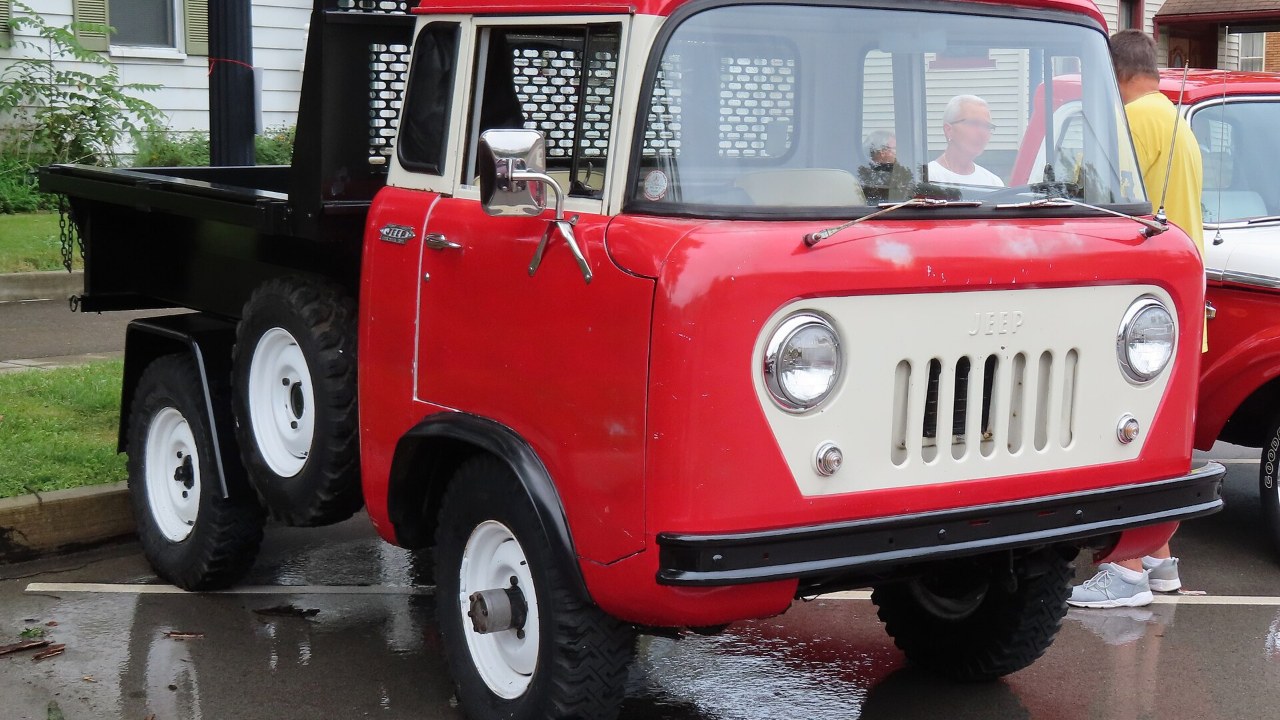
The Jeep Forward Control moved the driver up and over the engine. Willys launched the FC-150 late in 1956 on an 81-inch wheelbase, with four-wheel drive and a 72-horsepower four. Because the cab sat on top of the engine, the truck carried a full-size bed on a very short chassis.
The idea was simple. A conventional pickup spends a lot of its length on a hood. The Forward Control spent that length on cargo instead.
It sold well at first and then faded. Here’s what Willys built, how the two main versions differed, and how many left the factory.
When the Jeep Forward Control arrived
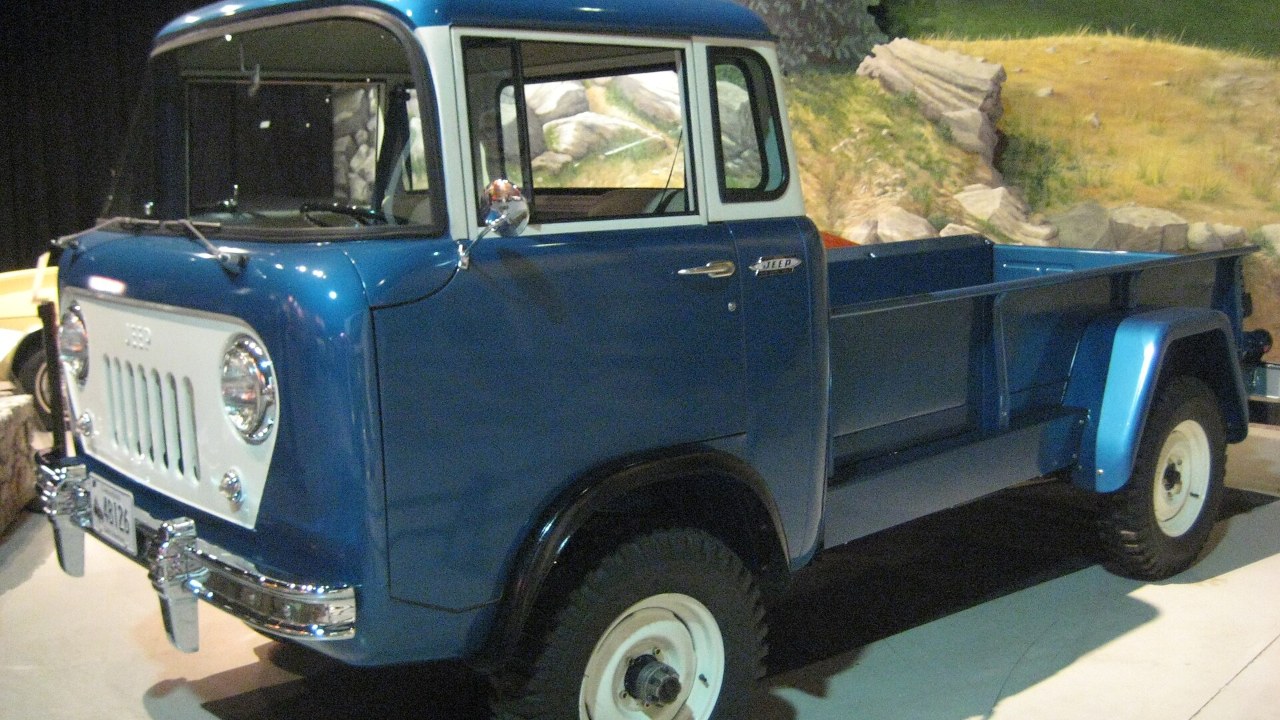
The sources disagree on the exact month, though only by a few weeks. According to Old Cars Weekly’s look at the Forward Control Jeeps, Willys introduced the FC-150 to the public in November 1956. A separate Old Cars Weekly Car of the Week profile says the truck reached showrooms on December 12, 1956.
Mac’s Motor City Garage also places the rollout of the FC series in December 1956. A bigger sibling followed soon after. Old Cars Weekly says Willys introduced the FC-170 on May 27, 1957.
Who drew the cab is less certain. The Car of the Week profile says designer Brooks Stevens built several passenger-van prototypes that shaped the cab-over layout. However, Mac’s Motor City Garage is more careful. It calls the cab “reportedly but not officially designed by Brooks Stevens.”
The FC-150: an 81-inch-wheelbase 4×4
The small truck is the one people remember. Mac’s lists the FC-150 at an 81-inch wheelbase and just 147 inches long overall. Even so, it carried a 6½-foot bed. In fact, Mac’s points out that the whole truck was shorter than a Nash Metropolitan. Old Cars Weekly gives the same bed in inches: 78.
That short body suited tight work. Mac’s says the stubby wheelbase and the high seating position made the FC-150 especially good at commercial snow removal.
Power came from a four-cylinder engine. Old Cars Weekly names it the F4-134 Hurricane and rates it at 72 horsepower at 3,600 rpm. That article calls the rpm figure “very optimistic.” Meanwhile, the Car of the Week profile lists the same 72-horsepower output.
Gearing favored work over speed. With a 5.38:1 ratio, the profile says, the trucks could “handle 60-percent grades” but topped out around 50 mph. A pickup weighed 3,020 pounds and started at $2,320, by that profile’s count.
Willys later widened the truck’s stance. Old Cars Weekly lists the early track at 48.4 inches and the later one at 57 inches. Mac’s dates that wider track to 1958.
The FC-170: a longer truck with a six
The FC-170 stretched the idea. Old Cars Weekly puts its wheelbase at just over 103 inches, with a 63-inch track. Mac’s Motor City Garage lists it at 103 inches and notes a dual-rear-wheel version for heavier work.
The bigger truck also got a bigger engine. Old Cars Weekly lists the L-head 226-cubic-inch “Super Hurricane” six at 105 horsepower at 3,600 rpm. Some other references list a higher rating, so treat 105 as that source’s number.
The FC also had military versions. Mac’s says the services commissioned numerous variants, including ambulances and reconnaissance vehicles. Old Cars Weekly lists four basic military models: the M676 pickup, M677 crew cab, M678 van and M679 ambulance.
How many Jeep Forward Control trucks were built
The first year was the best one. Mac’s says Willys built more than 9,500 FC trucks in 1957, and volume dropped sharply after that. In total, Mac’s puts production at about 30,000.
The Car of the Week profile, by contrast, counts 6,637 FC-150 sales in the first year. It gives 16,241 trucks for a three-year run. The two sources don’t line up neatly, so each figure stays with its source.
Where the design went next
The FC didn’t simply disappear. According to Mac’s, licensed production carried on in Spain through VIASA and in India through Mahindra.
Survivors still turn up in the hands of restorers. For example, Old Cars Weekly profiled Earl Pamperin’s red 1957 FC-150 in Juneau, Wisconsin. He spent about seven years restoring it and kept its original engine and transmission.
Pamperin made a few practical changes along the way. According to that profile, he added an electric fan and sprayed in a bedliner. Meanwhile, the checked cloth upholstery matches the original pattern. The mirrors, the profile notes, came from a late-1970s or early-1980s Chevrolet.
More from Fast Lane Only
- Unboxing the WWII Jeep in a Crate
- 15 rare Chevys collectors are quietly buying
- 10 underrated V8s still worth hunting down
- Police notice this before you even roll window down
This article was created with the help of AI and was reviewed and edited by Fast Lane Only editors before publication.