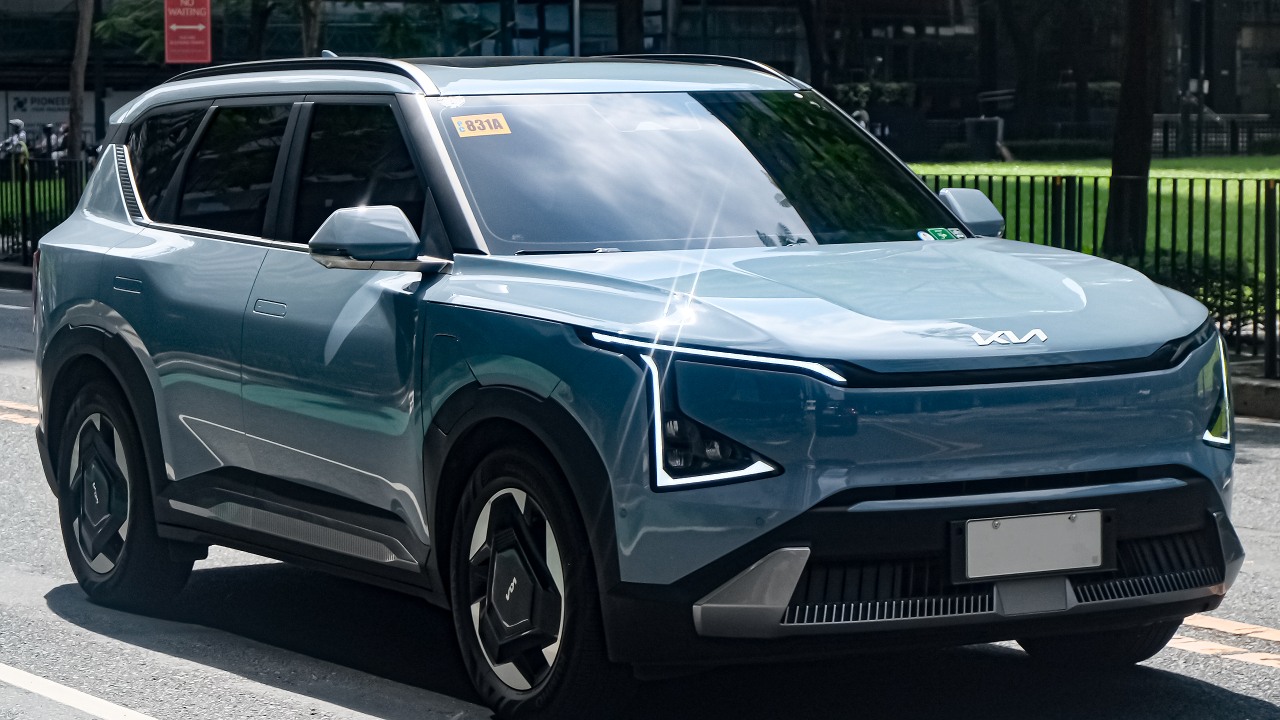
Kia has decided that its smallest and most affordable electric cars deserve a proper performance makeover, unveiling GT versions of the EV3, EV4, and EV5 at the Brussels Motor Show. The trio adds dual motors, all wheel drive, and a suite of software tricks aimed at making everyday EVs feel more engaging without turning them into unruly track specials. Yet for all the engineering effort, there is a real possibility that none of these GT models will be offered to buyers in the United States, underscoring how selectively Kia now treats this market.
I see these cars as a revealing test case for how far mainstream brands are willing to go in chasing driving fun in an era dominated by range charts and charging maps. They also highlight a growing split between regions that get the full breadth of Kia’s electric portfolio and those, like the U.S., that are increasingly curated to favor larger, more expensive models.
What makes the EV3, EV4, and EV5 worthy of a GT badge
Kia has not simply slapped badges on its compact EVs. All three GT variants adopt dual motor all wheel drive, a clear step up from the single motor setups that define the regular EV3, EV4, and EV5. The EV3 GT and EV4 GT are quoted at 215 kW, equivalent to 288 hp, while the EV5 GT edges ahead with 225 kW, or 302 hp, figures that move these cars firmly into hot hatch and sport sedan territory rather than basic commuter duty.
That hardware is paired with software designed to make the extra power feel more interactive rather than overwhelming. Kia has built in performance oriented drive modes and what some reports describe as “pretend gears,” simulated shift steps that give drivers a more familiar rhythm under acceleration instead of the usual single surge of torque. The company has also emphasized that each GT model keeps its outputs below the wildest rivals, prioritizing accessible speed and stability over headline grabbing numbers, a choice that fits the brief of turning everyday EVs into approachable performance cars rather than niche toys.
Design and cabin tweaks that signal serious intent
From the outside, the GT treatment is deliberately restrained, but the details matter. Each car gains more aggressive bumpers, unique wheel designs, and subtle aero elements that distinguish them from their standard counterparts without tipping into caricature. The EV3 GT in particular leans on its compact proportions and upright stance, using sportier trim and contrasting accents to telegraph that it is no longer just a city runabout.
Inside, Kia has gone further to create a distinct atmosphere. The EV3 GT is fitted with bucket style or semi bucket seats, similar in spirit to those used in the EV9 GT, and accented with neon interior trim and bespoke ambient lighting that reinforces the performance theme. The EV5 GT follows a similar template, with model specific seats and lighting signatures that separate it from the regular EV5. These touches are not merely cosmetic; they aim to hold occupants more securely during spirited driving while reminding them that they are in the most focused versions of these platforms.
Performance without the drama, by design
What strikes me most about Kia’s approach is how intentionally it avoids turning these GT models into unruly halo cars. The company has been clear that the EV3 GT, EV4 GT, and EV5 GT are quick, but not the most powerful options in their segments, and that outright acceleration was “clearly not a priority” compared with balance and usability. Each GT model uses its dual motor AWD system to deliver confident traction and brisk performance, but the calibration is meant to be progressive rather than spiky, with stability systems that stay quietly in the background instead of constantly flashing warning lights.
That philosophy extends to the way these cars are positioned within Kia’s broader performance range. The EV3 GT, EV4 GT, and EV5 GT are set to sit below the more extreme EV6 GT and EV9 GT, forming a second tier of accessible performance that can be driven daily without sacrificing comfort or efficiency. Production of the EV3 GT, EV4 GT, and EV5 GT is scheduled to begin in the second quarter of 2026, with European deliveries expected in the second half of the year, which suggests Kia sees them as volume capable additions rather than limited run curiosities.
Why the U.S. may miss out on Kia’s new GT trio
For American enthusiasts, the catch is that Kia has not committed to selling any of these GT variants in the United States. Reporting on the launch notes that while the EV3, EV4, and EV5 families are central to Kia’s global EV strategy, the GT versions are not confirmed for this market and “we might not get any of them.” That hesitation fits a broader pattern in which Kia prioritizes Europe and Asia for smaller, more affordable EVs while treating the U.S. as a place for larger crossovers and higher margin models.
The recent handling of the EV9 GT underlines that point. Coverage of the “EV9 GT cancellation shocker” for America describes how plans for a high performance EV9 variant in the U.S. were scaled back or delayed, with the host Hussein explaining that the model may never reach America at all. When I put that alongside Kia’s decision to launch the tiny, urban focused EV2 with no U.S. plans and to reserve higher trim long range and GT Line versions for other regions, a consistent strategy emerges: the company is willing to develop enthusiast friendly EVs, but it is increasingly selective about sending them across the Atlantic.
What Kia’s selective strategy says about the future of fun EVs
I read Kia’s GT push as a quiet rebuttal to the idea that mainstream EVs must be joyless appliances. The company has already experimented with playful touches like a gasoline scented air freshener for drivers who miss the smell of fuel, a tongue in cheek accessory that also underscores how seriously it takes the emotional side of the transition to electric power. By giving the EV3, EV4, and EV5 more power, sharper styling, and interactive software features, Kia is arguing that even budget oriented EVs can be entertaining without becoming impractical.
At the same time, the decision to keep many of these experiments focused on Europe and Asia reflects a hard headed reading of the U.S. market. With federal incentives in flux and buyers gravitating toward larger SUVs, Kia appears to be concentrating its American EV lineup on models like the EV6 and EV9 while letting smaller GT variants build brand character elsewhere. If that calculus holds, U.S. drivers may find themselves watching from afar as the EV3 GT, EV4 GT, and EV5 GT carve out a niche as attainable performance EVs in other regions, a reminder that the global electric future will not arrive in the same shape or at the same speed everywhere.
More from Fast Lane Only: