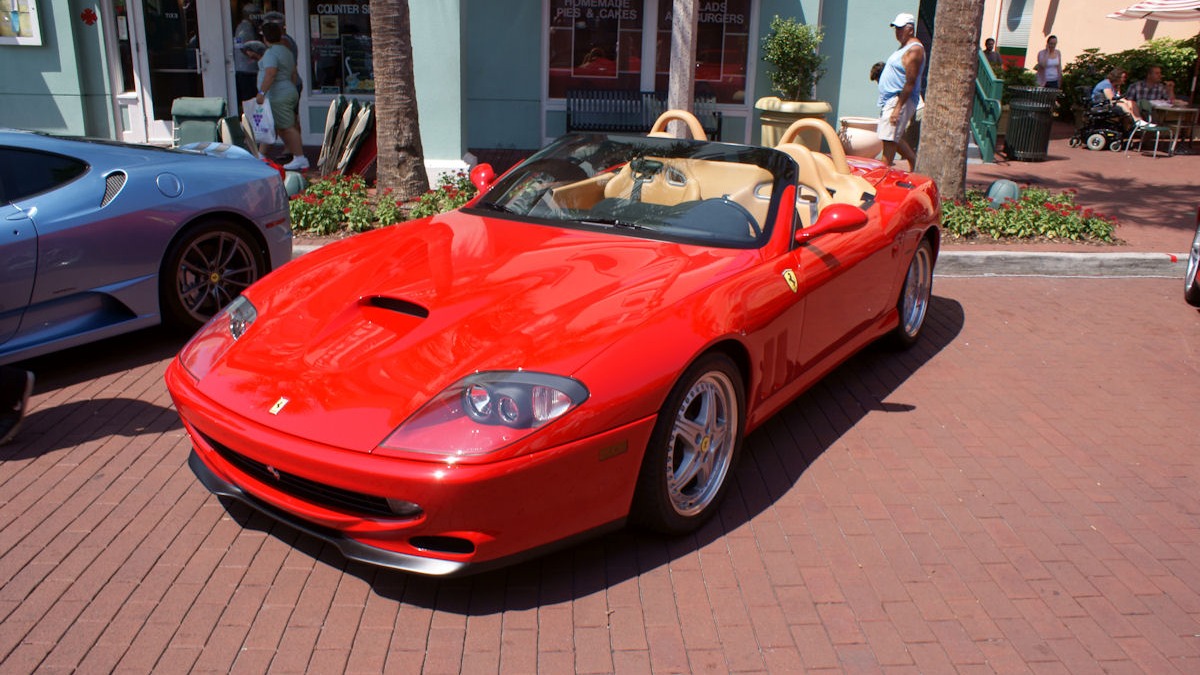
The Ferrari 550 Barchetta Pininfarina arrived at the start of the 2000s as a throwback to a simpler idea of speed: a big naturally aspirated V12, a six-speed manual, and almost no weather protection. Long before plug-in systems and battery packs began to define performance, this limited-run roadster showed how far an open-top grand tourer could go with little more than displacement and daring. Two decades later, it reads like a love letter to analog driving, written just before the industry’s shift toward hybrid power.
With only 448 examples built for the world, the 550 Barchetta has moved from new-car curiosity to blue-chip collectible. Its rarity, raw character, and link to Ferrari’s front-engined V12 lineage now make each appearance at auction a small event in itself, and a reminder of what high-speed open-air motoring looked like at the turn of the century.
A limited-run Ferrari with a clear purpose
The 550 Barchetta Pininfarina was conceived as a celebration model based on the 550 Maranello, Ferrari’s front-engined V12 coupe of the late 1990s. Where the Maranello was a long-legged grand tourer, the Barchetta stripped away the fixed roof and much of the practicality in favor of drama. The name reached back to Ferrari’s 1950s racing spiders, and the design brief followed that heritage: low windscreen, open cockpit, and a focus on sensation over convenience.
Ferrari and Pininfarina capped production at 448 cars, a figure chosen to reflect the coachbuilder’s 70th anniversary. Each one carried a numbered plaque and a specification that left little doubt about its intent. The bodywork kept the 550’s broad shoulders and long hood, while the cabin was reshaped with a shorter, more steeply raked windscreen and twin rollover hoops behind the seats. The effect was more speedboat than touring coupe, especially when viewed from the side with the roof stowed.
Underneath, the Barchetta stayed close to the Maranello’s mechanical package. The 5.5‑liter V12 sat far back in the chassis, sending power through a six-speed manual transaxle to the rear wheels. Ferrari quoted output in the neighborhood of 485 horsepower, enough to push the open car toward 190 mph in ideal conditions. The chassis used independent double wishbones at each corner, with electronically controlled dampers and large ventilated disc brakes. It was a serious performance car, not a styling exercise.
The most old-school part was the roof
What set the 550 Barchetta apart most clearly from modern convertibles was not its powertrain but its approach to weather. Instead of a complex power-operated top, the car shipped with a rudimentary fabric cover that owners could erect by hand. It was intended as an emergency solution rather than a daily-use roof, and Ferrari itself advised against high-speed driving with the top in place.
The low windscreen and open cabin meant that, with the roof removed, the driver and passenger sat deeply exposed to the air stream. At highway speeds, the cockpit filled with wind and induction noise from the big V12. At higher speeds, the car delivered the kind of buffeting and sound that modern convertibles work hard to suppress. For some buyers, that was the entire point. The Barchetta was designed for fair-weather blasts and special occasions, not for commuting through rainstorms.
This philosophy separated the Barchetta from later open-top Ferraris that would adopt more usable folding hardtops and multi-layer fabric roofs. It aligned the car more closely with classic racing barchettas, which often ran with no roof at all. In that sense, the 550 Barchetta was already something of a throwback when it launched, even before hybrid systems began to reshape performance benchmarks.
Design details that signal rarity
Beyond the obvious lack of a fixed roof, the 550 Barchetta gained several styling cues that help collectors distinguish it from the standard Maranello. The shortened windscreen not only changed the car’s proportions but also required unique glass and frame components. The twin rollover hoops, finished in body color or contrasting shades depending on specification, stood proud behind the seats and framed the rear deck.
The rear bodywork itself was reworked with a more pronounced tonneau area, sculpted to suggest individual headrest fairings. Many cars left the factory with unique wheel finishes, special paint colors, or interior trims that were not widely available on the coupe. Inside, carbon fiber and leather dominated, with Barchetta-specific badging and, in some cases, color-matched seat inserts and stitching.
Because of the low production volume, small variations in specification carry outsized weight in the collector market. Cars with unusual factory colors, such as non-standard reds, deep blues, or metallic yellows, can draw extra attention. So can examples with bespoke interior treatments or rare options. The overall package, however, always centers on the same elements: open cockpit, front V12, and a manual gearbox that connects the driver directly to the powertrain.
How it drove compared with the 550 Maranello
On the road, the 550 Barchetta shared much of its character with the coupe, though the absence of a fixed roof altered the experience. The chassis retained a similar balance, with a long nose and a rearward weight bias that favored high-speed stability. Steering remained hydraulically assisted, with a weight and feel that modern electric systems rarely match. The electronically controlled dampers could adjust to road conditions, but the overall tuning still reflected Ferrari’s grand touring focus rather than track-only stiffness.
The V12’s power delivery defined the driving experience. With no turbochargers to manage, throttle response was immediate and linear. The engine revved freely toward its redline, and the sound built from a deep growl at low rpm to a sharper wail higher in the range. In the open Barchetta, that soundtrack reached the cabin with little filtration. Drivers could hear intake roar from the front and exhaust notes from the rear in equal measure.
The six-speed manual required deliberate inputs, with a classic open-gate shifter that rewarded precise movements. The clutch pedal had real weight, and smooth progress in traffic demanded attention. At speed on a clear road, though, the combination of engine, gearbox, and steering produced a sense of mechanical cohesion that many later automated transmissions would trade away for outright speed.
From new-car indulgence to auction star
When the 550 Barchetta was new, it appealed to a narrow slice of Ferrari customers who valued drama over practicality. The limited run of 448 cars meant that supply was tight from the outset, and many examples went to existing clients with established relationships at dealerships. Over time, as the standard 550 Maranello depreciated and then began to climb again, the Barchetta followed a steeper curve.
Today, the model sits firmly in the collector category. Its rarity, manual gearbox, and naturally aspirated V12 make it especially attractive to buyers who see it as a bridge between classic and modern eras. Auction catalogs now highlight individual Barchetta chassis as marquee lots, emphasizing low mileage, documented history, and original specification.
One such example is a 2001 550 Barchetta Pininfarina that is being offered through Broad Arrow Auctions. The car is presented with detailed documentation and the kind of preserved condition that serious collectors expect from a limited-production Ferrari of this era. Its appearance on the block illustrates how the market now treats the Barchetta not as a used car but as a significant artifact of Ferrari’s V12 history.
Why the 550 Barchetta resonates in a hybrid age
The current performance car market is increasingly shaped by hybrid and electric technology. High-end manufacturers now rely on electric assistance to meet emissions rules and to achieve acceleration figures that would have been unthinkable when the 550 Barchetta was new. Against that backdrop, the Barchetta’s appeal has sharpened rather than faded.
For enthusiasts, the car represents a clear expression of a certain philosophy: performance achieved through displacement, revs, and driver involvement, rather than software and electric torque fill. The absence of a dual-clutch gearbox or hybrid system means that every aspect of the driving experience flows through mechanical linkages. The driver manages the clutch, selects each gear, and modulates the throttle without electronic mediation.
The open cockpit amplifies that sense of connection. Modern convertibles often insulate occupants from wind and sound in pursuit of refinement. The 550 Barchetta does the opposite. It exposes the driver to the elements and to the car’s own mechanical soundtrack, reinforcing the idea that speed is something to be felt as much as measured.
In collector circles, this analog character carries real value. As newer Ferraris integrate complex hybrid systems, earlier models that rely solely on internal combustion and manual gearboxes have become touchstones for a certain kind of driving purity. The Barchetta stands near the top of that group because it combines those traits with front-engined V12 power and extreme rarity.
Position in Ferrari’s front-engined V12 lineage
The 550 Barchetta occupies a specific place in Ferrari’s long run of front-engined V12 road cars. It followed classics like the 365 GTB/4 Daytona and the 456 GT, and it preceded later models such as the 575M and 599 GTB. Within that sequence, the 550 family marked Ferrari’s return to a front-engine layout for its flagship twelve-cylinder after years of mid-engined halo cars.
By basing the Barchetta on the 550 Maranello, Ferrari effectively created an open counterpart to its leading grand tourer, much as it had done in the 1960s with spider versions of its V12 coupes. The decision to limit production and to give the car a more extreme roof treatment set it apart from standard convertibles. It was not simply a 550 with a power top, but a distinct model with its own identity.
Later front-engined V12 Ferraris would adopt more advanced transmissions and, eventually, hybrid assistance. The Barchetta, with its manual gearbox and simple roof, now reads as the last of a line that began in the early postwar period. That continuity, from early barchettas to this modern interpretation, adds historical weight to its appeal.
How collectors judge the best examples
For buyers considering a 550 Barchetta today, several factors tend to separate the most desirable cars from the rest. Mileage is one obvious metric. Low-odometer examples, especially those that have been driven sparingly but regularly enough to keep mechanical systems healthy, command a premium. Service history is equally important, given the complexity and cost of maintaining a Ferrari V12 and its associated systems.
Originality also plays a major role. Cars that retain factory paint, interior materials, and matching-number drivetrains are favored over those that have been heavily modified or repainted. Presence of original accessories, such as the factory soft top, tool kit, books, and numbered plaques, can influence bidding at auction.
Color and specification add another layer. While traditional Rosso Corsa over tan leather remains popular, some collectors seek out less common combinations that highlight the car’s lines differently. Period-correct options, such as specific wheel designs or carbon interior trim, can further distinguish one example from another.
More from Fast Lane Only
- Unboxing the WWII Jeep in a Crate
- 15 rare Chevys collectors are quietly buying
- 10 underrated V8s still worth hunting down
- Police notice this before you even roll window down
*Research for this article included AI assistance, with all final content reviewed by human editors.