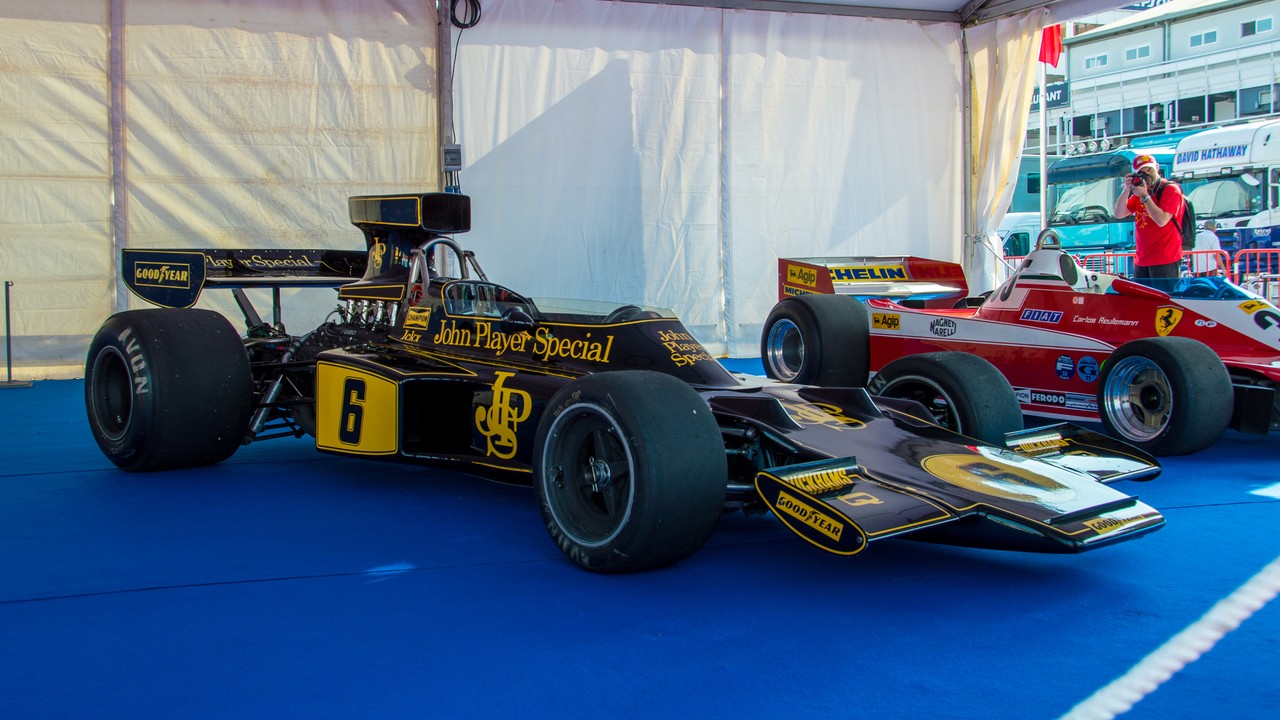
The Lotus 72 moved a Formula 1 car’s radiators out of the nose and into pods on either side of the driver. Colin Chapman’s team unveiled it in April 1970, and it went on to race in six straight Formula 1 seasons. Along the way, it won three constructors’ championships for Team Lotus.
Few Formula 1 designs stay at the front for long. However, the 72 kept racing, and kept collecting titles, through the first half of the decade.
That layout also changed how Formula 1 cars looked. Its wedge-shaped nose, built around the space the radiators left behind, became the template for the cars that followed.
A quiet launch at Hethel
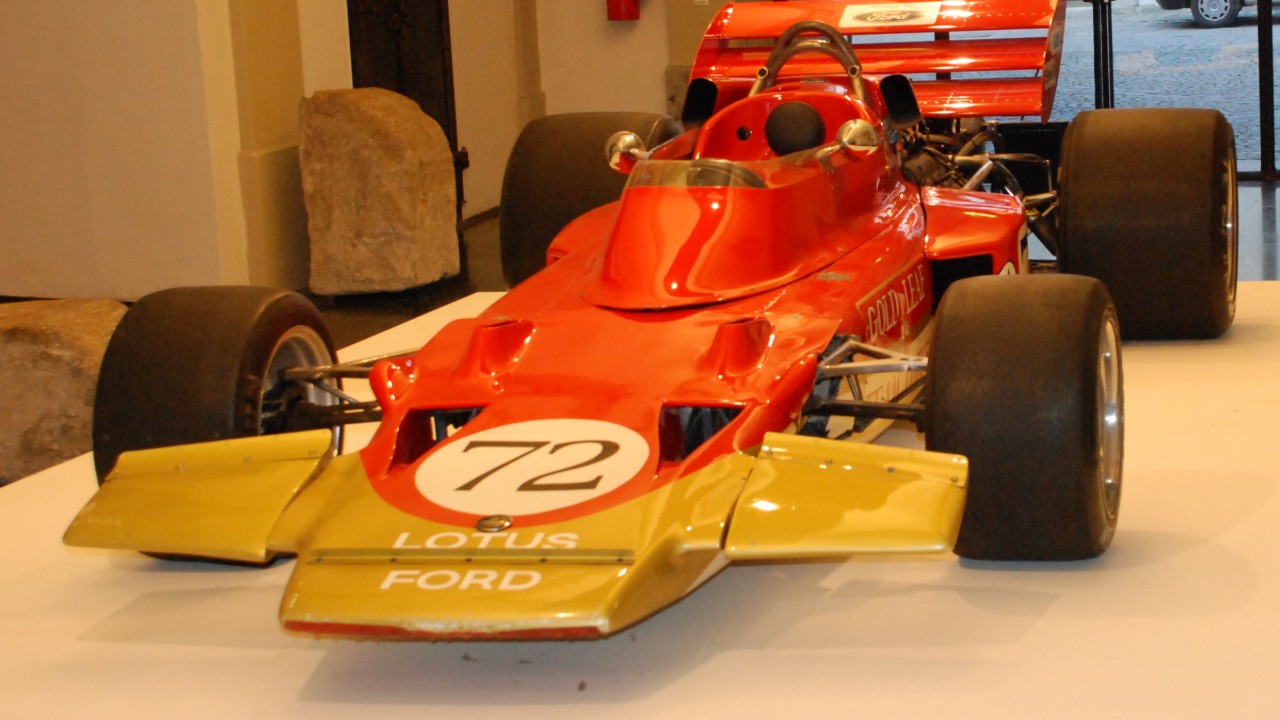
Chapman unveiled the Lotus 72 at the Hethel test track on Monday, 6 April 1970, “without fanfare,” according to Classic Team Lotus. The press gathered in Chapman’s hangar, normally home to his Gold Leaf-liveried Navajo airplane. Then Jochen Rindt took the new car out for a few fast laps in the wet.
Meanwhile, Maurice Philippe served as chief designer, working with Chapman, Classic Team Lotus says. Behind them, Martin Waide, John Baldwin and Geoff Aldridge were the principal draughtsmen.
What made the Lotus 72 different
The side radiators were the headline change. Lotus moved the water radiators “from the nose” and “split into two,” placing them “on each side of the cockpit,” according to F1technical’s car database. Lotus itself calls the side-mounted radiators the first visible sign of the car’s new aerodynamic thinking.
Moving the radiators freed the front of the car. As a result, Lotus could shape a sharp wedge nose and build its twin wings around it, the maker explains. Lotus adds that wedge-shaped aerodynamics later became standard in Formula 1.
The brakes moved too. Chapman mounted all four brakes inboard, F1technical notes. In addition, the suspension used torsion bar springs with a progressive rate. Classic Team Lotus credits that mix with delivering low drag, high downforce and better use of the tires.
Cosworth power and a 530 kg car
Behind the driver sat the Ford Cosworth DFV V8, rated at 440 to 475 brake horsepower, according to Lotus. Power went through a compact Hewland FG five-speed gearbox. Meanwhile, the car weighed 530 kg, the minimum the rules allowed.
The 72 arrived early in the season. It debuted at the Spanish Grand Prix on 19 April 1970, according to F1technical and Lotus. The team then withdrew the car and reworked it. Once it returned, Rindt went on to win four consecutive races, F1technical says.
Three constructors’ titles in four years
The results came quickly. Team Lotus won the constructors’ championship with the 72 in 1970, 1972 and 1973, according to Classic Team Lotus. Better still, the car also carried two drivers to the world title, Jochen Rindt and Emerson Fittipaldi.
Rindt’s 1970 title came posthumously, and the official record still lists him as Formula 1’s only posthumous world champion. Fittipaldi’s win at the 1970 United States Grand Prix secured that title for Rindt, Classic Team Lotus says. Two years later, Fittipaldi won the 1972 drivers’ championship in his own right.
Then, in 1973, Ronnie Peterson and Fittipaldi won seven of the season’s 15 Grands Prix between them. That haul delivered the third constructors’ crown, according to Classic Team Lotus.
The livery also changed along the way. Early cars wore red and white with gold stripes. From 1972, the 72s turned black and gold and became known as John Player Specials, F1technical notes.
Six straight seasons in Formula 1
Longevity became the car’s calling card. The 72 competed in six consecutive Formula 1 World Championship seasons, Classic Team Lotus says. Lotus dates that run from the car’s 1970 debut through 1975, with Peterson and Jacky Ickx driving it in its final year.
Even so, the end came eventually. The car was still racing in 1975 but took no more wins that season, Lotus says. Finally, for 1976, the Type 77 replaced it.
Still, its drivers never forgot it. “There’s no question about it, the Lotus 72 was the best F1 car I ever drove,” Fittipaldi said, as quoted by Classic Team Lotus. In March 2019, Autosport chose the Type 72 as the greatest Formula 1 car ever, Classic Team Lotus notes.
How many Lotus 72s survive
Team Lotus built 10 Type 72 chassis, according to Classic Team Lotus. In fact, eight of those 10 cars survive today.
More from Fast Lane Only