MG built its name on small sports cars, yet in 1936 it began selling big MG saloon cars with wood-framed bodies and jacks built into the chassis. The SA, VA and WA ran until war halted production in September 1939. After the war, the Y-type and the Magnette carried the idea into a new era.
These seven are our picks for MG saloons packed with details no maker would bother with now. The verdict is our take, but the facts behind it come from the record.
1. 1937 MG SA Saloon

The SA launched in 1936 at £375, and it was MG’s bid for buyers who wanted a fast, roomy saloon. Its six-cylinder engine grew from 2,288 cc to 2,322 cc during production. Inside, the fascia carries gold dials set in inlaid wood. There is also a rear-window blind the driver can work from the front seat. Underneath, a Jackall system lets the driver raise the front, the rear or the whole car from inside. According to the MG Car Club, 246 of the 2,739 SAs survive.
2. 1939 MG VA Saloon

The VA was the smallest of the three prewar saloons, with a 1,548 cc four instead of a six. That made it the lightest of the family. In fact, the MG Car Club says it had the best power-to-weight ratio of the trio. Its gearbox also gained synchromesh on second gear, which the SA lacked. Hydraulic jacks came standard here, too, and the saloon listed at £325 new. Today, the club counts 303 surviving VAs.
3. 1939 MG WA Saloon

MG began building the WA in December 1938, so war cut its life to well under a year. The engine was the SA’s six, bored out to 2,561 cc. Meanwhile, a wider rear track made room for a bigger body. The standard kit reads like a wish list: an oil cooler, a counterbalanced crank, a tandem brake master cylinder, an electric clock and an 18-gallon tank. MG built only 370, and the club knows of 44 survivors. That much engineering in a 1930s family car is exactly what we mean.
4. 1950 MG YA Saloon

The Y-type arrived in 1947 with independent front suspension designed by Gerald Palmer and Jack Daniels. That was modern thinking for a small British saloon. Yet MG kept one prewar luxury, a Jackall system with four hydraulic rams. A pump on the bulkhead drives them. Its 1,250 cc XPAG four made 46 bhp, so it was never quick. The Motor timed a 1951 car at 69.6 mph flat out. Even so, built-in jacks on a 1950 family car? Nobody does that now.
5. 1953 MG YB Saloon

MG launched the YB in 1952 and built just 1,301 before production ended in 1953. The changes were the kind an enthusiast notices. First, Lockheed twin-leading-shoe brakes replaced the old setup. Then the wheels shrank from 16 to 15 inches, and a front anti-roll bar arrived along with stronger dampers. MG also fitted a more modern hypoid rear axle. In other words, the factory kept improving the car right to the end instead of letting it fade out.
6. MG Magnette ZA
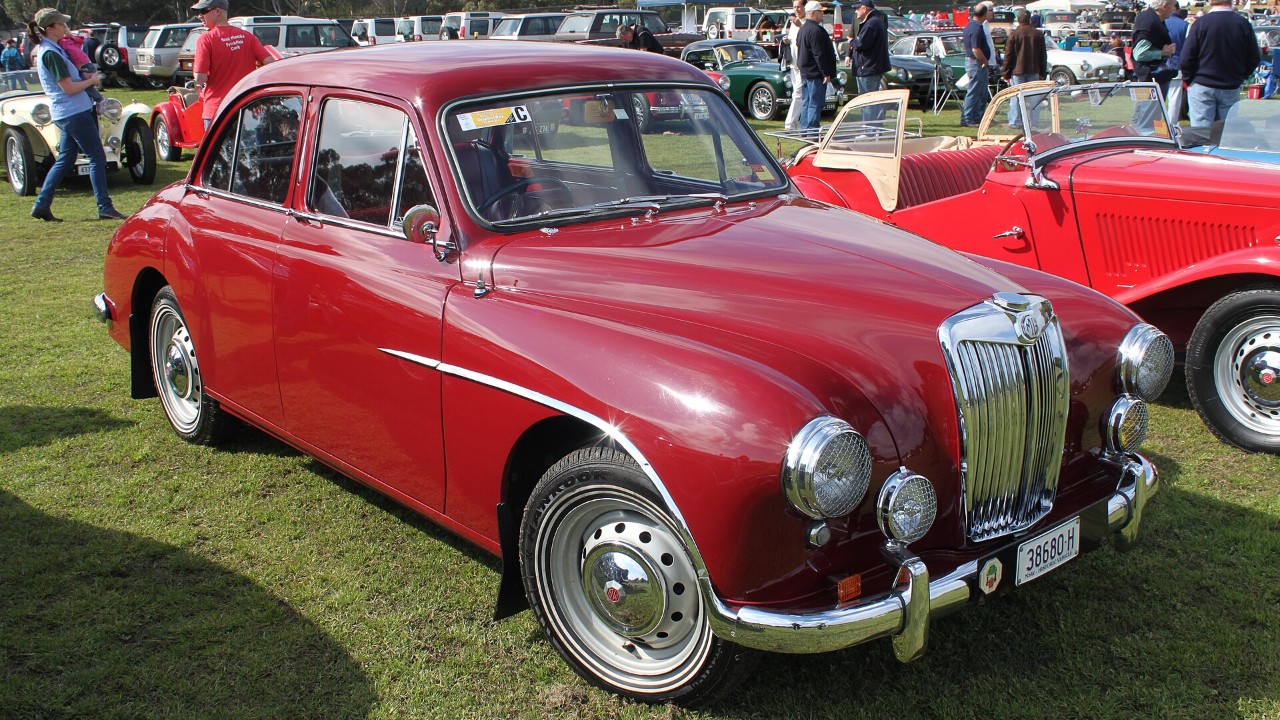
MG announced the ZA on October 15, 1953, at the London Motor Show, and it was the first MG with unibody construction. Gerald Palmer, who also drew the Jowett Javelin, designed it. Power came from a 1,489 cc B-Series four with 60 bhp. During its 1955 test, The Motor recorded 79.7 mph, and the test car cost £914 with taxes. MG sold 18,076 of them. It also appeared in our list of MGs that still stop traffic, and we stand by that pick.
7. MG Magnette ZB Varitone

The ZB followed on October 12, 1956, with bigger 1½-inch carburettors and higher compression lifting output to 64 hp. As a result, top speed rose to 86 mph. The Varitone was the flashy one, with a larger rear window and optional two-tone paint. Morris enlarged that window opening on each standard Pressed Steel shell at its Cowley body shop, before paint. Reworking every shell after it left the press is the kind of fuss modern factories avoid. For that reason, it closes our list.
More from Fast Lane Only