By the end of 1961, BMC had turned its tiny sedan into five new body styles. Together, they included a Mini Van, a pickup, a wood-trimmed Mini Traveller and two upmarket sedans with proper trunks. Later years added a sporty Clubman, a convertible and a run of anniversary cars.
These eight variants show how far one small transverse-engined platform could stretch. Each item below rests on BMW Group’s own heritage records or another named source.
1. 1960–1969 Austin and Morris Mini Van

The van came first, arriving in 1960, a year after the sedan. At first, BMC aimed it at workmen and tradespeople. To make room for cargo, engineers stretched the floor by 25 cm. They also moved the battery, spare wheel and fuel tank under the load floor.
BMW Group Classic’s record for the Morris Minivan lists an 848 cc four with 34 hp. On top of that, top speed was 116 km/h, and the price was £387. Because it was a work vehicle, there was no chrome, and even the grille was stamped steel painted in the body color. In fact, the Austin and Morris versions differed only in their badges.
2. 1961–1969 Mini Pick-up
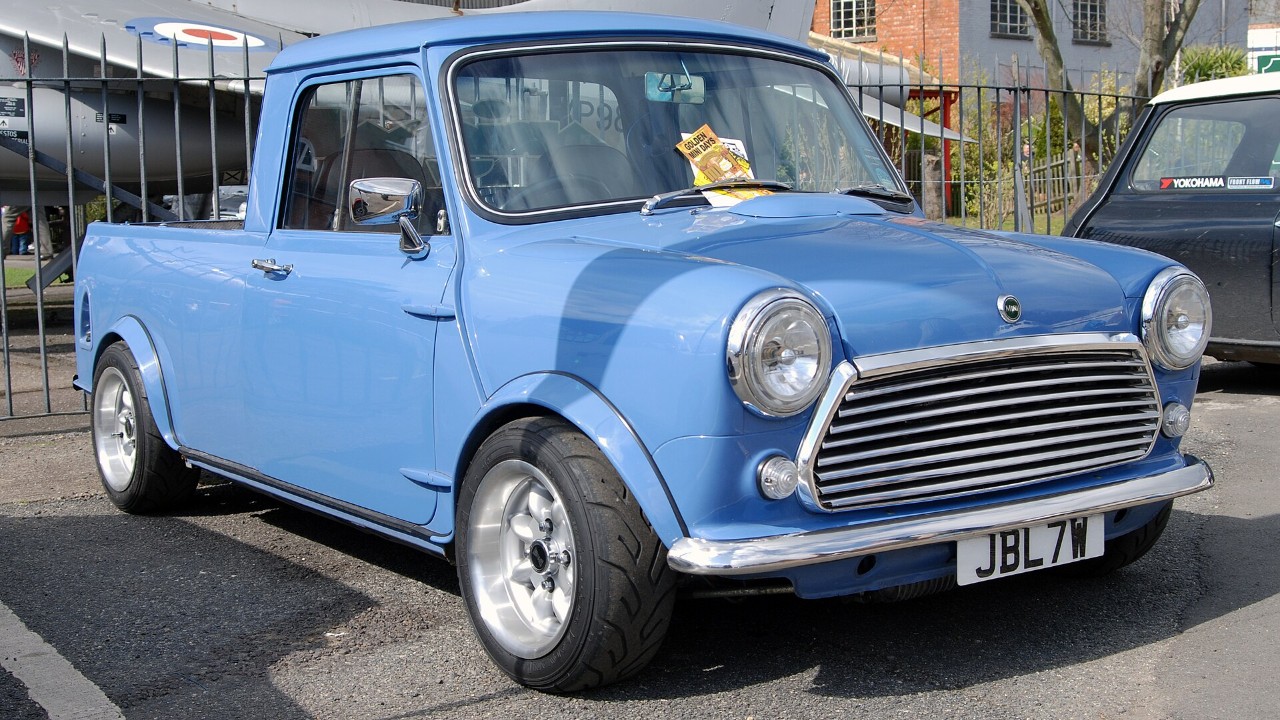
The Pick-up followed in January 1961 and finished BMC’s small commercial lineup. It shared the van’s front body up to the B-pillar, then swapped the box for an open load bed. Also, like the van, it skipped chrome trim entirely.
Oddly, it cost less than the van. BMW Group Classic lists the Morris Mini Pick-up at £380, with the same 34-hp, 848 cc engine and 116 km/h top speed. Then production ran until October 1969, and both Austin and Morris badges were offered.
3. 1960–1967 Morris Mini Traveller

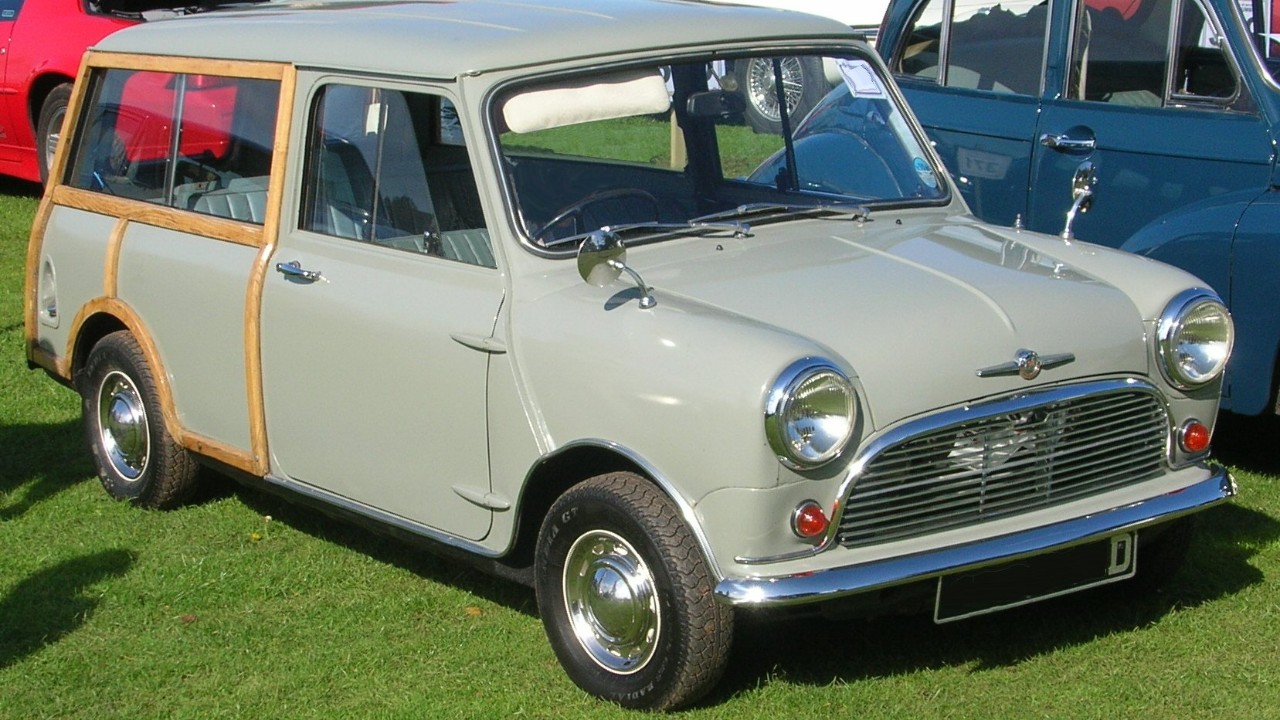
Meanwhile, the estate arrived in autumn 1960 with windows all the way around. BMC sold it as the Morris Mini Traveller and as the Austin Seven Countryman. That’s according to a 2020 BMW Group release marking its 60th birthday.
In particular, the rear carried wooden trim, which earned it the “Woody” nickname. BMW Group Classic says it was 25 cm longer than the sedan, at 3.30 m, and up to 50 kg heavier. Its listed top speed was 112 km/h, and the price was £623.
4. 1961–1969 Wolseley Hornet

The Hornet dressed the Mini in old-school British luxury. It had an upright grille, slim trim strips and a tail that stuck out a full 22 cm for a proper sedan profile. In addition, its illuminated badge was a Wolseley signature going back to 1932.
BMW Group Classic’s blog on the Hornet says early cars used the 848 cc engine with 34 hp. Later, the Mark II and Mark III moved to a 998 cc engine with 38 hp, and the Mark III added real leather. The last Hornets were built in August 1969.
5. 1961–1969 Riley Elf
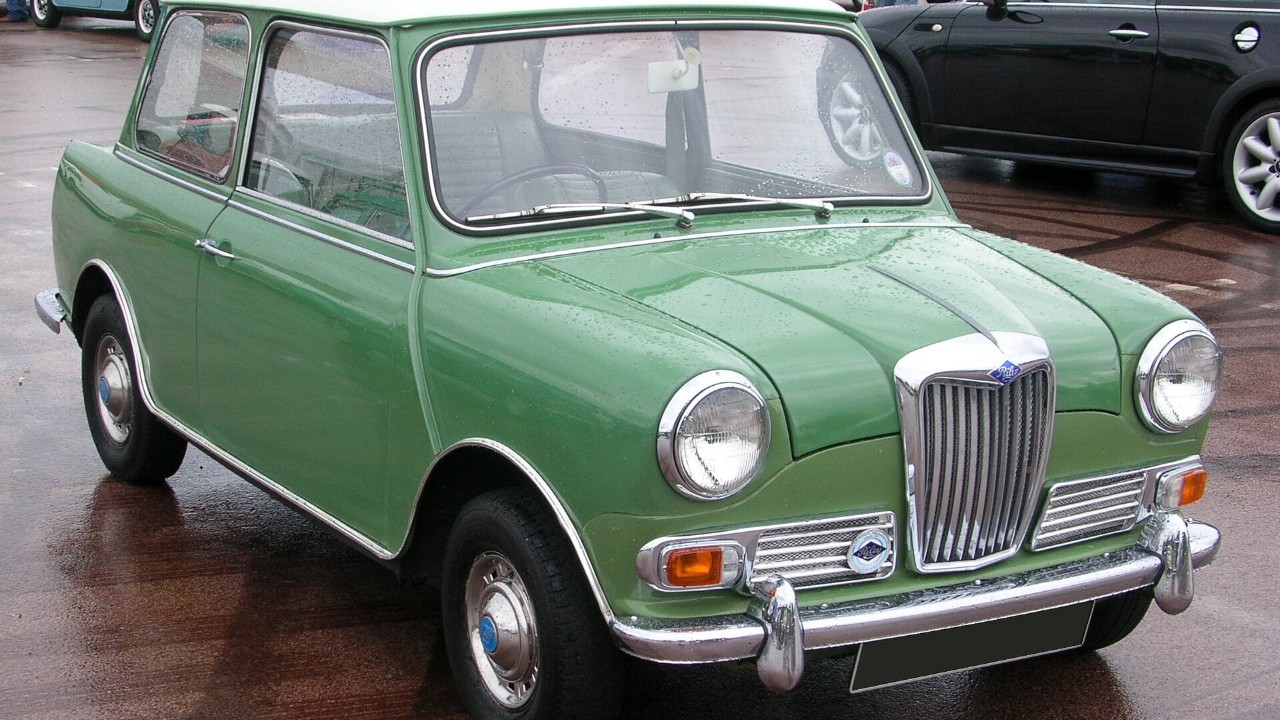
The Elf was the Hornet’s sibling, with its own grille, air intakes and badges. Similarly, BMC stylist Dick Burzi designed it as the top of the range. Inside, a full-width burr walnut dashboard framed a central speedometer, and even the gear lever was chrome-plated.
BMW Group Classic dates the first Elf from October 1961 to November 1962, at £575. However, all that equipment dulled performance from the 34-hp, 848 cc engine. That’s why BMC followed with a Mark II meant to fix it. The last version, the Mark III, ran from October 1966 to August 1969 with a 38-hp, 998 cc engine. It was also the first car in the Mini range with wind-up windows, and it lost the exterior door hinges.
6. 1969–1980 Mini 1275 GT

British Leyland launched the Clubman range in October 1969, and the 1275 GT sat at the top. For example, it borrowed parts from the Cooper S and took over from the Mini-Cooper Mk II, which ended that autumn. Chief stylist Roy Haynes shaped the series.
BMW Group Classic’s 1275 GT record lists a 1,275 cc four with 60 hp. In addition, it reached 140 km/h. It cost £834 when new. Still, the archive is candid: the car “lacked the charisma and performance of the popular Cooper S models.” It stayed in production until August 1980.
7. 1991–1996 Rover Mini Cabriolet

The open Mini began as a test. Rover commissioned German dealer Lamm Autohaus to convert 75 cars, which went on sale on June 23, 1991, at £12,250. All 75 sold within a month, according to an Iconic Auctioneers lot listing.
After that, Rover developed its own version with help from Karmann and Tickford and built it at Longbridge. BMW Group’s classic Mini timeline lists the 1992 convertible at £12,000 and calls it the most expensive Mini at the time. By comparison, Iconic sold one of the Lamm cars for £18,000 in March 2022.
Rover showed its Cabriolet at the NEC Motor Show in October 1992, and it stayed in production until 1996, according to Iconic’s listing for a 1996 car. The same listing says it’s generally accepted that 1,081 were sold.
8. 1999 Mini 40th Anniversary

For the car’s 40th birthday, Rover offered a limited edition in white, red or blue, the BMW timeline says. Under the hood, though, was the fuel-injected Cooper engine with 63 bhp. Meanwhile, the cabin got full leather and a brushed-alloy dash with extra gauges, the auction listing below notes.
According to a 2024 auction listing on The Market, Rover built 250 for the UK market. The split was 150 in Mulberry Red and 50 each in Old English White and Island Blue. Car number 141 sold there on August 21, 2024, for £48,780 with premium.
More from Fast Lane Only