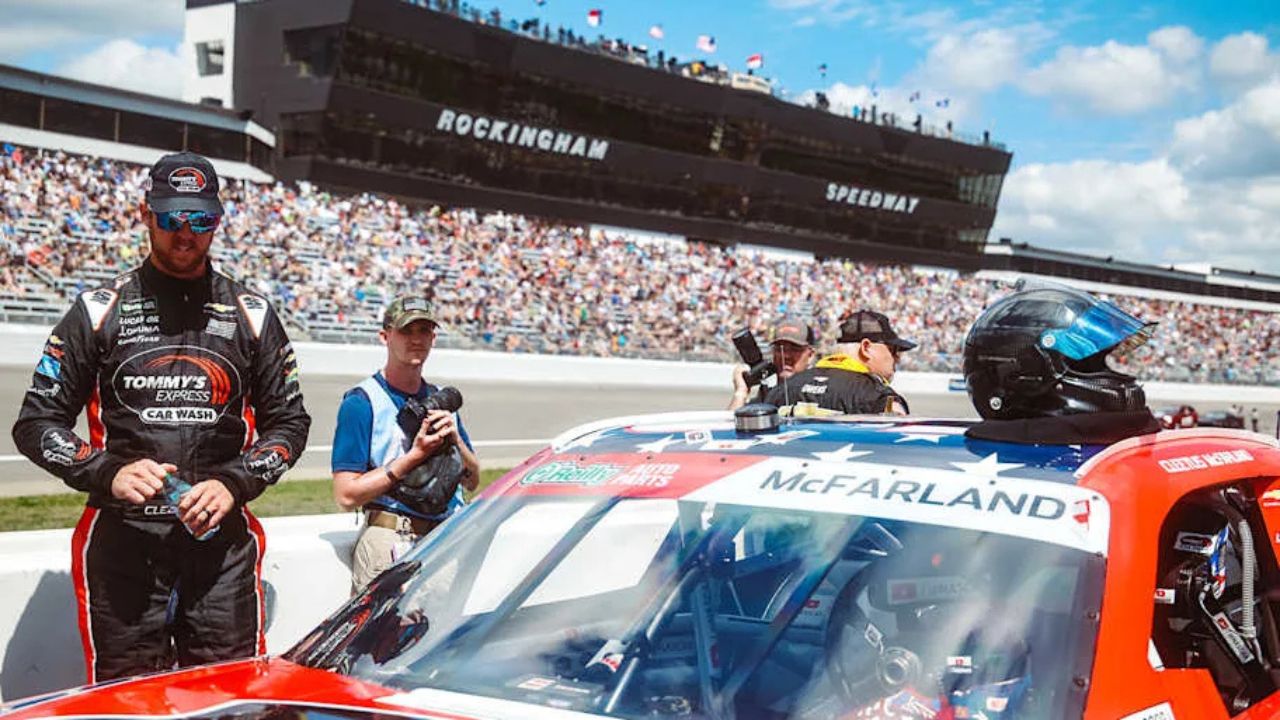
NASCAR has turned down YouTube star Cleetus McFarland’s bid to race at Talladega in the O’Reilly Series, shutting the door on what would have been one of the most high-profile influencer crossovers yet in stock car racing. The decision keeps McFarland out of the Talladega draft for now and throws fresh light on how tightly the sanctioning body guards its superspeedway licenses.
The move also underscores a collision between two worlds: a rule-bound professional series that treats Talladega as sacred ground for safety, and a digital creator whose brand is built on accessible, rowdy horsepower. How NASCAR manages that tension will shape not only McFarland’s future, but also how far the sport is willing to lean into creator-driven fandom.
What happened
Cleetus McFarland, whose real name is Garrett Mitchell, applied for NASCAR approval to compete in the O’Reilly Series race at Talladega Superspeedway with the team owned by Ryan Sieg. According to detailed reporting on the decision, NASCAR declined to approve him for superspeedway competition, which covers both Talladega and Daytona, while still clearing him for other O’Reilly events on shorter tracks later in the season. That split verdict left his Talladega plans on hold even though the rest of the entry was in place, including the No. 39 car and backing from his established fanbase.
NASCAR’s competition department judged that McFarland’s current résumé does not yet meet its standard for the unique demands of a drafting track where cars run in tight packs at more than 190 mph. Officials communicated that position directly to McFarland and the team, explaining that his prior experience in lower-level stock cars and exhibition events did not equate to full-speed superspeedway racing in a national series. As one account of the decision put it, the sanctioning body granted him a partial license that covers intermediate and short ovals but explicitly excludes the two big drafting tracks that define the upper limit of risk in the series.
McFarland had not been pursuing this opportunity as a one-off stunt. He has already logged competitive laps in late models and other stock car machinery, and he has run high-profile events such as his own Freedom 500 at Bradenton Motorsports Park. His brand centers on a mix of grassroots oval racing, burnout contests and drag racing, all broadcast to millions of subscribers on his main YouTube channel. That background helped open doors with teams in the O’Reilly Series, which saw commercial upside in pairing an established operation with a driver who could bring a built-in audience.
In the run-up to Talladega, McFarland and the Sieg operation submitted the standard paperwork for driver approval. NASCAR’s driver rating system looks at prior starts in comparable machinery, performance in those races and any recent test or practice data at similar tracks. According to reporting that cites NASCAR officials, the evaluation for McFarland focused heavily on the absence of prior experience in a national touring series on a track that behaves like Talladega. That gap became the decisive factor that kept his application from clearing the superspeedway bar.
The denial did not come with a public reprimand or any suggestion that McFarland had done something improper. Instead, NASCAR framed it as a procedural outcome of its long-standing approval ladder. The same process has historically kept rookies out of Daytona or Talladega until they prove themselves at less volatile venues. In McFarland’s case, the sanctioning body simply applied that ladder to a driver whose fame arrives from a different direction than the usual short track pipeline.
McFarland acknowledged the decision on his own channels, making clear that he would not be in the car at Talladega and that he intended to regroup with the team for other O’Reilly Series races where he is already cleared to compete. He also signaled that he remains interested in working through NASCAR’s process, rather than abandoning the project entirely, which keeps the door open for future starts once he meets the sanctioning body’s benchmarks.
The Athletic’s detailed breakdown of the decision notes that NASCAR’s internal view is that the Talladega denial is specific to superspeedways and not a blanket rejection of McFarland as a driver. In that reporting, officials emphasize that he can still race later in the year at tracks that fit his current approval level, which could include intermediate ovals where pack racing is less extreme and the closing speeds are lower than at Talladega or Daytona. That distinction is central to how NASCAR is trying to balance safety with the commercial upside of a popular creator entering the field.
Other coverage has framed the outcome as a snub that stings McFarland’s fans but might ultimately help him avoid being thrown into the deepest end of the pool too quickly. One analysis of the situation describes the denial as a potential “blessing in disguise” that could give McFarland time to gain more seat time in heavy stock cars on less chaotic tracks before confronting the Talladega draft. That perspective leans on the series’ long history of requiring drivers to climb through smaller ovals before they take on the most dangerous venues.
Why it matters
The McFarland decision lands at the intersection of three powerful forces in modern motorsport: safety protocols, sponsorship economics and the rise of creator-driven fandom. Each of those threads helps explain why this single approval ruling has drawn so much attention beyond the usual NASCAR circles.
Talladega and Daytona occupy a unique place in NASCAR’s risk calculus. The combination of restrictor-style rules, massive packs and narrow margins for error has produced some of the sport’s most spectacular and violent incidents. NASCAR’s driver approval ladder is built in large part around those two tracks, with officials historically requiring a specific body of work before a driver is cleared to race there. The decision to hold McFarland out of Talladega, while still allowing him on other O’Reilly circuits, fits that long-standing pattern in which superspeedways are treated as a separate category.
McFarland also represents a new type of commercial opportunity for teams and the series. His YouTube channel and associated social platforms reach millions of followers who might not otherwise tune into an O’Reilly Series broadcast. That audience translates directly into sponsor interest, which is why a veteran operation such as Ryan Sieg’s group was willing to put him in its car. One report on the saga highlighted how the proposed Talladega entry had already generated significant buzz among fans and sponsors before NASCAR’s decision, illustrating how creator crossovers can move the needle for mid-tier teams that live on thin margins.
Those commercial stakes are part of why the denial has triggered debate among fans and commentators. Some see NASCAR as leaving money on the table by blocking a high-visibility storyline that could have drawn casual viewers to Talladega. Others argue that the sanctioning body has to protect its competitive and safety standards, even when that means saying no to a driver who brings a large audience. The tension between short-term marketing gains and long-term credibility is at the heart of the discussion.
McFarland’s situation also highlights how digital creators are testing the boundaries of traditional sports structures. In motorsport, personalities such as Travis Pastrana and Conor Daly have crossed over into NASCAR and the Daytona 500 with varying levels of preparation and success. McFarland’s case is different in that his fame comes almost entirely from his own content ecosystem, where he controls the narrative and the level of risk he is willing to take in his events. NASCAR, by contrast, operates inside a tightly regulated environment where one driver’s learning curve can have consequences for 30 or more competitors in the same pack.
Coverage of the decision has emphasized that NASCAR did not close the door on McFarland forever. Reports indicate that officials have laid out a path for him to gain the necessary experience, which could include additional starts at non-superspeedway tracks in the O’Reilly Series and possibly formal evaluation sessions under NASCAR supervision. That roadmap suggests the sanctioning body is open to integrating creator-drivers, but only if they move through the same safety gates as any other newcomer.
From a competitive standpoint, McFarland’s absence at Talladega also preserves the status quo for full-time O’Reilly drivers who have spent years chasing opportunities at marquee tracks. Some of those drivers and teams might privately welcome NASCAR’s insistence that a YouTube following alone does not buy access to the most prestigious and hazardous events. The message is that the ladder still runs through performance and experience, not just social metrics.
At the same time, the conversation around the denial has already given McFarland and the series a wave of free publicity. Articles that chronicle how NASCAR weighed his application have circulated widely, with one prominent piece on his Talladega bid reaching both hardcore fans and general sports readers. Opinion-driven coverage has gone further, arguing that the setback could actually strengthen his long-term NASCAR prospects if he uses the time to build a deeper competitive record.
One such column on the Talladega “snub” frames the denial as a chance for McFarland to mature as a stock car driver away from the glare of a superspeedway debut. That piece points out that many accomplished NASCAR drivers spent years in lower series before earning their Daytona and Talladega approvals, and that jumping straight into the most volatile tracks could have exposed McFarland to a steep and unforgiving learning curve.
For NASCAR, the broader significance lies in the precedent. If the series had bent its rules to accommodate a high-profile creator with limited superspeedway experience, it would have opened itself to criticism the next time a lesser-known driver was held back. By applying the same standard to McFarland that it uses for traditional prospects, NASCAR can argue that its approval ladder remains consistent, even as the profile of applicants changes.
That consistency matters not only for fairness but also for liability. Superspeedway accidents often prompt questions about whether every driver in the field was properly vetted for the conditions. NASCAR’s decision to keep McFarland out of Talladega until he has a deeper record at other tracks can be seen as a preemptive answer to those questions, especially given the intense scrutiny that follows any big crash at Daytona or Talladega.
What to watch next
The Talladega denial is not the end of McFarland’s NASCAR story. It is more likely the start of a longer process in which he tries to convert his online success into a sustainable presence in the O’Reilly Series. Several reports have already outlined the next steps he will need to take if he wants another shot at superspeedway approval.
One account from a college sports and culture outlet that has expanded into motorsports coverage notes that NASCAR has already cleared McFarland for select O’Reilly Series races away from Talladega and Daytona. That report explains that he can compete at tracks that do not require the highest level of approval, which gives him a concrete path to log more laps in race conditions. The same piece adds that NASCAR communicated specific benchmarks he must hit before the sanctioning body will revisit the superspeedway question, including clean finishes and demonstrated comfort in traffic.
More from Fast Lane Only