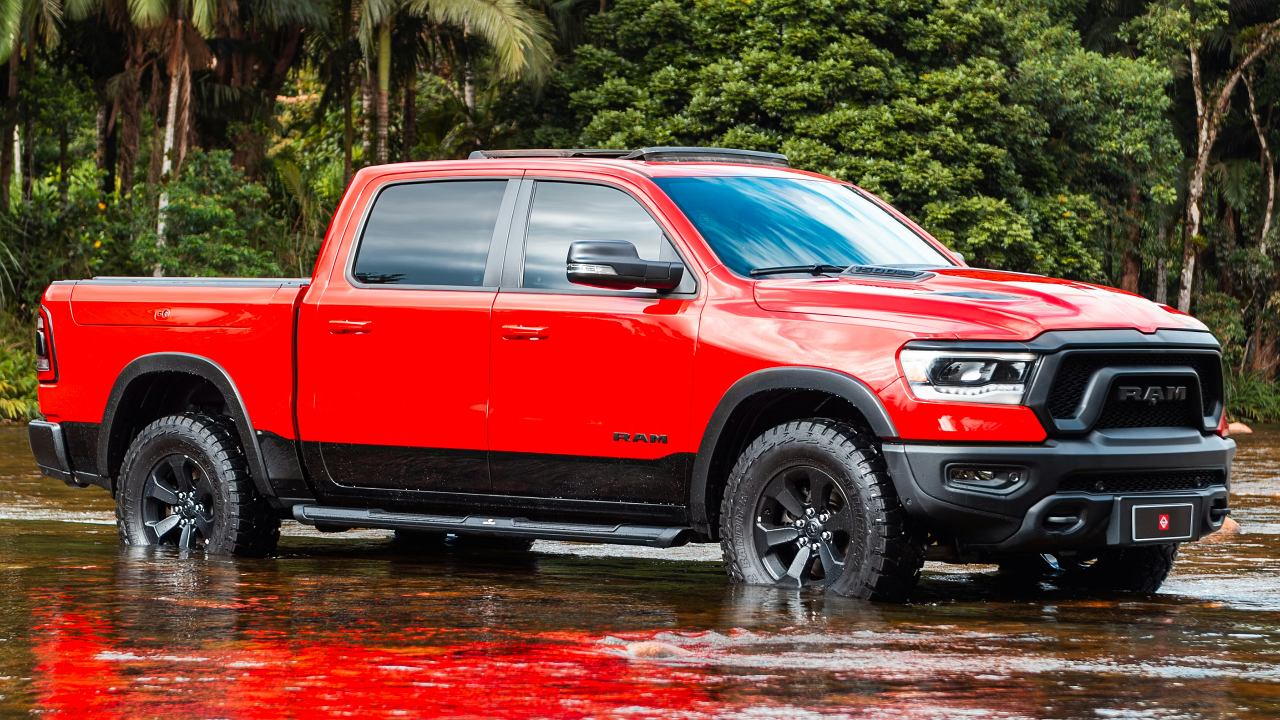
Ram is weighing whether its Brazilian-built Rampage compact pickup should make the leap to American showrooms just as the smallest end of the truck market is being reshaped. With Ford’s Maverick surging, Hyundai’s Santa Cruz on the way out, and Stellantis preparing a separate midsize model, the brand faces a high stakes decision about how many trucks, and of what size, the United States can absorb. The outcome will determine whether Ram becomes a full spectrum truck player or cedes the hottest new niche to rivals.
Ram’s compact conundrum
Inside Stellantis, the debate over the Rampage’s American prospects has become a test case for how finely the company can slice the truck market. Reporting on Ram Weighs, Future of Rampage, Eyes Compact Truck Market describes executives studying whether a compact unibody pickup can coexist with a planned body on frame midsize model without confusing buyers or cannibalizing sales. The Rampage, which has been sold in South America for years, is smaller than traditional midsize offerings and is pitched as a more urban friendly tool, yet it still needs enough capability and value to justify a place in Ram’s crowded lineup.
That internal calculus is complicated by the fact that Stellantis Chairman John Elkann has already committed Ram to a separate midsize pickup built at the previously idled Belvide plant, a project detailed in coverage of Earlier comments from Stellantis Chairman John Elkann about Ram and Belvide. At the same time, a memo from Stellantis COO Antonio Filosa, cited in reporting on Ram and Stellantis COO Antonio Filosa, Unit, outlines preparations for a U.S. bound Rampage by 2027, suggesting corporate momentum behind the compact. The result is a delicate balancing act, with Ram trying to position two trucks in adjacent size classes without tripping over its own strategy.
Rampage’s global march and American fit
While Ram hesitates on a U.S. launch, the Rampage is already being deployed as a global ambassador for the brand. Stellantis has announced that RAM will present the Rampage in Europe at the Fieracavalli event, signaling confidence that the compact format can win over buyers in markets where tight streets and small garages are the norm. Separate analysis of Ram, New Compact Pickup Is Tiny notes that the current Ram Rampage measures 198 inches in length, making it only slightly shorter than some midsize trucks but still compact enough to feel manageable in dense cities. That size, combined with a focus on maneuverability, has led some observers to describe Ram’s New Compact Pickup Is Tiny as one of the most European flavored trucks the company has built.
Those same traits raise questions about how the Rampage would be perceived in the United States. Commentary framed around What About The US and Initially, Ram, Rampage, Ford explains that early expectations cast the truck as a direct challenger to the Ford Maverick, yet its global tuning and packaging may not align perfectly with American preferences for towing, payload, and highway comfort. Another analysis of Rampage in South, America underscores that the truck has been tailored to South American conditions, where fuel prices, road quality, and usage patterns differ from those in the U.S. market. To succeed here, Ram would likely need to adapt the Rampage’s specification, pricing, or both, rather than simply importing the existing formula.
Maverick’s surge and Santa Cruz’s retreat
The competitive backdrop for any Rampage decision is dominated by Ford’s compact pickup. Data shared by Ford, Maverick, In July shows that, so far in 2025, Ford has sold 98,078 examples of the Maverick, an 8.9% increase over the same period a year earlier, with strong monthly performance In July as well. Additional reporting that Ultimately, Ford, Maverick has been crushing its closest rival attributes that success to Ford’s long standing reputation in trucks and the Maverick’s more traditionally masculine styling, which appears to resonate with buyers who might otherwise have chosen a crossover. The Maverick’s momentum demonstrates that there is sustained demand for a smaller, more affordable pickup that still looks and feels like part of the truck family.
Hyundai’s experience at the same end of the market has been less encouraging, and it is reshaping the competitive field Ram is studying. Coverage of Hyundai, Santa Cruz, Hyundai Tucson reports that Hyundai’s Santa Cruz small pickup truck, which is based on the Hyundai Tucson compact crossover, will not return for the 2027 model year, with slow sales and a planned shift toward a midsize truck cited as key reasons. A separate comparison that highlights Nicer for the, Why, Hyundai Santa Cruz, MSRP notes that the 2024 Hyundai Santa Cruz starts at just under $27,000 MSRP, with references to $27,000 M and $27,000, positioning it above the Maverick’s entry point and potentially limiting its appeal. For Ram, the contrast between Maverick’s growth and Santa Cruz’s retreat underscores how sensitive this segment is to pricing, branding, and perceived truck authenticity.
How a U.S. Rampage would need to compete
If Ram brings the Rampage to America, it will enter a segment already defined by sharp value propositions and clear identities. The Maverick has carved out a role as an affordable, no nonsense work and lifestyle truck, while the Santa Cruz, with its higher starting price and crossover roots, struggled to find a distinct niche. Any Ram entry would need to undercut or at least closely match the Maverick on price while offering a compelling mix of capability and comfort. Reporting on Ram CEO views in Jan, Key Points, Ram CEO, Rampage, Dakota, Compact indicates that Ram’s leadership is acutely aware of this, with the chief executive warning that a U.S. Rampage launch depends on how a separate Dakota style midsize model is positioned and how much price overlap the company can tolerate.
There is also the question of architecture and driving character. One analysis that invokes Alternatively, Ram, Stellantis STLA Large suggests that a future compact Ram truck could sit on a version of the Stellantis STLA Large platform, which is used for other vehicles in the group and could be tailored to American tastes. That would give Ram flexibility to tune ride quality, interior packaging, and electrification options specifically for this market, rather than relying entirely on the South American specification. At the same time, the existing Rampage’s footprint, captured in the 198 inch length figure from Ram, New Compact Pickup Is Tiny, places it close enough to midsize territory that Ram must decide whether to lean into compact maneuverability or emphasize traditional truck strengths that might blur the line with its upcoming Belvide built model.
Stellantis’s broader truck chessboard
Ram’s compact debate does not occur in isolation, it is part of a wider Stellantis strategy to cover every profitable corner of the truck market. Earlier remarks from Stellantis Chairman John Elkann about Ram and Belvide confirm that the company will build a midsize pickup at the revived Belvide facility, giving Ram a direct rival to established players from Ford and Chevy in that class. At the same time, internal communication from Stellantis COO Antonio Filosa, referenced in coverage of Ram, Stellantis COO, Antonio Filosa, Unit, describes preparations for a U.S. bound Rampage by 2027, indicating that the compact is still very much on the table. The company is effectively setting up a two pronged attack, with one truck aimed squarely at traditional midsize buyers and another targeting those drawn to smaller, more efficient pickups.
More from Fast Lane Only