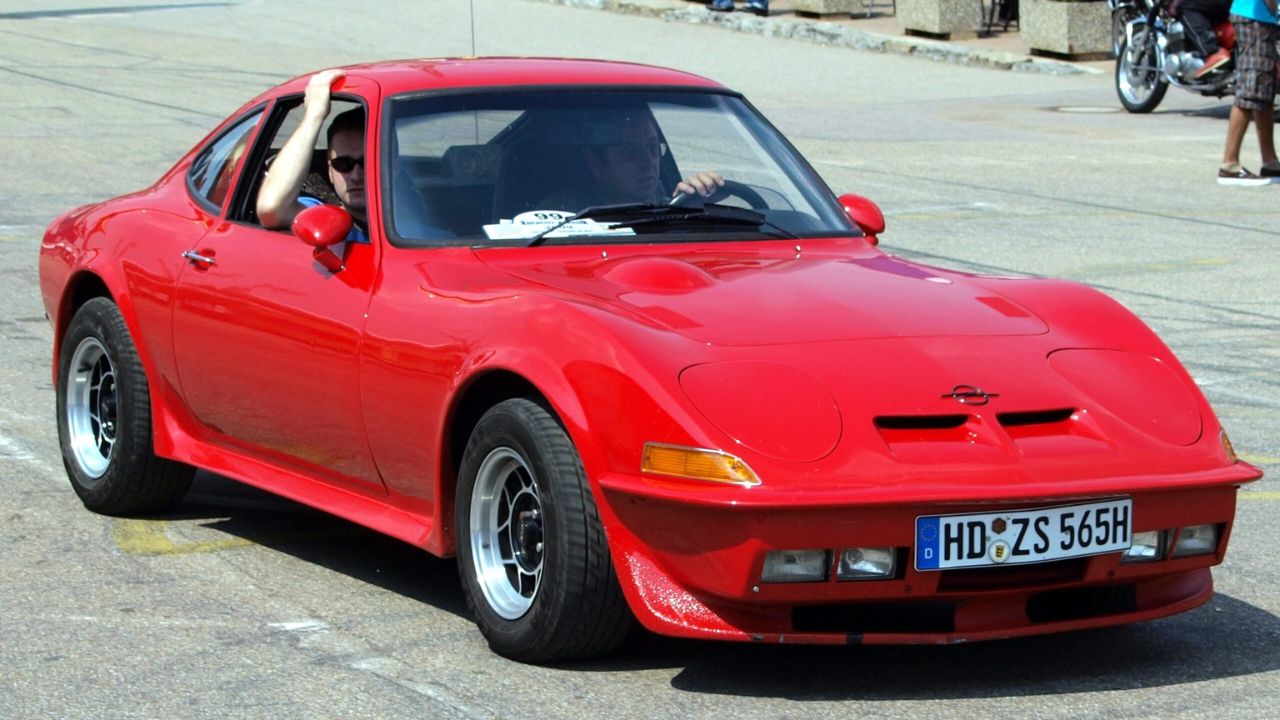
The 1969 Opel GT arrived as a small, low-slung coupe that looked as if it had slipped out of an Italian design studio and onto American streets. Beneath its fiberglass-smooth curves, it carried modest power and practical mechanicals, yet the combination delivered more poise and personality than its size or spec sheet suggested. For drivers who discovered it new or decades later as a survivor in a driveway or barn, the GT proved that a compact sports car could feel exotic without being fragile or temperamental.
What happened
When Opel introduced the GT for the 1969 model year, the company aimed at drivers who wanted sports-car style without full sports-car compromises. The car rode on a shortened version of the Opel Kadett platform, which kept costs in check and made the GT relatively easy to service. Under the long hood, buyers in the United States typically found a 1.9-liter inline-four paired with a manual gearbox, a combination that offered usable performance rather than outright speed. The emphasis fell on balance and feel instead of headline-grabbing horsepower.
The styling told a different story. The GT wore a low nose, hidden headlights and a fastback tail that looked closer to a scaled-down European exotic than to a Kadett. Its headlights rotated sideways in the body, operated by a lever in the cabin, a theatrical touch that delighted owners and passersby. The proportions gave the car a classic front-engine, rear-drive stance, with a long hood and short rear deck that visually promised more performance than the numbers alone could deliver.
Inside, the GT placed the driver low and close to the floor, with a simple dashboard and a pair of supportive bucket seats. The cabin was tight, especially for taller drivers, but the layout focused attention on the road and the view over the sculpted fenders. Thin pillars and a sweeping windshield helped the small coupe feel more open than the dimensions suggested. While the interior materials reflected its modest price point, the overall impression leaned more toward European sports car than economy runabout.
On the road, the GT traded brute acceleration for agility. Its compact footprint and relatively light weight allowed the car to change direction quickly, and the chassis rewarded smooth, precise inputs. Drivers who kept the engine in its power band and used the gearbox actively found the car eager and responsive. Suspension tuning and the rear-wheel-drive layout encouraged confident cornering, which helped the GT feel lively even at legal speeds.
That mix of style and approachable performance helped the GT carve out a niche in the American market. It appealed to buyers who might have looked at British roadsters or entry-level Italian coupes but wanted something more practical to own and maintain. The Opel badge, backed by General Motors, gave some reassurance about parts and service, even if the car itself felt more continental than corporate.
Decades later, that same blend of attributes still draws attention when a GT appears in traffic or at a local show. In one South Jersey neighborhood, a yellow 1969 example parked in a driveway became a minor landmark, its compact shape and bright paint standing out among modern sedans and pickups. Local coverage of the car highlighted how the GT’s small footprint and distinctive lines still turned heads, and how its owner enjoyed the way strangers stopped to ask about the unusual coupe. The story captured how a single surviving GT could spark curiosity and nostalgia in a community that had not seen one in years, with the car’s presence described in a feature on a South Jersey driveway.
Survivor cars like that yellow GT often carry layers of personal history. Many were bought as affordable sports cars by young drivers who wanted something distinctive but could not stretch to a Corvette or a Porsche. Over time, some were parked when family priorities shifted, only to be revived later as hobby cars. Others passed through multiple owners, each leaving small traces in the form of aftermarket wheels, updated radios or improvised repairs to keep the car on the road.
The GT’s mechanical simplicity helped it endure. The engine and drivetrain shared components with more common Opel models, which made routine maintenance straightforward for mechanics familiar with European four-cylinder cars. Enthusiasts who took on restoration projects could often source parts from donor vehicles or specialist suppliers. The body, with its complex curves, demanded more care, but owners who kept rust at bay preserved the car’s most distinctive asset.
Why it matters
The 1969 Opel GT matters today because it represents a particular moment in automotive history when style, efficiency and everyday usability briefly aligned. At a time when American roads were dominated by large sedans and muscle cars, the GT offered a different idea of fun. It suggested that a driver could enjoy sports-car looks and engaging handling without needing a big engine or a large garage.
In design terms, the GT showed how a mainstream manufacturer could deliver a car that looked far more expensive than it was. The flowing bodywork, hidden headlights and tidy proportions gave the coupe a presence that rivaled more exotic machinery. That visual impact helped the car punch above its weight, both in period and in hindsight. Modern enthusiasts often react with surprise when they learn that the striking little coupe in front of them shares mechanical roots with a humble Kadett.
The GT also illustrates how expectations around performance have evolved. By contemporary standards, its acceleration figures appear modest, yet owners and period testers often praised the car for its responsiveness and balance. The key lay in how the GT encouraged drivers to work with the chassis and gearbox, rather than relying on straight-line speed. That focus on engagement over raw power anticipated later enthusiasm for lightweight, driver-focused cars that prioritize feel over figures.
From a cultural perspective, the GT occupies an interesting space between domestic and imported performance. Sold in the United States through channels tied to a major American automaker, it introduced some buyers to European driving dynamics without the full leap into unfamiliar brands or service networks. Owners could enjoy a taste of continental style while still feeling connected to a broader dealership infrastructure.
For collectors and hobbyists, the GT’s relative rarity on modern roads adds to its appeal. While not produced in tiny numbers, many examples succumbed to rust, neglect or simple attrition. Surviving cars, especially those in original or carefully restored condition, now draw attention at local shows and club gatherings. They offer a more accessible path into vintage sports-car ownership than some better-known nameplates, particularly for enthusiasts who appreciate the car’s under-the-radar status.
The GT’s story also highlights how memory and nostalgia shape automotive enthusiasm. For some, the car recalls a first glimpse of its unusual shape at a gas station or a neighbor’s driveway decades ago. For others, it represents a family connection, perhaps a parent’s or grandparent’s pride and joy. These personal associations give the car meaning beyond its specifications, turning each surviving example into a rolling piece of shared history.
In the context of modern car culture, the GT offers a counterpoint to the trend toward ever-larger, more complex vehicles. Its compact size, simple controls and clear focus on driving enjoyment stand in contrast to contemporary machines loaded with electronics and driver aids. That difference does not make the GT inherently better, but it does explain why some drivers find such older cars refreshing. The experience feels direct and mechanical, with fewer layers between the steering wheel and the road.
The car’s presence in local media, such as the coverage of that yellow example, demonstrates how a single vintage vehicle can still capture public imagination. A small coupe parked in an ordinary driveway becomes a conversation starter, a photo opportunity and a reminder of a different automotive era. The attention such stories receive suggests that interest in distinctive, analog cars remains strong, even among readers who may never have heard of Opel before encountering the GT.
For the broader industry, the GT’s legacy offers lessons about how design and character can create lasting appeal. The car did not rely on cutting-edge technology or record-breaking performance. Instead, it combined a striking shape, honest mechanicals and a clear sense of purpose. That formula has helped it remain relevant to enthusiasts long after many of its contemporaries faded from view.
What to watch next
Looking ahead, the Opel GT’s future influence will likely play out in two main arenas: the collector market and the way modern designers think about compact sports cars. On the collector side, interest in the GT appears poised to grow as more enthusiasts seek distinctive classics that remain relatively attainable. As higher-profile sports cars from the same era become more expensive, attention often shifts to models that offer similar charm at lower prices. The GT fits that pattern, with its eye-catching design and engaging driving experience.
Potential buyers and current owners will be watching how values evolve for well-preserved and sympathetically restored examples. Cars with original drivetrains, correct trim and clean bodywork tend to attract the most interest, especially when documentation supports their history. Modified cars, particularly those altered in period with period-correct parts, may also find an audience among drivers who prioritize usability over strict originality.
Support from clubs and parts suppliers will play a key role in determining how many GTs remain on the road. Enthusiast organizations that share technical knowledge, sourcing tips and restoration advice help keep these cars viable as regular drivers or weekend toys. As long as owners can find critical components and trustworthy information, the barrier to maintaining a GT stays manageable. If that support network weakens, more cars risk being sidelined as static projects.
On the design front, the GT’s enduring visual appeal may continue to influence how automakers approach small coupes and sports cars. Its success in delivering a dramatic shape on a modest platform shows that memorable design does not require exotic materials or complex engineering. Future compact performance models that prioritize clean lines, balanced proportions and distinctive details can trace part of their lineage to cars like the GT.
There is also the question of how modern powertrains might intersect with the GT’s philosophy. As manufacturers explore smaller, more efficient engines and alternative propulsion systems, the idea of a lightweight, visually striking coupe with modest power and sharp handling could resurface in new forms. While the specific mechanical solutions will differ, the underlying concept of attainable, stylish fun remains relevant.
For current GT owners, the immediate focus often lies in preservation and sympathetic upgrades. Many choose to improve reliability with modern ignition components, better cooling systems or updated tires, while keeping the car’s character intact. Others pursue more extensive modifications, such as engine swaps or suspension changes, to create personalized interpretations of the original concept. The variety of approaches reflects the car’s flexibility as both a collectible and a canvas for individual expression.
More from Fast Lane Only