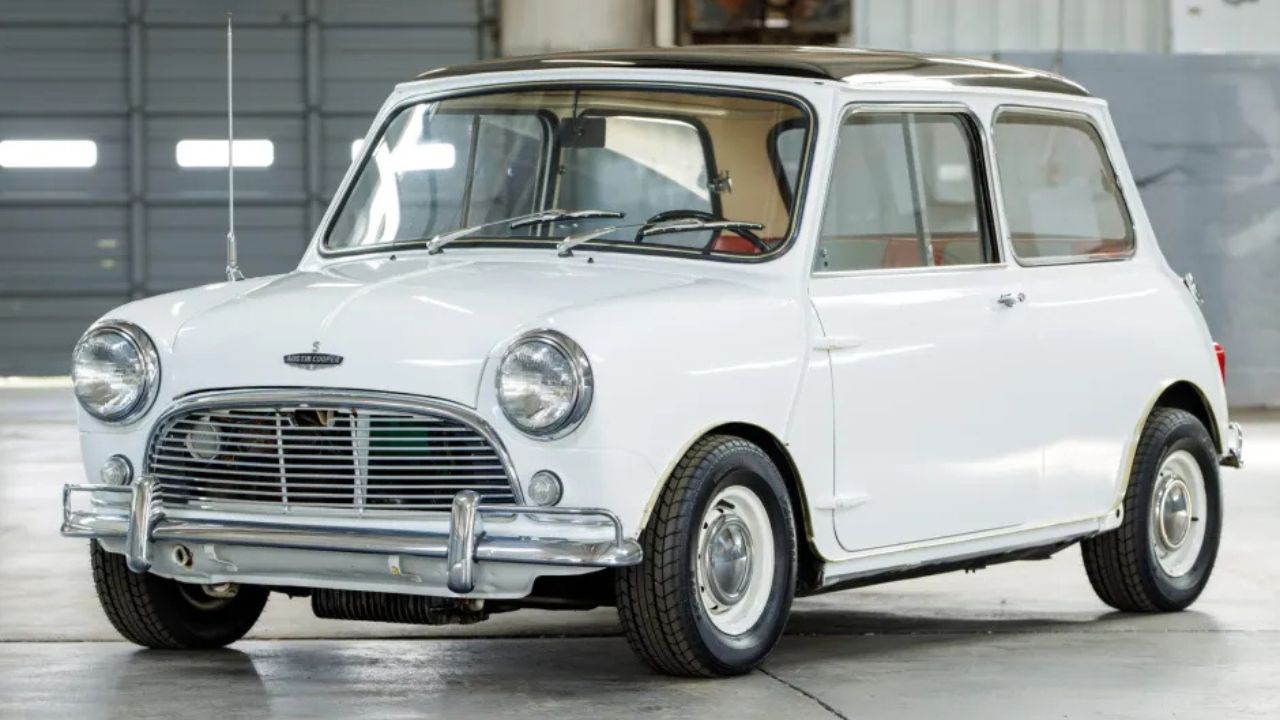
The 1964 Mini Cooper S looked like the car left behind in the paddock car park, not the one destined to set the pace on icy mountain stages. Yet this small, upright city runabout repeatedly embarrassed larger, more powerful machinery and turned rallying into a story of agility over brute force. Its victories did more than fill a trophy cabinet; they rewrote expectations of what a compact front-drive car could do at the limit.
What began as a humble urban commuter became a motorsport benchmark once racing engineer John Cooper turned his attention to the tiny saloon. By the time the 1964 Mini Cooper S hit the stages, the car had evolved into a precision tool that thrived where others struggled, from the streets of Monte Carlo to the snowbound passes above the Mediterranean.
From city traffic to special stages
The original Mini was conceived as a practical answer to congested streets and fuel-conscious driving, a tiny footprint wrapped around a transverse engine and front-wheel drive. A later factory celebration described how a tiny city car, the Mini Cooper S, was humbly built for everyday urban driving before being transformed by the visionary engineer John Cooper into a competition weapon, a transformation still highlighted in modern tributes to the Mini Cooper.
Cooper saw performance potential in the car’s unusual layout. The short wheelbase and wheels pushed to the corners created a stable platform, while front-wheel drive offered traction on loose or slippery surfaces. His upgrades focused on extracting more power from the compact engine, strengthening brakes and suspension, and tailoring gearing for rally use. The result was the Mini Cooper and, ultimately, the more potent Mini Cooper S that would define the brand’s competition legacy.
The 1964 Mini Cooper S: small car, serious hardware
By 1964 the Mini Cooper S had become the sharpest version of the range, built in 1275 cc form as the most powerful Mini of its time. Later brand material describes the Mini Cooper S 1275, produced from 1964 to 1971, as the top performance variant and the most powerful Mini of its era, a status still celebrated in modern references to The Mini Cooper as the definitive “small, but mighty” package.
Factory-prepared rally versions pushed the specification further. Detailed technical data on the 1964 Morris Mini Cooper S Works Rally car lists output at 52.2 kW with torque of 62.0 ft lbs at 4500 rpm, figures recorded in an In Detail specification table submitted by Richard Owen. On paper this left the Mini well short of the six-cylinder and V8 rivals it faced on Alpine climbs, yet the numbers only told part of the story.
The works cars combined that modest power with low weight, a compact footprint, and suspension tuned for rough surfaces. The Mini’s lightness meant less inertia under braking and direction changes, while the front-drive layout helped pull the car out of tight hairpins where rear-driven competitors struggled for grip on snow and ice.
Monte Carlo: where the MINI magic began
The defining chapter opened on the Monte Carlo Rally, a winter epic that mixed public-road liaison sections with timed stages through the Alps and along the coast. Official heritage material from the brand describes the 1964 event as the moment where the MINI magic began, recalling how the rally’s Monégasque finish line became the stage where when Patrick Hopkirk crossed the line and the whole racing world took notice of the WHERE THE MINI.
Monte Carlo was not a simple sprint. Another heritage account of the event’s format recalls how early rallies featured one of the most intense, stuff-of-legends stages of any race, a Bollène-Vésubie to Sospel section that traversed narrow, twisting mountain roads and punished cars that were heavy or unwieldy, a route still remembered in descriptions of the Boll Sospel challenge. In this environment, raw horsepower often mattered less than balance and traction.
Paddy Hopkirk’s breakthrough win
The turning point came when Paddy Hopkirk, driving a Mini Cooper S, secured victory at the Monte Carlo Rally and defied a field of significantly more powerful cars, a result later described as The Triumph at the Monte Carlo Rally. That win did more than add a line to Hopkirk’s résumé; it announced that the compact British car had become a serious threat in international motorsport.
Official corporate history describes how the classic Mini won the Monte Carlo Rally for the first time in January 1964 and how the achievement quickly took on legendary status. A retrospective from Munich and Monte Carlo recalls a small car with a huge win and marks how that first victory turned the one-off British small car into a motorsport legend, with the text explicitly celebrating the event as a big victory for the small car and noting that it is now 50 years since that breakthrough, a milestone still associated with the figure 50.
Another official commemoration of the same event describes January 1964 as a historic victory for the classic Mini at the Monte Carlo Rally, again linking Munich and Monte Carlo and stressing how those days mark the 60th anniversary of the breakthrough, with the text referring to the moment as a Historic win for the Mini at the. The language underlines how quickly the result moved from current news to enduring legend.
Why the Mini was so fast where others struggled
The conditions at Monte Carlo played directly into the Mini’s strengths. A later reflection on Paddy Hopkirk’s win notes that icy conditions and narrow roads proved a considerable advantage for the small, front-drive Mini and even quotes the driver describing how the French plows left snow in the middle of the road that the Mini could straddle while heavier cars had to fight it, a perspective preserved in analysis of how Icy stages favored.
Where large sedans and coupes wrestled with understeer and wheelspin, the Mini Cooper S could place its compact chassis precisely between snowbanks and brake far later into hairpins. The car’s low center of gravity reduced body roll, and its short gearing let the modest engine stay on the boil. On twisty climbs and descents, outright speed on straights mattered less than how quickly a car could change direction, and in that metric the Mini excelled.
The same advantage translated beyond Monte Carlo. Technical and historical accounts of the 1964 Morris Mini Cooper S Works Rally car describe how drivers such as Timo Makinen used the car’s balance to full effect. One period recollection notes that Makinen, facing a challenging event, put in an amazing performance in his Cooper S and achieved the fastest time in three out of four stages, a feat still associated with the factory-prepared Morris Mini Cooper. The pattern repeated across rallies: on complex, technical sections, the small car often set the pace.
From David vs Goliath to serial winner
By the mid 1960s the Mini was no longer a curiosity in rally service but a benchmark. A later retrospective describes how it became clear that the classic Mini was better equipped than any other car to pull off the classic David vs Goliath act, crediting John Coope with helping the car shock the world by winning the Monte Carlo Rally and explicitly framing the upset as a modern David versus Goliath story, language that still appears in assessments of the Mini as David.
The 1964 victory did not stand alone. The same corporate history that marks the first win as a big victory for the small car also records that Timo Maekinen and Rauno Aaltonen repeated the triumph in 1965 and 1967, turning a single upset into a pattern of dominance on the same event. That consistency reinforced the message that the Mini Cooper S was not just lucky in one set of conditions but fundamentally suited to the demands of top-level rallying.
Later heritage storytelling leans into this narrative. A social media feature on the Monte Carlo Rally 1964 describes how the Mini, referred to as this little guy, used a 1.0 liter engine with 70-hp and 111 Nm of torque to accelerate from 0 to 100 km/h in just 7 seconds, with the text insisting that all of this performance came from a car that still looked like a city runabout, a description preserved in a modern look back at how the Mini delivered 70-hp while keeping its humble appearance.
How the Mini ended up at Monte Carlo
The path from city car to Alpine rally winner was not inevitable. A later narrative on the event explains How The Humble Mini Cooper Won The Monte Carlo Rally Ahead Of Significantly More Powerful Cars and traces How The Mini Ended Up At Monte Ca, describing how the car’s unusual layout and low cost made it an attractive platform for tuners who saw potential beyond commuting, a story preserved in analysis of How The Humble.
John Cooper’s involvement proved decisive. His racing experience guided engine tuning, braking upgrades, and suspension geometry that could withstand long-distance punishment. Once the British Motor Corporation competition department committed to a works program, the Mini Cooper S gained factory backing, dedicated mechanics, and test mileage that transformed it from an enthusiastic privateer’s choice into a fully developed rally car.
One veteran of that competition department later recalled how time with the BMC competitions team involved racing big Austin Healeys and later racing at Le Mans in an MG, before turning to the Mini and discovering that the small car could be hustled just as hard on demanding events, a memory captured in a personal account of BMC and the. That crossover of experience from larger sports cars into the Mini program helped ensure the small saloon was prepared to the same standards as more glamorous machinery.
Technical ingenuity behind the legend
Even stripped of romance, the engineering behind the 1964 Mini Cooper S explains much of its success. The transverse engine and gearbox-in-sump layout shortened the drivetrain, which allowed the wheels to be pushed to the corners. This maximized interior space for road use but also produced a long wheel track relative to the car’s length, which aided stability on rough surfaces.
Front-wheel drive, still unusual in performance cars of the period, gave the Mini a traction advantage on slippery climbs. With the engine’s weight over the driven wheels, the car could pull itself out of slow corners where rear-drive rivals spun their inside wheels. Combined with relatively soft suspension and high-profile tires, the Mini could absorb bumps and maintain contact with the road on broken surfaces that unsettled heavier cars.
Power figures such as 52.2 kW and 62.0 ft lbs might look modest beside the outputs of period sports cars, yet the Mini’s low mass meant that each kilowatt had less weight to move. Short gearing, particularly in rally trim, traded top speed for acceleration, which suited tight Alpine stages where long straights were rare.
More from Fast Lane Only