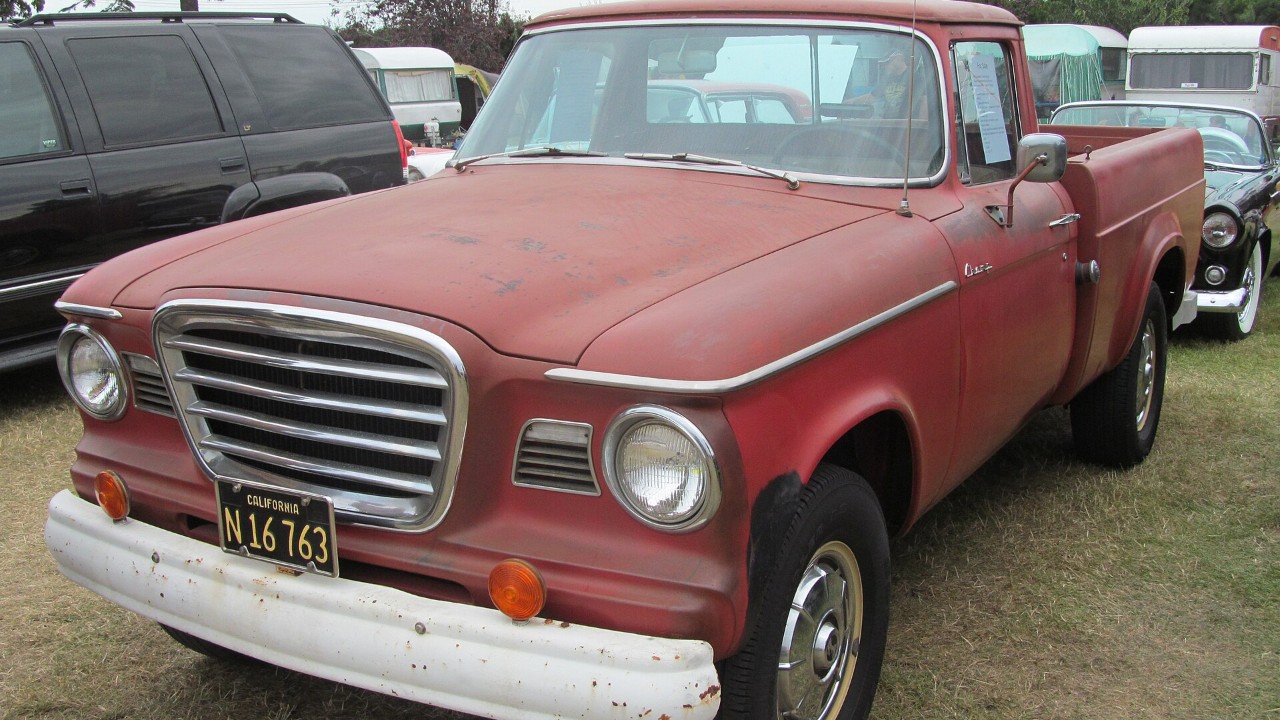
The Studebaker Champ looked like a new truck in 1960, but most of it was not new at all. Its cab was the front half of a Lark compact sedan, closed off with a fresh rear wall. Studebaker reportedly did it on a budget of about $900,000.
That number explains almost every choice on the truck. Studebaker could not afford a clean-sheet pickup, so it borrowed from the car it already had and from the truck it had been selling since 1949.
The result ran from 1960 to 1964. It was the last pickup Studebaker ever built, and it remains one of the more clever bits of thrift in American truck history.
How the Studebaker Champ got a $900,000 budget
Studebaker was short of money by the late 1950s. A Hagerty Marketplace history of the Champ says the company had been in financial trouble since the mid-1950s. It adds that the design department reportedly had only $900,000 to make the pickup look newer.
Other accounts give the same figure. Autoevolution describes it as a small budget of $900,000 for the project. A Carsforsale.com history calls it a “shoe-string budget of $900,000.”
The need was real, too. Autoevolution reports that Studebaker sold fewer than 8,000 trucks in 1959, the year before the Champ arrived.
Half a Lark, plus a new back wall
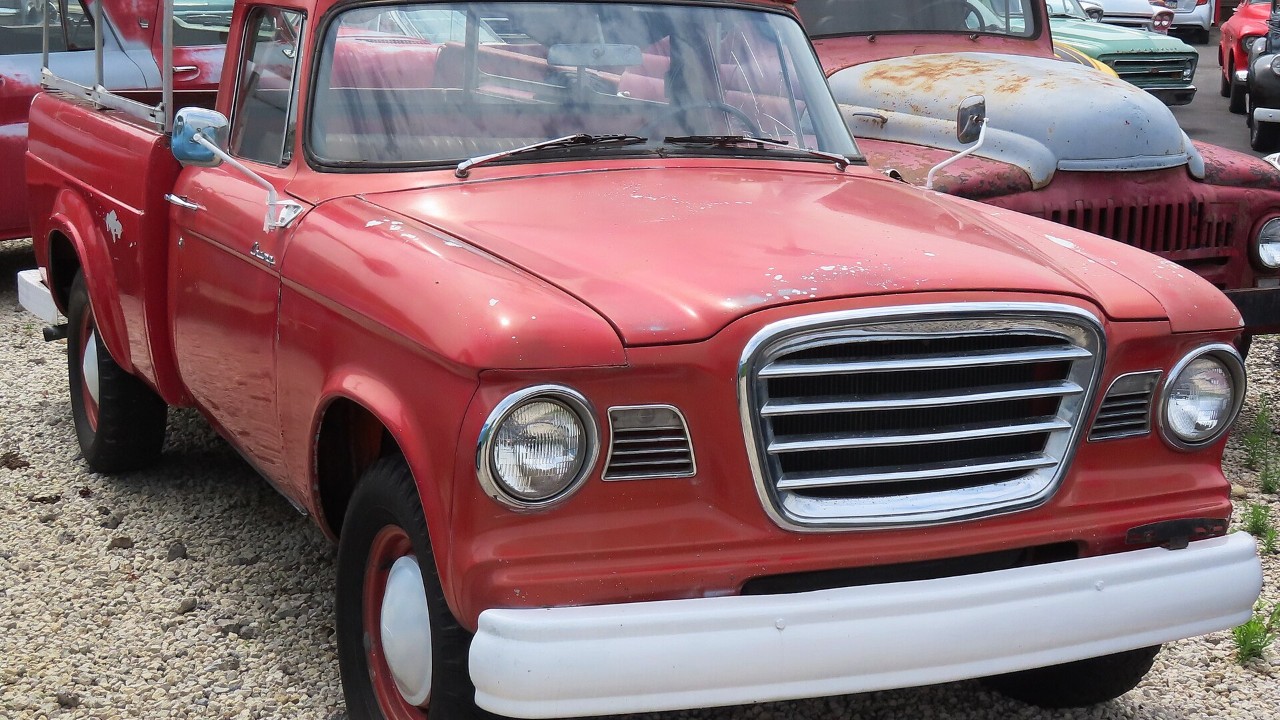
The fix was to cut up a car. Autoevolution describes the Champ cab as “pretty much half of a Lark four-door sedan with a new back wall.”
Mac’s Motor City Garage lists what came across. The doors, cowl, instrument panel and front clip were all Lark parts, and the site credits design chief Duncan McRae with the conversion. Then a closeout panel sealed the back of the cab.
The car parts needed some help to sit on a truck. Carsforsale.com notes that the Champ used larger bumpers, mounted lower to suit the higher ride height. It also says the sealed rear panel carried a sliding rear window, which it calls the first such window in a U.S. production pickup.
The old truck underneath
Below the cab, the Champ was mostly familiar. Mac’s Motor City Garage says the bubble-fendered bed, the chassis and the running gear all carried over from the pickup line that Studebaker introduced in 1949. Hagerty adds that the chassis came from the earlier 2R and 3E trucks.
The engines carried over too. For 1960, Mac’s lists two L-head sixes, a 170-cubic-inch unit with 90 horsepower and the 245-cubic-inch “Big Six” with 118 horsepower. Buyers could also pick a 259 V8 with 180 horsepower or a 289 V8 with 210 horsepower.
Some things the budget never covered. Mac’s notes that Studebaker offered half-ton and three-quarter-ton models on 112-inch and 122-inch wheelbases. Power steering, however, was never on the options list.
Even the name was borrowed. Mac’s says it came from the Champion passenger car, and Studebaker sold the truck with the slogan “tougher than the job.”
A bed bought from Dodge
The thrift did not stop after launch. For 1961, the 170 six switched to overhead valves and 112 horsepower, while the Big Six was dropped, according to Mac’s Motor City Garage.
That year also brought a new cargo box. Carsforsale.com says Studebaker bought tooling from Dodge, which had used it for the 1958–60 Sweptline. Studebaker called the result the Spaceside. However, the bed and the cab never quite matched in width, as both Mac’s and Carsforsale.com point out.
What the Champ sold for, then and now
Studebaker leaned hard on price. Hagerty quotes a period ad that called the Champ “the newest American truck on the road today” and also “the lowest priced,” with a starting price of $1,875.
Sales held up for a while. Mac’s Motor City Garage puts output at more than 5,000 in most years, with a peak of 7,325 in 1962. Autoevolution counts 6,592 trucks for 1961.
Then the money ran out. Mac’s says Studebaker closed its South Bend plant in December 1963 and moved car building to Hamilton, Ontario. The trucks did not make the trip, so the 1964 Champ was the last. Mac’s and Carsforsale.com both put that final model year at 2,509 trucks.
Surviving Studebaker Champ pickups are still affordable. On June 13, 2024, a 1960 Champ with the 170 six and a three-speed manual sold on Hagerty Marketplace for $13,375, with no reserve and in need of mechanical work.
More from Fast Lane Only