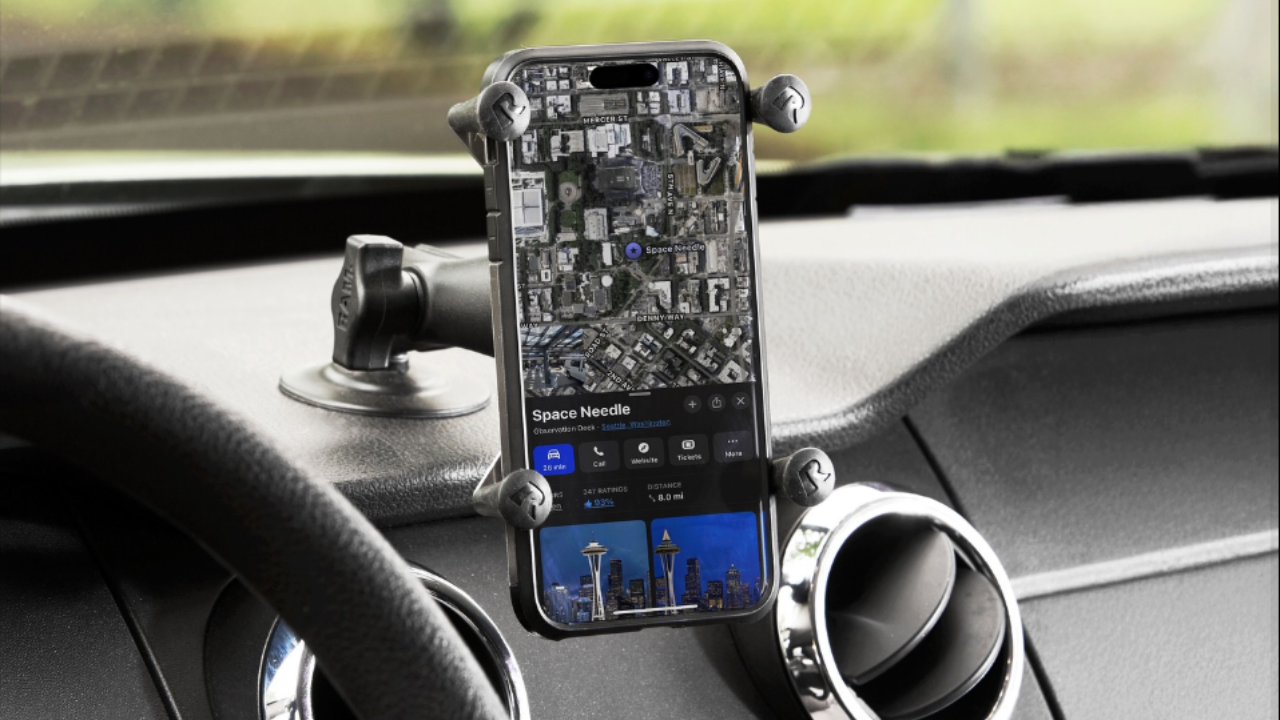
Your phone mount may feel like a safety upgrade, but in much of the country it is actually a legal liability stuck to your glass. States have quietly tightened rules on what can sit on your windshield, and the result is that a simple suction cup can put you on the wrong side of traffic law even if you never touch your screen. If you rely on Google Maps, Waze, or Apple Maps to get around, it is worth understanding where that little disc is allowed and where it could cost you a ticket.
The rules are not intuitive. Some states ban almost anything on the glass, others carve out tiny “safe zones,” and a few focus more on how you use the phone than where you stick it. The upshot is that you cannot assume your setup is legal just because you bought it from a big-box retailer or saw it in a rideshare car.
Why so many states treat windshield mounts as a problem
Traffic law has long treated the windshield as sacred real estate, and the logic is simple: anything that blocks your view, even a few inches of plastic, can hide a pedestrian or a motorcycle at the worst possible moment. That is why broad obstruction rules exist in a large share of the country, and why a suction cup that seems harmless in your compact SUV might be treated as a violation in a neighboring state. Earlier guidance shared by Apr, Tue, From Pro, Clip AND and POI, Factory noted that restrictions on windshield devices touch roughly 70 percent of the United States, a reminder that the default in many jurisdictions is to keep the glass as clear as possible.
Those rules are not just theoretical. A detailed breakdown of state limits shows how often lawmakers frame the issue as one of obstruction rather than technology, which means your mount is treated the same way as a parking placard or a novelty ornament. When you add in distracted driving campaigns that target any behavior that might pull your eyes off the road, the suction cup becomes an easy enforcement hook, even if you think it is making you safer by keeping your hands off the device.
The states where a suction cup on the glass is flat-out illegal
Some jurisdictions do not leave much room for interpretation. Lists of States, Which Suction Cup Windshield Mounts Are Illegal include Alabama, Arkansas, Connecticut, and Delaware, where statutes treat almost any object on the glass as a prohibited obstruction. In these places, the law is written broadly enough that a suction cup holding an iPhone 15 or a budget Android is treated no differently from a cardboard sign taped to the windshield, and officers do not have to prove you were actively using the phone to write a citation. The guidance for these states typically urges drivers to mount devices as low and as far to the edge of the windshield as possible, but the underlying message is that the glass is the wrong place entirely.
Even where the language looks similar on paper, the fine print can change what is allowed. Certain rules, flagged under headings like Certain qualifications of these devices differ from state to state, make clear that you need to check what your own legislature has decided before assuming a universal standard. In California, for example, the law allows limited mounting in specific lower corners, while other states such as Flo, which appears in the same set of notes, may treat the same setup differently. That patchwork is why relying on a generic “fits any car” claim on the box is risky, and why you should read your own code instead of trusting a product photo.
When the law gets murky: partial bans, odd carve-outs, and confusing language
Once you move beyond the outright bans, the rules get messy. Some states allow windshield mounts only for certain devices, such as GPS units, or only in tightly defined zones measured in inches from the top or bottom of the glass. A widely shared explainer on suction cup rules notes that other states restrict the type of device or the exact placement, citing provisions like [56-5-5000] to show how granular the statutes can be. For drivers, that means a mount that is legal for a small navigation puck might not be legal for a large smartphone, even if it uses the same suction cup.
Some states also spell out their bans with chapter-and-verse precision. Alabama, for instance, ties its obstruction rule to section 32, 215, while Colorado uses 42, 201, and Connecticut relies on Sec 14-99f with cross-references such as Also see Subsec (c). Those citations, collected in one place for Alabama, Colorado, and Connecticut, underscore how lawmakers have tried to anticipate every possible gadget that might end up on the glass. For you, the driver, the effect is that the legality of your mount can change the moment you cross a state line, even if your driving behavior does not.
Hands-free laws, federal rules, and why “everyone does it” is not a defense
Complicating matters further, many states have layered hands-free phone rules on top of windshield obstruction laws. A popular guide for shoppers notes that Most states prohibit “holding” or “supporting” a mobile device while driving, but that window mounts are sometimes treated as an exemption only when they comply with separate obstruction rules. In other words, a suction cup might help you satisfy the hands-free requirement while simultaneously violating the visibility standard, leaving you technically compliant with one law and in trouble under another. That tension is why you see so much confusion in online forums and at the counter in accessory shops.
At the federal level, regulators have focused more on commercial vehicles, but their approach still shapes what is considered reasonable. Updated guidance on dash cameras and similar gear explains that the revised rule permits devices like GPS units to be mounted up to 8.5 inches below the upper edge of the windshield, and only within a narrow band of the driver’s line of sight. While that rule applies to trucks and buses, it reflects a broader safety philosophy that anything on the glass should be tightly controlled. None of the federal rules give you a free pass in your personal car, but they do show why a trooper might look skeptically at a large phone floating in the center of your field of view.
Real-world enforcement: from Maine to Ohio to New Jersey
The abstract rules become very real when you look at how they are enforced on the road. In Maine, local coverage under the banner Aug and Another Thing It Is Illegal To Do In Your Car With Your Cell Phone has warned that You may be breaking the law simply by sticking a device to the windshield, even if you never tap the screen while moving. That kind of messaging reflects how officers often use visible violations, such as an illegal mount, as a starting point for broader distracted driving stops, especially in areas where cellphone crashes have become a political flashpoint.
Other states have updated their laws more recently. Ohio, for example, rolled out a Phone Down campaign alongside a new distracted driving statute and has explicitly clarified that it does not allow the use of windshield mounts for phones or similar devices. That means a driver cruising through Columbus with a suction cup holding a navigation app is now a clear target for enforcement, even if they believe they are driving more safely by avoiding handheld use. In New Jersey, local radio has asked bluntly, Have You Been Putting Yourself At Risk With a Suction Cup Mount, warning that a lot of New Jersey drivers have been at risk of getting pulled over for cellphone distractions and a citation simply because of where they placed their hardware.
More from Fast Lane Only