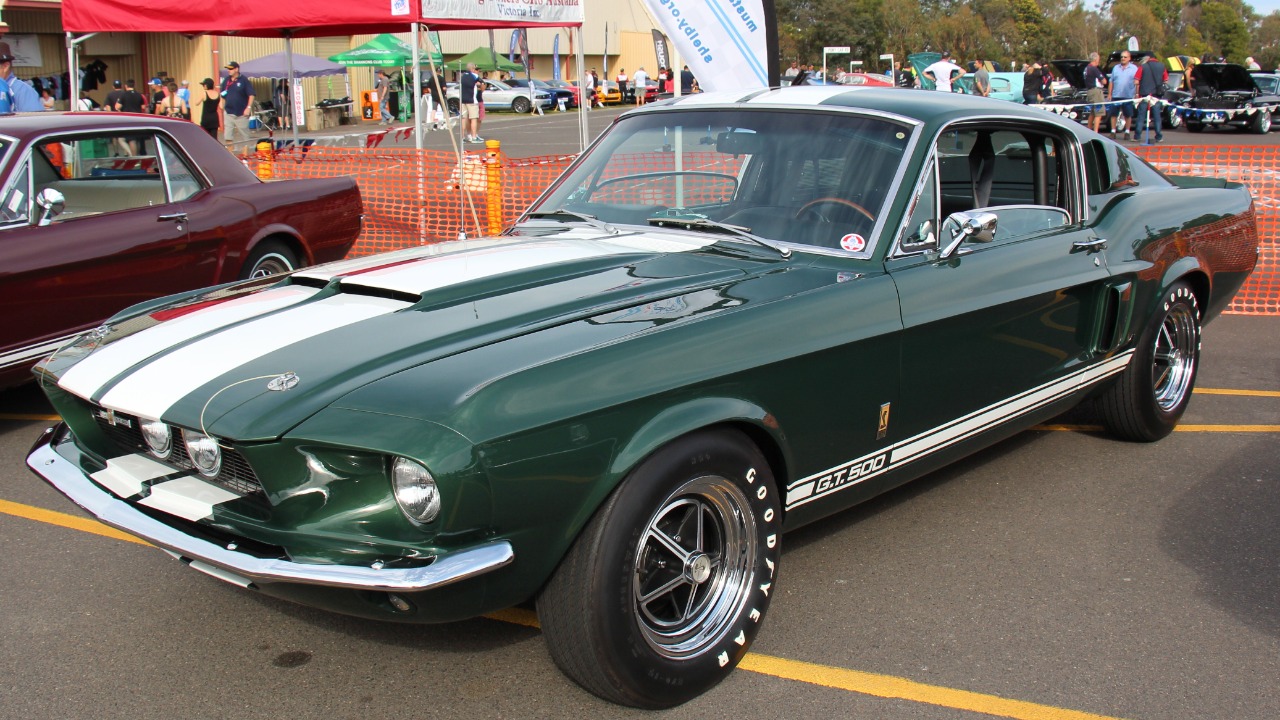
By 1967, Ford’s pony-car fight wasn’t just about looks or straight-line speed anymore. Buyers wanted bragging rights, but they also wanted something that felt more grown-up and more effortless on the street. That’s the backdrop for why Shelby offered two distinct flavors of Mustang performance—and why one of them needed more cubic inches.
The GT350 had already earned a reputation as a sharp-edged driver’s car. But the market was shifting quickly, and rivals were showing up with bigger-displacement V8s and louder spec sheets. Shelby’s answer wasn’t to replace the GT350’s mission; it was to add a higher rung for customers who wanted more power with less drama.
Two cars, two jobs
It helps to think of the GT350 and GT500 as aimed at different kinds of enthusiasm. The GT350 leaned into balance and responsiveness, built around a lighter, more rev-happy small-block approach for the era. The GT500 was positioned as the heavyweight—still sporty, but meant to deliver stronger acceleration with a more relaxed, muscular feel.
That split mattered because a single “best” engine doesn’t exist for every use case. If you’re chasing a nimble front end and quick turn-in, keeping weight down is part of the equation. If you’re chasing effortless speed and highway-passing punch, torque and displacement start to look like the smarter tool.
What “bigger” really meant in 1967
The 1967 GT350 used a 289 cubic-inch V8, while the GT500 moved up to Ford’s 428 cubic-inch big-block. That’s not a minor step; it’s a fundamental change in character. Bigger engines of that period generally delivered more low- and mid-range torque, which is what you feel when you roll into the throttle at everyday speeds.
On the street, that torque can matter more than headline horsepower. It makes the car feel strong without needing to be wrung out. The GT500’s larger displacement was a direct way to deliver that kind of performance using the technology of the time.
The marketplace pushed Shelby upward
Mid-’60s performance was an escalation game. Chevrolet, Pontiac, and others were selling increasingly serious muscle with larger engines, and buyers were learning to shop by cubic inches. A GT350 was quick and well-known, but it risked looking outgunned on paper as displacement numbers climbed across the industry.
The GT500 gave Shelby a clear answer for customers who wanted “the most.” It created a step-up model that could compete in the showroom conversation before anyone even turned a key. That mattered because perception and prestige were part of what made these cars sell.
Torque changed how the car drove
A bigger engine wasn’t just about winning stoplight races. The additional torque from a big-block made the car feel more effortless in normal driving—merging, passing, climbing grades, or pulling from low speeds without a downshift. That’s a different kind of satisfaction than a smaller engine that likes to rev and rewards a more active right foot.
It also suited a grander, more substantial personality. The GT500’s point wasn’t to mimic the GT350’s vibe; it was to give drivers a Mustang that felt like it had deep reserves. For a lot of owners, that “always on tap” feel was the reason to spend more.
Packaging and balance were real trade-offs
Dropping a big-block into a Mustang-sized engine bay was never a free upgrade. Big-blocks typically weigh more than small-blocks, and that can affect steering feel and weight distribution. Shelby and Ford had to manage those compromises while still delivering a car that felt special, not clumsy.
That trade-off is part of the reason the two models could coexist instead of one replacing the other. The GT350 could keep appealing to drivers who valued a lighter nose and a more tossable character. The GT500 could lean into straight-line strength and a more commanding, muscular demeanor.
It fit the GT500’s role as the range-topper
Shelby wasn’t just selling performance; he was selling a hierarchy. Having a flagship model meant it needed a clear mechanical and emotional advantage over the GT350. In the 1960s, the simplest and most convincing way to do that was with a larger engine.
That bigger-displacement identity also made the lineup easier to understand. GT350 signaled the classic Shelby recipe, while GT500 signaled more of everything—especially shove. The engine choice helped draw that line without a long explanation from the salesperson.
Why Shelby didn’t just “tune” the smaller engine instead
Could a smaller engine be tuned to run harder? Sure, and the GT350 already benefited from performance-focused thinking. But there are limits to what you can accomplish while keeping street manners, durability, and a broad powerband that feels strong everywhere. Displacement is the straightforward path to more torque without demanding sky-high rpm.
That mattered in an era when drivability and refinement were becoming selling points even in fast cars. A big-block could deliver strong performance without feeling peaky. For buyers who wanted speed with less fuss, the larger engine was a practical answer, not just a marketing flex.
It also reflected how people actually used these cars
Not everyone bought a Shelby to chase apexes. Plenty of owners wanted something that looked aggressive, sounded serious, and surged forward with minimal effort—often on regular roads, not racetracks. A larger engine complements that kind of use because it doesn’t require constant shifting to stay in the sweet spot.
That’s also why the GT350 remained relevant. Some drivers wanted the more involved, responsive feel of the smaller-engine approach. Shelby’s decision to offer the big-block GT500 alongside it acknowledged that “fast” can mean different things depending on the person behind the wheel.
The bigger engine was a strategic choice, not a random escalation
From today’s perspective, it’s easy to reduce the difference to a simple numbers game. But in 1967, the larger engine supported a specific goal: create a flagship Mustang-based Shelby with stronger real-world pull and a clear place at the top of the lineup. The GT350 and GT500 weren’t redundant—they were complements.
That’s the real reason the GT500 went bigger. It wasn’t because the GT350 was lacking; it was because Shelby needed a model that answered the era’s appetite for torque, prestige, and effortless speed in one unmistakable package.
More from Fast Lane Only
- Unboxing the WWII Jeep in a Crate
- 15 rare Chevys collectors are quietly buying
- 10 underrated V8s still worth hunting down
- Police notice this before you even roll window down
*Research for this article included AI assistance, with all final content reviewed by human editors.