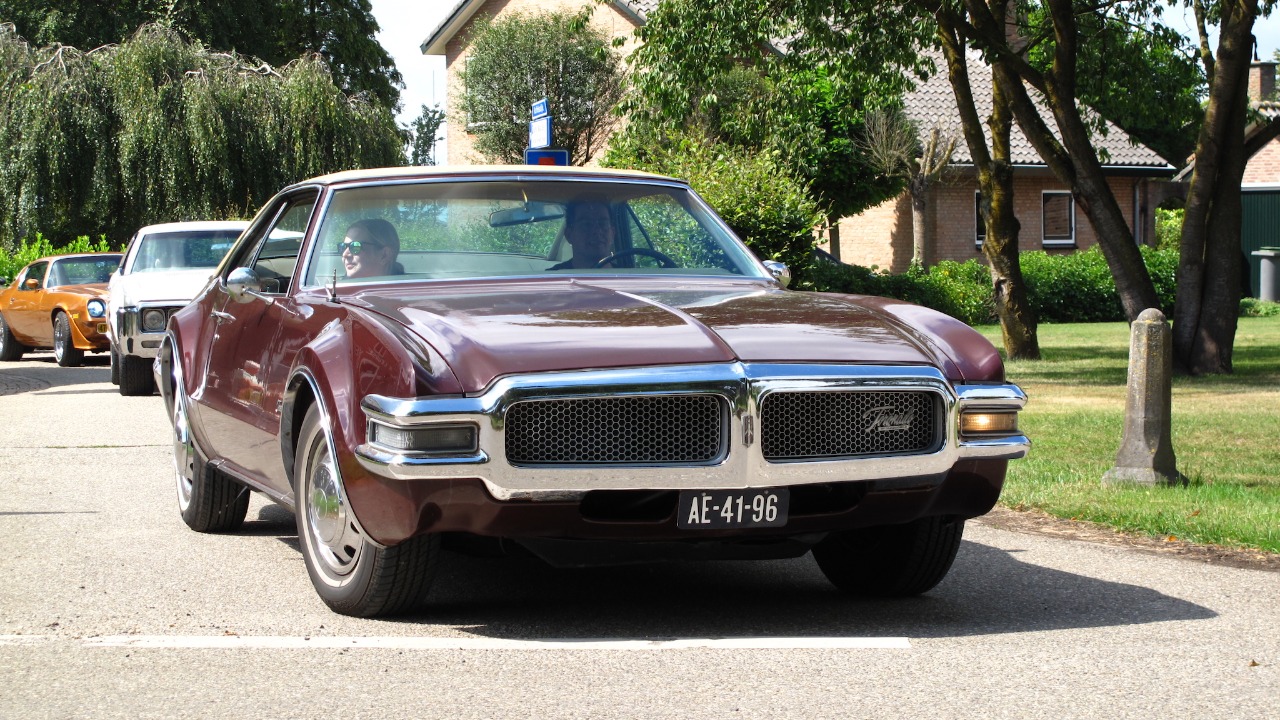
The 1968 Oldsmobile Toronado arrived as a confident refinement of one of Detroit’s boldest experiments: a big-block, front-wheel-drive personal luxury coupe. It carried forward radical engineering choices that had stunned the industry only two years earlier, while addressing some of the rough edges that came with putting so much power through the front axle. The car embodied both the promise and the limits of American innovation in the late 1960s, where packaging brilliance met the realities of weight, cost, and changing buyer expectations.
Viewed today, the 1968 Toronado stands at a crossroads between futuristic drivetrain ideas and traditional full-size American comfort. Its engineering solutions solved specific problems yet introduced new compromises in handling, efficiency, and long-term durability that helped shape how front-wheel drive would evolve in the decades that followed.
The radical front-wheel-drive layout
The Toronado’s signature engineering feature was its front-wheel-drive layout in a full-size, V8-powered coupe. Oldsmobile did not simply rotate an existing drivetrain. Engineers created a compact package that allowed a massive 425 cubic inch V8 to drive the front wheels while preserving a low floor and sleek body proportions. This layout, marketed as the Unitized Power Package, stacked key components in line with the crankshaft, then turned power sideways to the transaxle through a chain drive.
Unlike earlier American experiments with front-drive luxury, Oldsmobile’s system was designed for mass production and everyday use. The engine sat longitudinally, with the transmission positioned alongside it, and a chain-driven transfer arrangement connecting the two. That configuration allowed the Toronado to retain the long-hood, short-deck profile personal luxury buyers expected, while eliminating the conventional driveshaft hump that intruded into cabin space on rear-drive cars.
On paper, the configuration promised better traction in poor weather, more interior room, and a smoother floor for front passengers. In practice, the packaging was a clever workaround to the problem of fitting a large-displacement engine and automatic transmission ahead of the firewall without stretching the wheelbase to unwieldy lengths. The design also simplified assembly, since the entire power unit could be built as a self-contained module.
The Unitized Power Package and chain drive
The heart of the Toronado’s engineering story lay in the Unitized Power Package, or UPP. Instead of a traditional torque tube or driveshaft, power flowed from the crankshaft through a heavy-duty chain to the Turbo-Hydramatic transaxle. This chain, running in an enclosed housing, allowed the engine and transmission to sit side by side while still delivering torque to the front differential.
Oldsmobile engineers relied on a wide, high-strength chain to handle the torque output of the big-block V8. Its design aimed to balance durability with compactness, avoiding the bulk of gearsets that would have added weight and complexity. This packaging also helped keep the engine relatively low in the chassis, which aided hoodline styling and forward visibility.
There were trade-offs. The chain drive introduced an additional wear component that required meticulous lubrication and robust materials. Under heavy use, or if maintenance was neglected, the chain and associated components faced higher stress than a conventional rear-drive shaft and differential. The UPP’s complexity also meant that major drivetrain repairs could be more involved than on a conventional layout, since the power unit was tightly integrated.
Big-block power and torque steer
Powering the 1968 Toronado was Oldsmobile’s 455 cubic inch V8, an evolution of the earlier 425 that had launched the model. The engine delivered abundant torque at low rpm, a key selling point for a luxury coupe that needed effortless acceleration and quiet cruising. In a rear-drive car, that torque would have been shared between a driveshaft and rear axle. In the Toronado, it went almost directly to the front wheels.
Feeding so much torque through the front axle created a classic front-drive issue: torque steer. Under hard acceleration, unequal half-shaft angles and compliance in the suspension and steering could cause the car to pull to one side. Oldsmobile engineers worked to mitigate this with equal-length half-shafts, careful geometry, and a robust front suspension, but the sheer output of the 455 meant that some steering tug remained when the driver floored the throttle.
Contemporary testers praised the Toronado’s straight-line speed and smoothness, yet they also reported that aggressive acceleration required a firm grip on the wheel. The car’s power delivery rewarded relaxed, confident driving more than sudden full-throttle bursts. For buyers used to big American coupes, the behavior felt acceptable, but it highlighted a fundamental limitation of combining large-displacement V8 power with front-wheel drive.
Suspension, handling, and weight distribution
The Toronado’s chassis had to cope with both the weight of the powertrain over the front axle and the demands of a luxury ride. Engineers chose a torsion-bar front suspension paired with a rear setup tuned for comfort. The car’s weight distribution skewed heavily toward the nose, which influenced both handling balance and braking behavior.
On smooth highways, the Toronado delivered the kind of isolation buyers expected from an upscale Oldsmobile. The front suspension carried the burden of the engine and transaxle while still filtering out road harshness. When pushed on winding roads, however, the car displayed pronounced understeer. The front tires were responsible for steering, power delivery, and most of the braking load, and the heavy nose resisted quick changes of direction.
This front-biased layout also affected braking feel. Under hard stops, the front end did most of the work, which could place greater fade-resistance demands on the front brakes and increase wear. Oldsmobile addressed part of this with sizable front drums initially and later with available disc brakes, but the underlying physics of a front-heavy, front-drive layout limited how agile and responsive the car could feel compared with lighter, rear-drive competitors.
Interior packaging and comfort gains
One of the Toronado’s clear advantages came inside the cabin. By removing the rear driveshaft and live axle, Oldsmobile created a flatter floor and improved legroom, especially for front passengers. The absence of a transmission tunnel allowed a more open seating arrangement and easier ingress and egress, which aligned with the car’s role as a personal luxury coupe.
The low floor also contributed to a feeling of spaciousness. Designers could drop the seating positions slightly while preserving headroom under the sweeping roofline. That helped the Toronado deliver a lounge-like environment, with wide seats and generous shoulder room that matched the expectations of buyers who might also be considering large rear-drive coupes from Buick or Chrysler.
Packaging gains came with some subtler drawbacks. The concentration of mass at the front made the rear of the car feel lighter over rough surfaces, which could translate into a slightly busier ride for rear passengers. The flat floor, while comfortable, did not fully offset the sense of heft that came from the car’s overall size and weight. The Toronado felt substantial and secure, but not especially nimble, a trade-off that reflected Oldsmobile’s priorities at the time.
Styling, aerodynamics, and mechanical realities
The Toronado’s exterior design was as bold as its engineering. The long hood, hidden headlamps, and sweeping fenders gave it a futuristic presence that stood apart from more conservative coupes. Clean flanks and a relatively low roofline hinted at aerodynamic thinking, although the car’s broad frontal area and squared-off rear still reflected the styling tastes of the era more than any wind-tunnel obsession.
Styling choices influenced engineering details. The low hoodline required careful packaging of the engine and ancillary components, which the front-drive layout helped enable. Designers also used the absence of a rear axle hump to create a lower, more cohesive rear deck. At the same time, the emphasis on visual drama added weight in the form of heavy body panels, extensive trim, and complex front-end mechanisms such as the hidden headlamp doors.
These elements contributed to the Toronado’s substantial curb weight. Combined with the big-block V8 and front-drive hardware, the car’s mass affected fuel consumption and acceleration feel. While performance remained strong for the period, the car’s efficiency lagged behind smaller, lighter competitors. The styling succeeded in making a statement, but it also locked in a set of mechanical compromises that engineers had to work around rather than fully control.
Comparisons with the 1966 original
The 1968 Toronado did not exist in isolation. It followed the groundbreaking 1966 model, which had introduced the UPP and front-drive concept to the American market. That earlier car had drawn attention for its daring layout and the way it packaged a 425 cubic inch V8 with a front transaxle, as described in contemporary evaluations of the 1966 Toronado. By 1968, Oldsmobile had the chance to refine the formula based on real-world feedback.
Changes for 1968 included updates to the engine family, detail revisions to the suspension, and incremental improvements in noise and vibration control. The basic architecture, however, remained the same. The big front-drive power unit, the torsion-bar front suspension, and the overall size and weight carried over. In that sense, the 1968 car represented evolution rather than revolution.
Compared with the 1966 original, the later Toronado felt more polished and better insulated from mechanical harshness. Yet the fundamental limitations of the concept persisted. The car still faced torque steer under hard acceleration, still carried a front-heavy weight distribution, and still consumed fuel at a rate that reflected its displacement and mass. The refinements made the car more livable, but they did not transform its underlying character.
Reliability, serviceability, and ownership trade-offs
For owners, the Toronado’s engineering choices influenced not just how the car drove, but how it aged. The integrated power package, with its chain drive and transaxle, required technicians to understand a layout that differed from the rear-drive norm. Routine maintenance could proceed much like on other Oldsmobile V8s, but deeper drivetrain work demanded familiarity with the UPP’s specific procedures.
The chain drive, while designed for long life, introduced another component that could suffer from wear if lubrication or adjustment fell behind. The front suspension and steering hardware also endured higher loads than on a comparable rear-drive car, since they had to manage both propulsion and directional control. Over time, this could translate into more attention to front-end components such as ball joints, bushings, and steering linkages.
These factors did not doom the Toronado to unreliability, but they did shape the ownership experience. Buyers who followed maintenance schedules and worked with knowledgeable service departments could enjoy the benefits of the front-drive layout with relatively few issues. Those who treated the car like any other full-size coupe, ignoring the specific demands of the UPP, were more likely to encounter expensive repairs. The complexity that made the Toronado innovative also raised the stakes when things wore out.
Legacy and influence on later front-drive cars
The 1968 Toronado’s engineering story did not end with its production run. The car demonstrated that front-wheel drive could handle big-car duties in the American market, even with large-displacement V8 engines and automatic transmissions. It proved that a domestic manufacturer could package a complex drivetrain in a way that felt seamless to the average driver, at least under normal conditions.
More from Fast Lane Only
- Unboxing the WWII Jeep in a Crate
- 15 rare Chevys collectors are quietly buying
- 10 underrated V8s still worth hunting down
- Police notice this before you even roll window down
*Research for this article included AI assistance, with all final content reviewed by human editors.