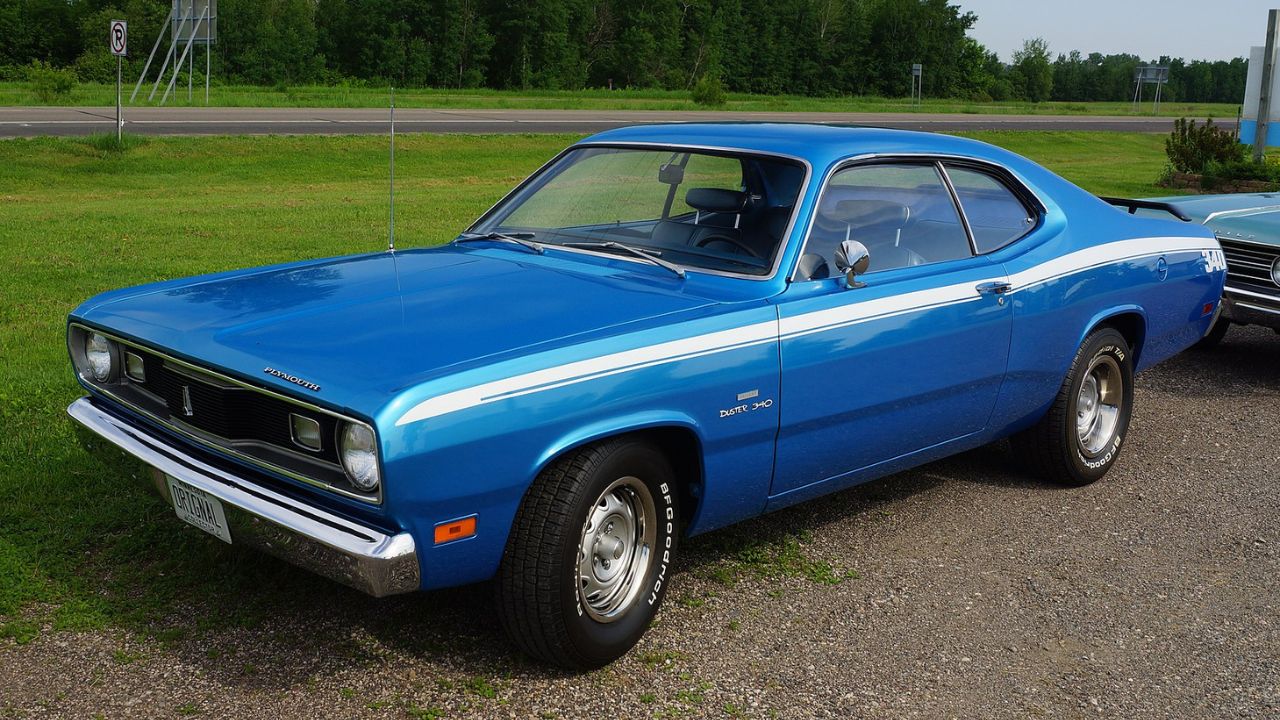
When most people think of classic muscle cars, they picture machines like the Dodge Charger, Plymouth Road Runner, or Chevrolet Chevelle SS. These cars were designed to look fast, with aggressive styling, bold graphics, and powerful engines proudly advertised on their hoods and fenders.
The 1970 Plymouth Duster 340 took a different approach.
At first glance, it looked like a simple compact coupe aimed at budget-conscious buyers. It lacked the imposing size of many muscle cars and didn’t carry the same intimidating presence as some of Detroit’s most famous performance machines. Yet beneath its modest appearance was a surprisingly potent combination of power, lightweight construction, and affordability that made it one of the quickest cars on the street.
In many ways, the Duster 340 became a classic example of a sleeper—a car that performed far better than its appearance suggested.
Plymouth Needed a Fresh Compact
By the late 1960s, Plymouth’s compact Valiant platform was showing its age. While dependable and affordable, it wasn’t generating much excitement among younger buyers.
To address the problem, Plymouth introduced the Duster for the 1970 model year. The new car shared much of its engineering with the Valiant but featured a sleek fastback roofline and sportier styling that helped modernize the compact platform.
The Duster was designed to appeal to a broad audience, offering everything from economical six-cylinder engines to high-performance V8 options.
The most exciting version would become the Duster 340.
A Serious Performance Engine
The heart of the Duster 340 was Chrysler’s respected 340 cubic-inch small-block V8.
Officially rated at 275 horsepower, the engine featured a four-barrel carburetor, high-flow cylinder heads, a performance camshaft, and a relatively high compression ratio. Many enthusiasts have long believed the factory horsepower rating was conservative, especially considering the engine’s real-world performance.
The 340 V8 loved to rev and delivered strong acceleration throughout the power band. Unlike some larger engines that focused primarily on low-end torque, the 340 combined flexibility with impressive top-end performance.
Buyers could pair the engine with either a four-speed manual transmission or a performance-oriented automatic, creating a compact car that could hold its own against much larger rivals.
Lightweight Equals Speed
One of the Duster 340’s greatest advantages wasn’t found under the hood—it was found in the car’s overall weight.
Compared to many intermediate muscle cars of the era, the Duster was significantly lighter. This meant the 340 engine had less mass to move, resulting in impressive acceleration and strong quarter-mile performance.
The combination proved remarkably effective.
While some competitors relied on massive big-block engines to achieve quick acceleration, the Duster often matched or exceeded their performance through a more balanced formula of power and lightweight design.
The result was a car that felt eager, responsive, and surprisingly fast.
Underestimated by Competitors
Part of the Duster 340’s appeal came from the fact that many people underestimated it.
Unlike high-profile muscle cars covered in stripes, scoops, and performance badges, the Duster maintained a relatively restrained appearance. Even though Plymouth added sporty trim and special graphics, it still looked more like an affordable compact coupe than a street racer.
That made the car particularly effective in stoplight contests and local drag races.
Drivers of larger muscle cars occasionally discovered that the seemingly ordinary Duster beside them was far quicker than expected.
This sleeper reputation became one of the model’s defining characteristics.
Affordable Performance
Another reason for the Duster 340’s success was its value.
Performance cars were becoming increasingly expensive by 1970, but the Duster offered impressive speed at a relatively affordable price. Buyers could enjoy strong V8 performance without stepping up to a larger and more costly intermediate muscle car.
This combination of affordability and capability attracted younger enthusiasts who wanted serious performance without stretching their budgets.
It was the same formula that had helped make vehicles like the Plymouth Road Runner successful, but now packaged in a smaller and lighter platform.
The Beginning of a Challenging Era
Unfortunately, the Duster 340 arrived just as the muscle car era was beginning to face major challenges.
Rising insurance premiums, tightening emissions regulations, and changing consumer priorities would gradually reduce horsepower throughout the industry during the early 1970s.
Although Plymouth continued to offer performance-oriented Duster models, the high-compression 340-powered version represented one of the last pure expressions of the classic muscle car formula before regulations began reshaping the market.
As a result, the 1970 model holds a special place among enthusiasts.
A Modern Collector Favorite
Today, the 1970 Duster 340 is highly respected among Mopar enthusiasts and muscle car collectors.
Its combination of lightweight construction, strong performance, and relative rarity has helped boost its popularity in recent years. Collectors appreciate not only its speed but also its status as one of the era’s most underrated performance cars.
While larger and more famous muscle cars often attract the spotlight, the Duster 340 continues to earn admiration from enthusiasts who understand just how capable these compact machines were.
Conclusion
The 1970 Plymouth Duster 340 became faster than its image suggested because it combined a powerful small-block V8 with a lightweight platform and a surprisingly understated appearance. What looked like an ordinary compact coupe was actually a serious performance machine capable of challenging much larger muscle cars.
More than fifty years later, the Duster 340 remains one of the best examples of a classic sleeper. Its success proved that speed isn’t always about size, and sometimes the quickest cars are the ones nobody expects.
More from Fast Lane Only