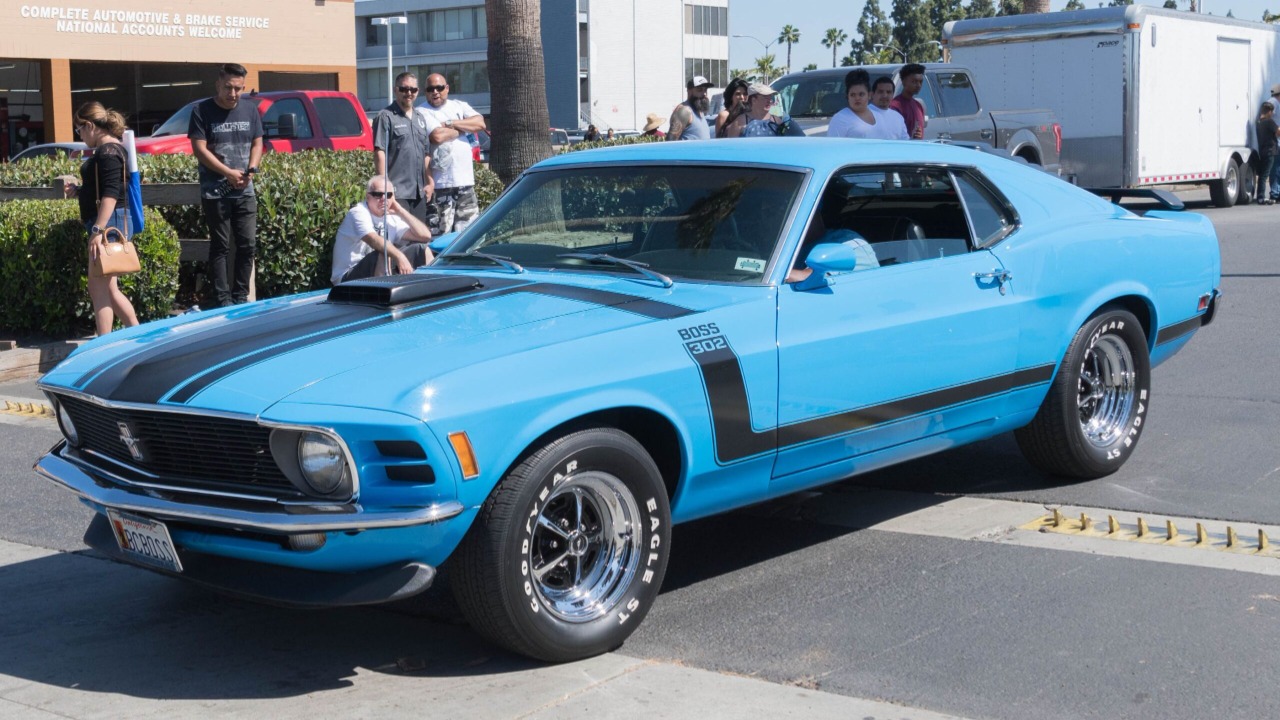
Ford has spent more than half a century refining the Mustang into a global icon, yet there was a moment when a different badge almost sat at the top of the company’s performance pyramid. The Boss-branded muscle cars of the late 1960s and early 1970s were conceived as limited weapons for racing and showroom bragging rights, but internal momentum briefly pushed them toward something closer to a flagship line. The story of how that ambition rose and then receded explains a great deal about Ford’s past, and about how the company thinks about performance in an era of recalls, electrification, and intense global competition.
The near-ascendancy of the Boss nameplate, particularly on the Mustang and its siblings, shows how quickly the balance can shift between engineering bravado and corporate caution. It also foreshadows the strategic tension that still shapes Ford today: build halo cars that stir emotion, or channel resources into the next wave of technology and mass-market products.
How Ford’s Boss program evolved from skunkworks special to near-flagship
The Boss project began as a focused response to racing rules and rival brands, not as a polished top-of-the-line marketing play. Engineers built the original Boss 302 Mustang to homologate a high-revving small-block V8 for Trans-Am competition, while the Boss 429 existed mainly to put a massive semi-hemi V8 into NASCAR. The word “Boss” on these cars was not a casual nickname. It reflected an internal code name tied to the engine program and then migrated onto the fenders as a badge of authority, a detail later unpacked in depth by muscle-car historians and enthusiasts who have traced what the Boss name really signified inside Ford.
Once those cars hit showrooms, however, the dynamic changed. The Boss Mustangs quickly became aspirational machines for young buyers who saw them as sharper, more focused alternatives to the standard GT. Inside Ford, that reception encouraged talk of using the Boss label more broadly, as a kind of performance umbrella that could sit above regular trim levels. Period planning documents and later retrospectives describe proposals for expanded Boss variants, including more street-oriented packages that would have brought the badge closer to the center of the Mustang range rather than leaving it as a niche homologation tool.
Meanwhile, Ford’s broader portfolio was in flux. The company was juggling the Torino, the full-size Galaxie and LTD lines, and a growing truck business. Some of those cars, such as the Capri and certain high-spec Escorts, would later earn spots in lists of the best Ford models of all time, underscoring how many internal contenders there were for “top model” status. The Boss program had to compete for resources with everything from big-block intermediates to luxury sedans.
The turning point came as insurance costs, emissions rules, and the first oil crisis converged. Management began to see ultra-high-performance packages as a liability rather than a path to higher-volume prestige. The Boss models were retired after only a few years, and the idea of turning them into a standing flagship quietly faded. In their place, Ford leaned on the broader Mustang brand and, later, on more flexible performance labels such as GT and Cobra that could be scaled up or down without the same racing baggage.
Why the almost-flagship Boss matters in Ford’s current performance identity
The decision not to elevate the Boss line permanently still shapes how Ford uses performance today. Instead of a single, enduring sub-brand that sits above everything else, the company cycles through limited-run specials and nameplate revivals. The modern Mustang Boss 302 revival, the Shelby GT350 and GT500, and even off-road trucks like the F-150 Raptor all function as halo vehicles without displacing the core models that carry the bulk of sales.
This approach has practical advantages. When Ford has to deal with large-scale issues, such as the recall of nearly 1.4 million F-150 pickups over an unexpected downshift condition that could cause a sudden loss of speed, the company’s focus naturally turns to its highest-volume products. The recall of almost 1.4 million trucks underscores how much more exposure comes from mainstream models than from limited performance cars. A single problem in a mass-market pickup can affect far more customers, and far more revenue, than any issue with a low-volume muscle car.
At the same time, Ford is navigating a strategic pivot toward electrification and new markets. The company has committed major investment to electric vehicles, including joint ventures and local partnerships in China, where its EV strategy has become a test case for how a legacy American brand can compete with domestic manufacturers. Ford’s efforts to expand its electric lineup in show that the company now treats cutting-edge technology and regional tailoring as its real flagships, not a single global muscle car.
Viewed in that context, the historical near-miss of the Boss as a top model looks less like a lost opportunity and more like an early lesson. The company learned that tying its identity too tightly to one extreme performance label can limit flexibility. Instead, Ford has chosen to let the Mustang name itself carry the emotional load, while reserving badges like Boss, Shelby, and Raptor for targeted bursts of attention. This strategy keeps the door open for future reinterpretations without locking the brand into a single hierarchy that might not age well as technology and regulations shift.
The broader car market has also changed around Ford. Collectors now treat classic muscle machines as investments as much as toys, and guides to muscle cars worth often highlight Boss Mustangs for their rarity and racing pedigree. That collector halo retroactively elevates the Boss image, but it does so outside the company’s direct control. The cars that almost became Ford’s in-house flagship have instead become cultural flagships, curated by enthusiasts and auction houses rather than by corporate product planners.
How electrification and future performance could revive the Boss idea in new form
Looking ahead, the question is not whether Ford will resurrect the Boss badge again, but how it will define performance in an era dominated by batteries, software, and range metrics. The history of electric cars shows that high performance and zero-emission drivetrains are not mutually exclusive. From early experiments to modern hypercars, engineers have used instant torque and advanced control systems to create EVs that can outrun traditional muscle machines, a trend documented in detailed timelines of the development of electric.
Ford has already taken a bold step by putting the Mustang name on an electric crossover, the Mustang Mach-E. That decision signaled that the company now views its most famous performance badge as a flexible brand that can span body styles and powertrains. If the Boss concept returns, it may not look like a stripped, high-revving V8 coupe. It could instead emerge as a software-defined performance package, an over-the-air upgrade, or a limited-production EV tuned for track work and marketed as the spiritual successor to the original race-bred cars.
There is also a safety and reliability dimension that did not exist in the same way during the original muscle era. Modern performance flagships must coexist with stringent durability expectations, active safety systems, and complex electronics. Any future Boss-style project would need to fit inside a corporate environment that has learned hard lessons from large recalls and from the reputational stakes attached to global EV launches. The balance between thrill and trust is far more delicate than it was in 1969.
Internally, Ford’s product planners now juggle a matrix that includes the F-150, Bronco, Explorer, Transit, and a growing list of electric models. Analysts who track the company’s portfolio often point out that the true “top model” in financial terms is not a muscle car at all, but a well-equipped pickup or SUV that sells in high volumes. In that sense, the Boss program’s failure to become the official flagship freed Ford to let market reality, rather than nostalgia, determine which vehicles sit at the top of the hierarchy.
More from Fast Lane Only
- Unboxing the WWII Jeep in a Crate
- 15 rare Chevys collectors are quietly buying
- 10 underrated V8s still worth hunting down
- Police notice this before you even roll window down
*Research for this article included AI assistance, with all final content reviewed by human editors