The modern performance sedan battlefield has long been framed as a German monopoly, with badges from Stuttgart, Munich, and Ingolstadt treated as the default choices for speed and status. Yet a Japanese four door with a naturally aspirated V8 is quietly dismantling that assumption, delivering old school drama, everyday usability, and long term durability that its European rivals increasingly struggle to match. In a market pivoting to smaller turbo engines and complex hybrids, this car’s very existence is a pointed reminder that there is another way to build a fast luxury sedan.
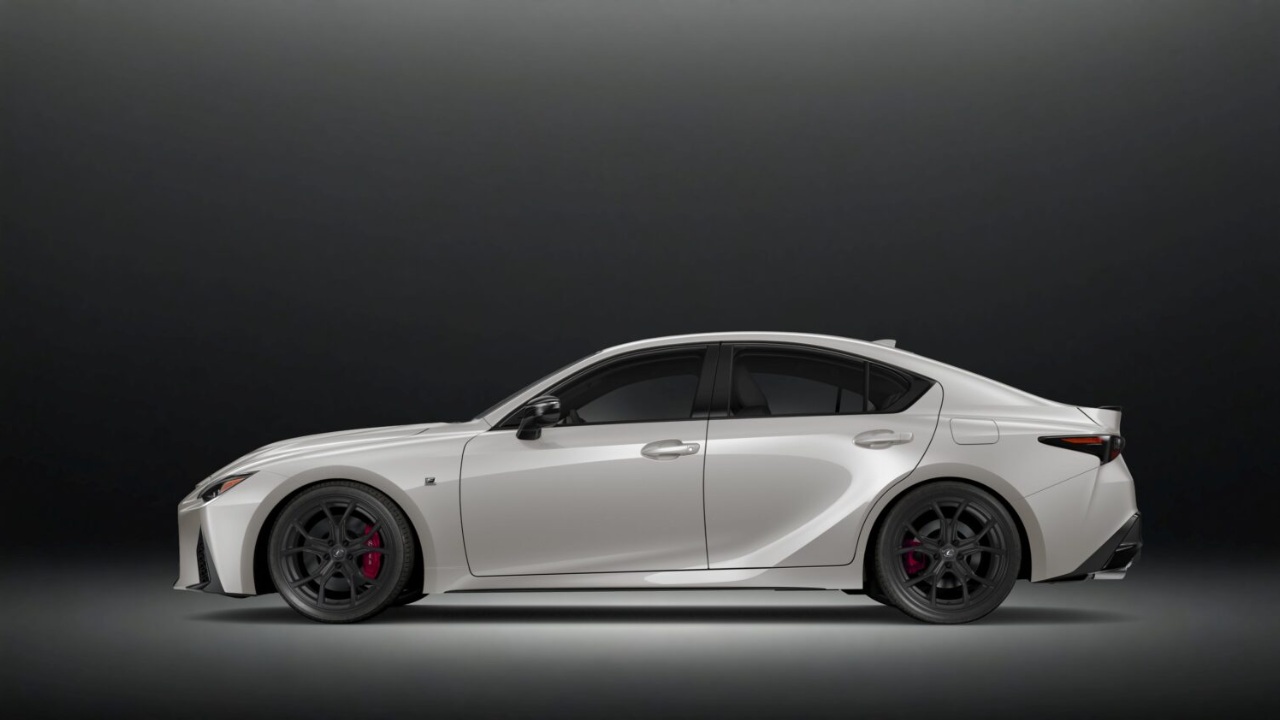
That sedan is the Lexus IS 500, a compact, rear wheel drive machine that pairs a big displacement engine with the brand’s reputation for reliability and restraint. It does not chase lap time headlines or Nürburgring bragging rights, but it does something more subversive: it makes German performance saloons look fragile, fussy, and poor value when judged over the years an owner actually lives with the car.
The last of the old school V8 sports sedans
From a driver’s seat perspective, the most striking thing about the Lexus IS 500 is how defiantly it ignores current European fashion. While rivals downsize and turbocharge, this compact sedan still relies on a naturally aspirated V8 that delivers Power: 472 hp, a figure that would have been supercar territory not long ago. On paper, the IS 500 should not exist in today’s emissions constrained market, yet it does, and that alone gives it an authenticity that many boosted four cylinder competitors lack. The car is positioned as a love letter to enthusiasts, offering a big engine in a small chassis without playing what one report calls the typical German game of constant escalation and complexity.
The character of that engine matters as much as the numbers. The IS 500’s five liter V8, referenced in enthusiast coverage of “The IS five 00 F Sport,” is celebrated precisely because it is an old school, naturally aspirated unit rather than a high strung turbo. That same reporting notes that this configuration allows the car to combine “bulletproof reliability and performance” while still competing directly with its German rivals in the same segments. When another source describes the IS 500 F Sport Performance as potentially the last naturally aspirated V8 sports sedan ever made, it underscores how far the European establishment has moved away from this formula, and how deliberately Lexus has chosen to stand apart.
While Germans downsize, Lexus doubles down
The contrast with the German approach is stark. The Mercedes performance benchmark in this class, The Mercedes AMG C63, has been defined by its V8, specifically a 4.0 liter twin turbocharged motor that set this Merc apart from other fast Germ sedans. Yet reporting on the next generation of this car indicates that it could abandon that V8 entirely in favor of a four cylinder hybrid powertrain. The shift promises efficiency and headline grabbing combined output, but it also adds layers of complexity and long term maintenance risk that owners will eventually have to absorb.
BMW has followed a similar path. Coverage of the Lexus IS F, the IS 500’s spiritual predecessor, notes that the BMW M3 which competes directly with the Lexus IS F ditched its own V8 engine for a smaller turbocharged six cylinder. That decision mirrored a broader German trend toward forced induction and intricate engineering solutions, choices that may deliver impressive performance figures but also introduce more parts, more heat, and more potential failure points. Against that backdrop, Lexus looks almost contrarian for persisting with a large, naturally aspirated V8 in the IS 500, yet that simplicity is precisely what gives the Japanese sedan its long term edge.
Reliability as a performance weapon
Where the IS 500 truly embarrasses its German rivals is not just on a spec sheet, but in the ownership experience that follows the initial thrill of a test drive. Lexus as a brand has consistently been recognized as one of the most reliable luxury manufacturers in the world, with one assessment flatly stating that “lexus is the most reliable in the world” and even noting that it is closing in on, and in some opinions surpassing, the comfort associated with Mercedes. Another analysis of rental fleets highlights Lexus as a top choice for dependability, crediting the way the company blends Japanese luxury with Toyota engineering, and pointing out that the brand routinely earns top scores in reliability ratings.
Technical comparisons between Japanese and German engines reinforce why this matters. A detailed breakdown of Japanese and German powertrains explains that Japanese engines often tolerate normal servicing without complaint, while German units can become expensive to maintain much faster if they are not treated with meticulous care. The same source frames the biggest maintenance difference as a question of how forgiving the hardware is to real world use. In that light, the IS 500’s naturally aspirated V8, with fewer turbos, high pressure fuel systems, and hybrid modules to worry about, becomes a performance advantage in its own right. It allows owners to enjoy 472 hp without living in fear of every warning light or out of warranty repair bill.
A legacy of undercutting German luxury
The IS 500 is not an isolated act of rebellion, but part of a longer Lexus tradition of building cars that quietly outclass German rivals on quality and durability while undercutting them on cost. The original Lexus LS400 is the clearest historical example. Contemporary reporting recalls how the LS400 earned rave reviews while selling at a discount to comparable luxury sedans such as the stately Mercedes flagships. One retrospective notes that the car made up in value what it lacked in inherited prestige, and another describes how the LS 400 immediately put the Germans on notice by offering higher quality and more features at a lower price point.
That value story has persisted in the used market. A survey of modern classic saloons points out that, After years languishing in the secondhand doldrums, the Lexus LS400 has begun a resurgence as a true modern classic, recognized as a car built specifically to take on the S Class. A separate enthusiast video even frames The Lexus LS400 as a $10,000 Luxury V8 Sleeper That DESTROYS German Rivals, underlining how, decades later, the car’s engineering still exposes the fragility and depreciation of its European contemporaries. When I look at the IS 500, I see that same playbook updated for a new era: a Japanese sedan that may not shout as loudly as its German peers on launch day, but quietly wins the long game.
The broader Japanese performance philosophy
The IS 500’s success also reflects a wider Japanese approach to performance cars that prioritizes balance, simplicity, and real world usability over pure spec sheet dominance. Technical commentary on suspension design notes that, When comparing Japanese setups with German and Chinese philosophies, Japanese designs tend to keep things simple, light, and efficient, while German systems often chase complexity and precision. That same mindset shows up in the way brands like Nissan, once known for its boldness with models like the GT R, 350Z, and Skyline, blend innovation and power without losing sight of durability and day to day drivability.
Discussions among enthusiasts about whether Japanese cars still lag behind their German rivals often reveal a similar pattern. One owner recounts how a Japanese performance model was “ripped apart by the press” for being slower on track than its rivals, yet on the road it felt “overpowered” and deeply satisfying. Another Lexus driver describes the ES 350 as a fantastic car, praising its extremely reliable and smooth 3.5L V6, quiet ride, quality interior, and stylish design, all delivered at a price that undercuts many European alternatives. These perspectives suggest that Japanese manufacturers, and Lexus in particular, are less interested in chasing marginal gains on a circuit and more focused on building cars that feel strong, refined, and dependable in everyday use.
More from Fast Lane Only