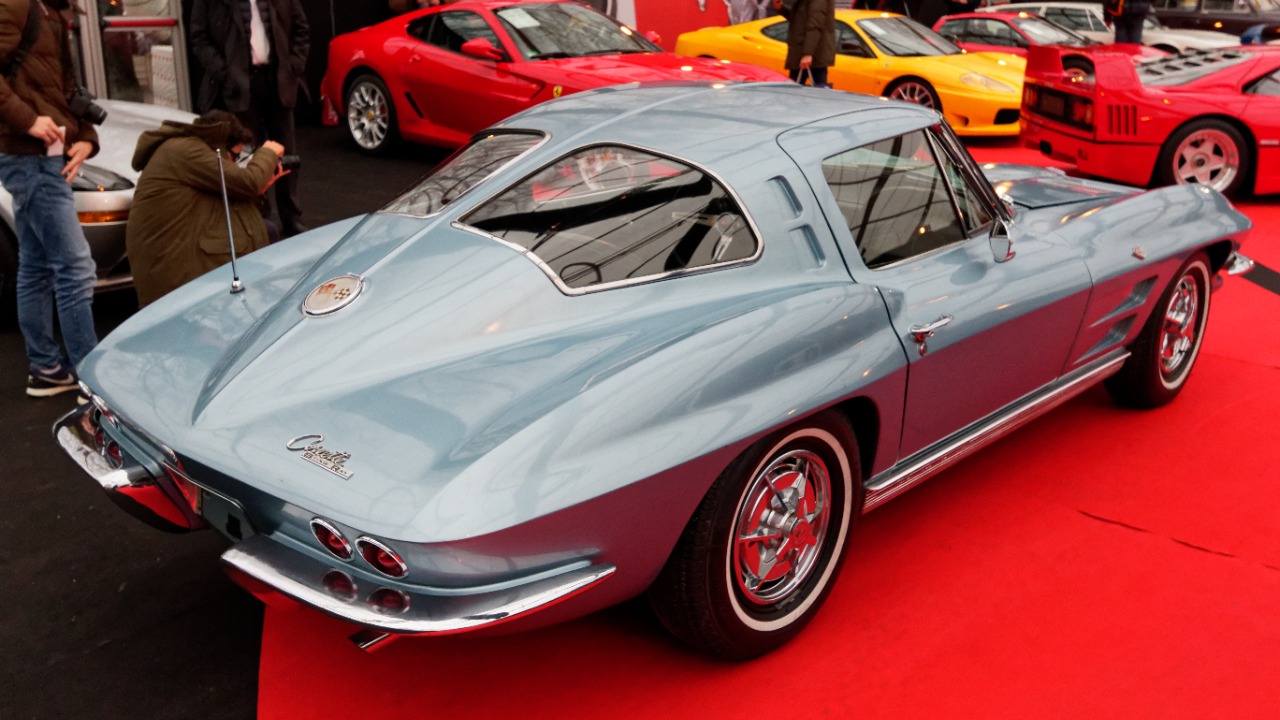
The Corvette has worn many identities over seven decades, from chrome-laden boulevard cruiser to mid-engine supercar. Yet among collectors, one detail from a single model year still sparks the fiercest debate and commands the highest premiums: the split rear window of the 1963 Corvette Sting Ray coupe. Offered for one year only, then erased by Chevrolet’s own engineers, it has become an obsession that shapes how the entire C2 generation is valued and remembered.
That thin strip of fiberglass between two panes of curved glass did not add power or improve lap times. It added drama. It also added headaches, which is why it disappeared almost as quickly as it arrived. The tension between style and function that killed the split window now fuels its legend.
How a styling flourish became a one-year-only obsession
When Chevrolet launched the second-generation Corvette for 1963, the Sting Ray coupe was the first closed-roof Corvette and a radical break from the C1. The most striking feature sat at eye level: a divided rear window framed by a sharp spine that ran from the roof to the tail. Design chief Bill Mitchell championed the split, which echoed his earlier XP-87 race car and gave the new Corvette a more exotic, almost European profile.
Inside General Motors, the split window was controversial from the start. Styling loved the dramatic line that bisected the roof and rear glass. Engineers and racers did not. The central pillar compromised rearward visibility, especially at night and in tight traffic. Corvette chief engineer Zora Arkus-Duntov reportedly argued that the car should prioritize performance and drivability over a styling gimmick, and dealers began hearing complaints from early buyers who struggled with the obstructed view.
The conflict was settled quickly. For 1964, Chevrolet removed the divider and installed a single-piece rear window, while keeping the rest of the Sting Ray’s bodywork essentially intact. That decision instantly transformed every surviving 1963 coupe into a rolling anomaly. Chevrolet itself encouraged owners who disliked the split window to retrofit the new one-piece glass, which meant some cars lost their defining feature long before collectors realized its value. A later barn-find coupe, described as a forgotten 1963 Corvette, illustrates how easily the signature element could vanish while the car remained desirable for its underlying C2 bones.
That mix of factory rarity, internal controversy, and owner modifications created the perfect conditions for a future collectible. The split window was not just rare, it was a feature the manufacturer itself tried to erase.
What changed when Chevrolet deleted the split window
On paper, the change from 1963 to 1964 looks minor. The chassis layout, small-block V8 lineup, and independent rear suspension carried over. Yet visually and psychologically, the Corvette’s character shifted. The one-piece rear glass made the car easier to live with, especially for drivers who used their Sting Ray as a daily commuter or long-distance tourer. Rearward visibility improved, and the cabin felt slightly more open.
From a design perspective, the flowing fastback roofline became cleaner, with the spine now a subtle crease rather than a structural divider. Some purists argue that the 1964 and later coupes look more resolved, as if the original sketch finally matched the production car. Others insist the split window’s drama is what turns a handsome sports car into a piece of rolling sculpture.
The market has rendered its own verdict. While condition, originality, and engine options drive any Corvette valuation, the presence or absence of the split window often trumps everything else. A base-engine 1963 split-window coupe in honest, unrestored shape can command more attention than a heavily optioned 1964 with similar mileage. Cars that were converted to one-piece glass in period sometimes undergo painstaking reversals, with owners hunting for original-style trim and correct glass to recreate the factory 1963 look.
The deletion of the split window also changed how Chevrolet thought about Corvette design risk. The company learned that a bold styling signature could win magazine covers yet frustrate real buyers. Later generations still experimented with dramatic shapes, but rarely in ways that compromised basic usability. The split window became a quiet lesson inside GM about the cost of pushing form ahead of function.
Why the 1963 split-window still drives collector behavior
Decades after Chevrolet dropped the center bar, the 1963 coupe’s rear glass configuration remains one of the clearest dividing lines in Corvette collecting. Auction catalogs highlight the split window before they mention horsepower. Private sellers lead with it in classified ads. For many buyers, it is the single non-negotiable feature.
Several forces keep the obsession alive. First is simple scarcity. The split-window design appeared for only one model year, and not every 1963 coupe retains its original configuration. Some were converted to the later glass, damaged in accidents, or heavily modified during the custom craze of the 1970s and 1980s. That attrition means truly original split-window cars represent a fraction of total C2 production.
Visual uniqueness plays a major role as well. In a parking lot full of Corvettes, the split-window coupe still stops people in their tracks. It reads instantly as an artifact of early 1960s optimism, when American manufacturers were willing to treat production cars like concept vehicles. The spine that so annoyed engineers now functions as a badge of courage from a more experimental era.
The story behind it matters just as much. Collectors do not just buy fiberglass and steel; they buy narratives. The split window carries a built-in plot: a bold idea, internal corporate drama, a quick reversal, and decades of second-guessing. Owners can tell that story at every cars-and-coffee meet, reinforcing the feature’s mystique and, by extension, its value.
The obsession also shapes how the broader C2 generation is perceived. Convertibles from 1963 avoid the visibility issue entirely, yet they rarely command the same aura as the split-window coupes. Later C2s gained big-block engines and more refined interiors, but many enthusiasts still see the 1963 split-window as the purest expression of the Sting Ray concept, even when the spec sheet suggests otherwise.
How the split-window legacy influences future Corvettes
Although Chevrolet has not repeated the exact split-window treatment on later Corvettes, the 1963 coupe’s legacy still influences design and product planning. Every new generation faces a version of the same question that divided Mitchell and Arkus-Duntov: how far can the car lean into dramatic styling before it compromises function for the people who actually drive it.
The mid-engine C8, for example, uses aggressive creases, flying buttresses, and complex vents to signal its performance ambitions. Yet rear visibility, while not perfect, is managed through camera systems and glass shapes that avoid a literal split. Modern safety expectations and customer tolerance for inconvenience leave little room for a feature that intentionally blocks the driver’s view.
Instead, the split window’s influence shows up in subtler ways. Designers reference the 1963 car in surface lines, fender peaks, and roof contours that echo the Sting Ray’s tension between sharp edges and flowing curves. Special editions and heritage packages often lean on C2-inspired cues, from badging to wheel designs, as a way to tap into the same nostalgia that makes the one-year-only rear glass so powerful.
On the collector side, the split window sets a template for how future rare features might be valued. Limited-run aero packages, short-lived interior options, or one-year color combinations are already being tracked by enthusiasts who hope they will become the next 1963-style anomaly. The market’s response to those bets often depends on whether the feature carries a story as compelling as the split window’s clash between design bravado and real-world usability.
As Corvette moves deeper into the era of electrification and software-defined performance, the 1963 split-window coupe stands as a reminder that some of the most enduring automotive obsessions have little to do with lap times or range. A thin strip of fiberglass, installed for a single model year and then erased, continues to shape how collectors rank, price, and romanticize America’s sports car. For many, the Corvette story still begins with two panes of glass and the line that dared to run between them.
More from Fast Lane Only
- Unboxing the WWII Jeep in a Crate
- 15 rare Chevys collectors are quietly buying
- 10 underrated V8s still worth hunting down
- Police notice this before you even roll window down
*Research for this article included AI assistance, with all final content reviewed by human editors