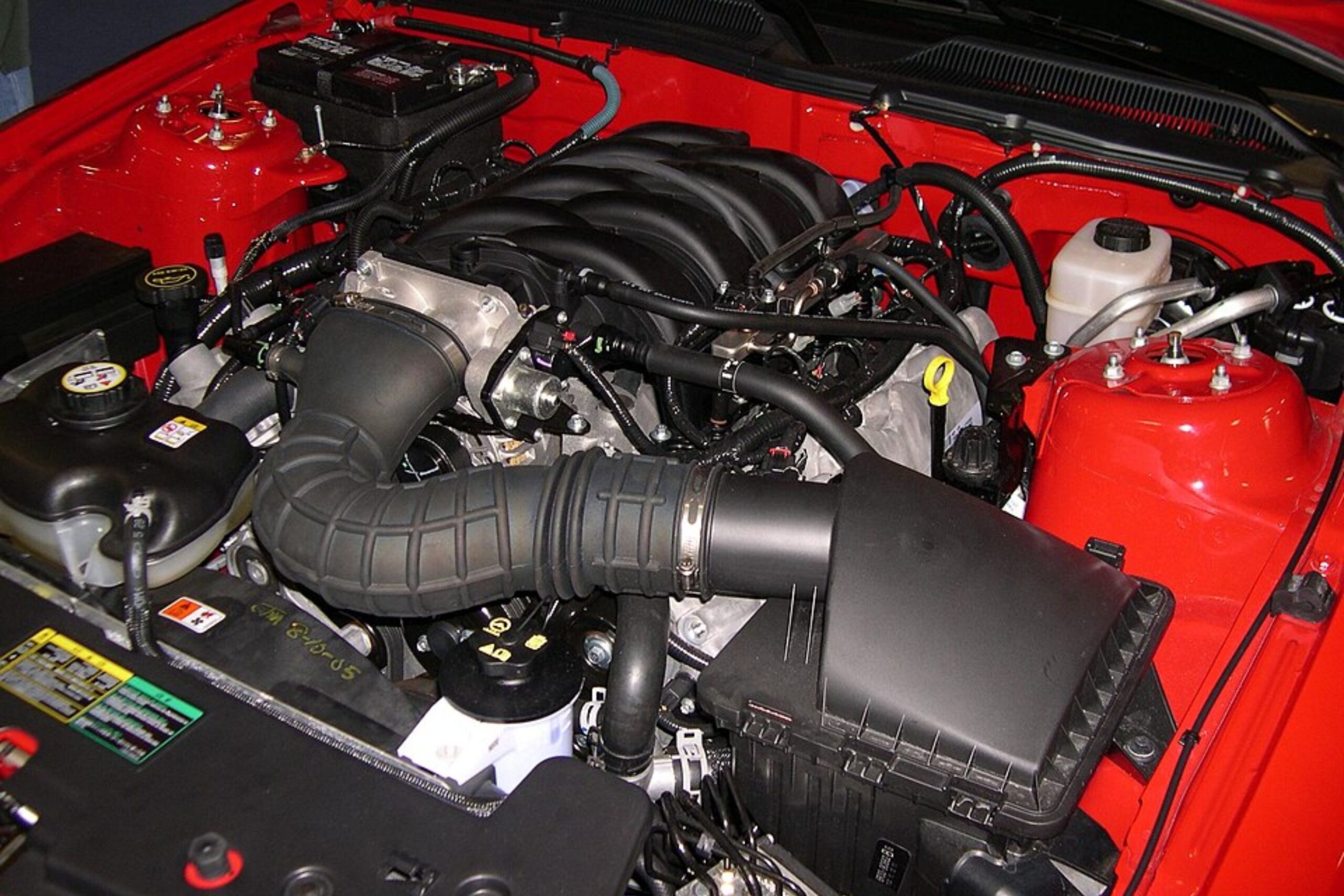
Every car brand has that one powerplant that never really got the spotlight, yet somehow shows up everywhere, refuses to die, and quietly makes owners look like geniuses. For Ford, one of the best examples is the 4.6-liter Modular V8. It didn’t arrive with muscle-car mythology or a flashy “reborn legend” narrative. It just showed up, did the work, and kept doing it for years longer than most people expected.
Ask enthusiasts to name Ford’s greatest hits and you’ll hear plenty about big-blocks, small-blocks, and modern supercharged monsters. The 4.6 often gets a shrug: “It’s fine.” That’s the funny part—it was more than fine, and its track record has aged surprisingly well.
A V8 that wasn’t supposed to be exciting
When the 4.6L Modular rolled in during the early 1990s, it landed in a world where pushrod V8s still felt like the default American soundtrack. Overhead cams sounded like something for imports or exotics, not the engine bay of a mainstream sedan. But Ford had a different plan: make a modern, scalable engine family that could cover a lot of vehicles without reinventing the wheel every few years.
The result was an engine that, on paper, didn’t scream “instant classic.” Early versions in many applications weren’t exactly tire-melters, and that shaped the reputation. Yet the design choices that made it feel conservative to some drivers—like its focus on refinement and durability—ended up being the reason it lasted.
Where it showed up (hint: basically everywhere)
Part of the 4.6’s story is how widely it was used. It powered everything from Mustang GTs to Crown Victoria police cruisers, plus big, comfy sedans and a whole parade of trucks and SUVs. When an engine appears in that many places, it becomes a kind of national appliance—something mechanics know, parts stores stock, and owners rely on without thinking twice.
That broad footprint also meant Ford had plenty of incentive to keep improving it. Small updates, better tuning, and incremental revisions added up. The 4.6 didn’t need one dramatic makeover to prove itself; it just needed time, miles, and a lot of real-world testing in the hands of regular drivers.
The Modular idea: boring name, smart concept
“Modular” sounds like a corporate buzzword, but it was a genuinely practical strategy. The architecture was designed so multiple engines could share manufacturing approaches and key dimensions. That made it easier to build different displacements and configurations while keeping production efficient.
For owners, it meant something simple: the engine family stuck around, and support stayed strong. When an engine is common, it’s cheaper to keep on the road. Nobody frames that on a garage wall, but it’s one of the reasons people end up loving these things after 200,000 miles.
Power that grew up nicely
The 4.6’s reputation often gets stuck on its earlier, milder outputs, especially in big sedans where it was tuned for smoothness. But the engine matured. Different versions—two-valve, three-valve, and four-valve setups—gave it a wide range of personalities, from relaxed commuter to legitimately quick performance V8.
In sportier trim, it could rev, it could breathe, and it could take modification better than skeptics wanted to admit. It wasn’t always the biggest engine in the room, but it frequently felt better behaved and more consistent. And that’s a kind of performance that doesn’t show up in bench racing, but it shows up in ownership.
The durability legend that snuck up on everyone
If there’s a single reason the 4.6 earned long-term respect, it’s how well it handled real life. High mileage, long idle hours, fleet abuse, heat, cold, missed oil changes (not recommended, but reality happens)—the engine developed a reputation for staying in the fight. Plenty of them lived in vehicles that were worked hard and maintained just “good enough,” and still kept rolling.
Police departments and taxi fleets didn’t care about internet arguments over horsepower per liter. They cared about uptime and repair costs. The fact that so many 4.6-equipped vehicles spent years doing stop-and-go duty and still became mileage champs tells you more than any spec sheet ever could.
It made certain Ford vehicles quietly iconic
There’s a whole generation of drivers who associate the 4.6 with cars that felt unkillable. The Crown Victoria, Grand Marquis, and Town Car became symbols of dependable, comfortable transportation, and the engine was a big piece of that. It wasn’t glamorous, but it was consistent—like that reliable friend who always answers the phone and never makes things weird.
In the Mustang, the 4.6 helped bridge eras. It carried the model through the 1990s and 2000s with a modernizing approach, setting the stage for what came next. Even people who prefer other engines often admit the cars themselves were easy to live with, and the 4.6 played a major role in that everyday friendliness.
Not perfect, just better than the jokes implied
Yes, it had quirks. Certain years and setups had known weak spots, and some repairs can be more annoying than on simpler pushrod designs. It also didn’t always deliver that big low-end shove people expect from a V8, especially in heavier vehicles.
But the long view matters. For an engine that powered so many vehicles for so many years, the overall record is impressively steady. The 4.6 wasn’t trying to be the loudest personality at the party—it was trying to show up on time, every time, for decades.
Why it still matters now
Today, the 4.6 sits in an interesting place. It’s old enough to be overlooked, common enough to be affordable, and proven enough that people still seek it out for certain projects. That mix has turned it into a quiet bargain, especially for anyone who values durability and parts availability over bragging rights.
It also represents a moment when Ford pivoted toward modern engine design while still feeding traditional American V8 appetite. The industry has moved on—turbocharging, direct injection, hybrids, and all the rest—but the 4.6 remains a reminder that “good” can be a superpower. Sometimes the engines that outperform expectations aren’t the ones with the loudest fans. They’re the ones still running when everyone else is shopping for a replacement.
More from Fast Lane Only