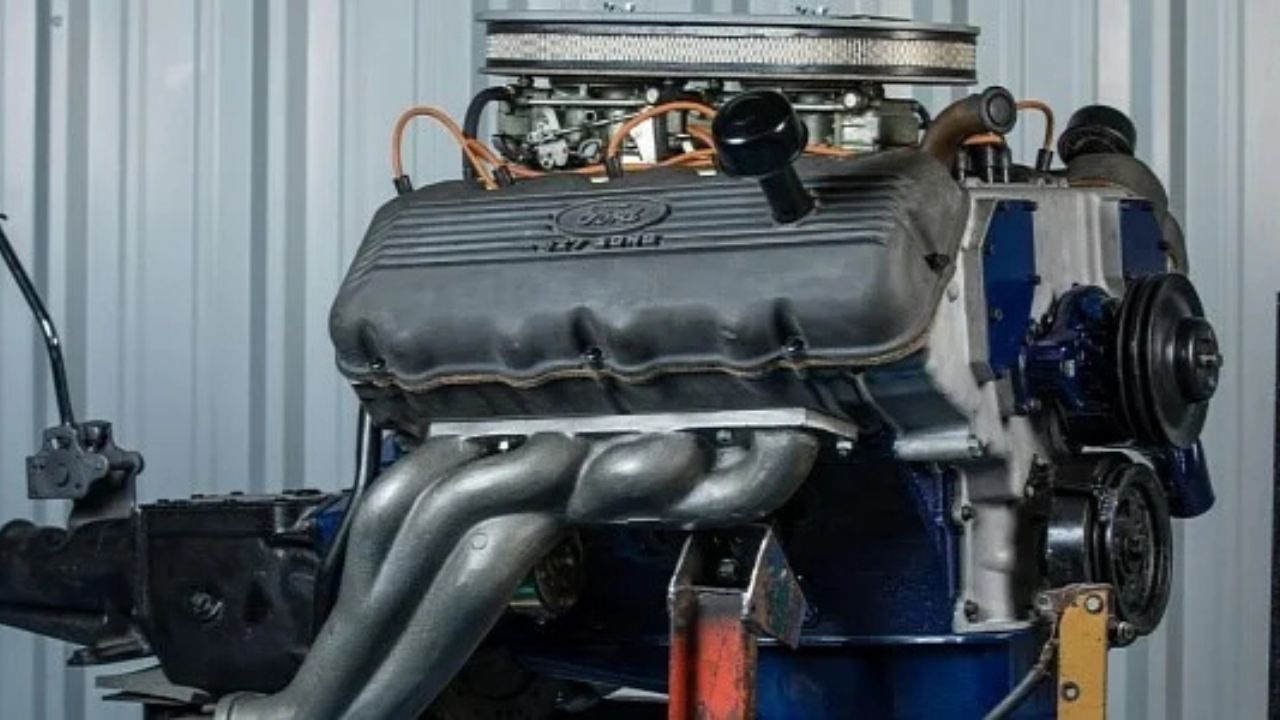
The Ford 427 SOHC “Cammer” engine is one of the most legendary and controversial big-blocks ever developed during the height of American racing innovation. Built to dominate NASCAR and challenge Chrysler’s Hemi supremacy, it was so advanced and extreme that it nearly never reached production at all due to racing politics, cost concerns, and rule changes.
Ford created the Cammer to defeat the 426 Hemi in NASCAR competition
When Ford Motor Company developed the Ford 427 SOHC engine, the goal was clear: outperform the dominant Chrysler 426 Hemi on NASCAR’s high-speed oval tracks. Engineers designed a revolutionary single overhead camshaft system that improved high-RPM breathing, giving Ford a potential edge in sustained top-end power.
The engine was part of Ford’s broader racing arms race during the 1960s, where manufacturers pushed extreme engineering solutions to gain even the smallest advantage. With its massive displacement and advanced valvetrain, the Cammer had the potential to redefine stock car racing performance. However, its complexity and cost immediately set it apart from conventional pushrod engines used at the time.
NASCAR rule changes nearly killed the Cammer before it could compete
As the Ford 427 SOHC engine was being developed, NASCAR introduced stricter homologation rules requiring manufacturers to produce a minimum number of engines for public sale before they could be used in competition. This rule was widely seen as a direct response to the escalating technology war between Ford and Chrysler.
The Cammer engine was expensive to build and difficult to manufacture at scale, making mass production extremely challenging for Ford Motor Company. Even though the engine showed massive performance potential in testing, the cost and production requirements nearly prevented it from ever reaching homologation approval. This created a situation where Ford had a race-winning engine that was not easily legal for the series it was designed for.
The Cammer’s complexity made it a manufacturing and financial challenge
Unlike traditional big-block engines, the Ford 427 SOHC engine used a single overhead camshaft system driven by a complex chain arrangement. This design allowed for higher RPM capability and improved airflow, but it also introduced manufacturing difficulties and increased production costs compared to simpler pushrod engines.
For Ford Motor Company, building enough Cammer engines to satisfy NASCAR’s homologation requirements meant significant investment in tooling, assembly, and parts supply. As racing rules tightened, the engine’s advanced design became both its greatest strength and its biggest obstacle to widespread use.
Racing politics and rule enforcement shaped the Cammer’s fate
The fate of the Ford 427 SOHC engine was heavily influenced by NASCAR’s effort to control escalating speeds and maintain competitive balance. Even though Ford had engineered a technological leap forward, sanctioning officials were increasingly reluctant to allow engines that could dramatically outpace the existing field.
As a result, the Cammer was effectively sidelined before it could achieve full dominance in NASCAR competition. While it did see limited use in drag racing and special applications, it never reached its intended full racing potential. Today, it stands as a symbol of how regulatory decisions can shape the direction of automotive engineering, even during its most innovative era.
More from Fast Lane Only