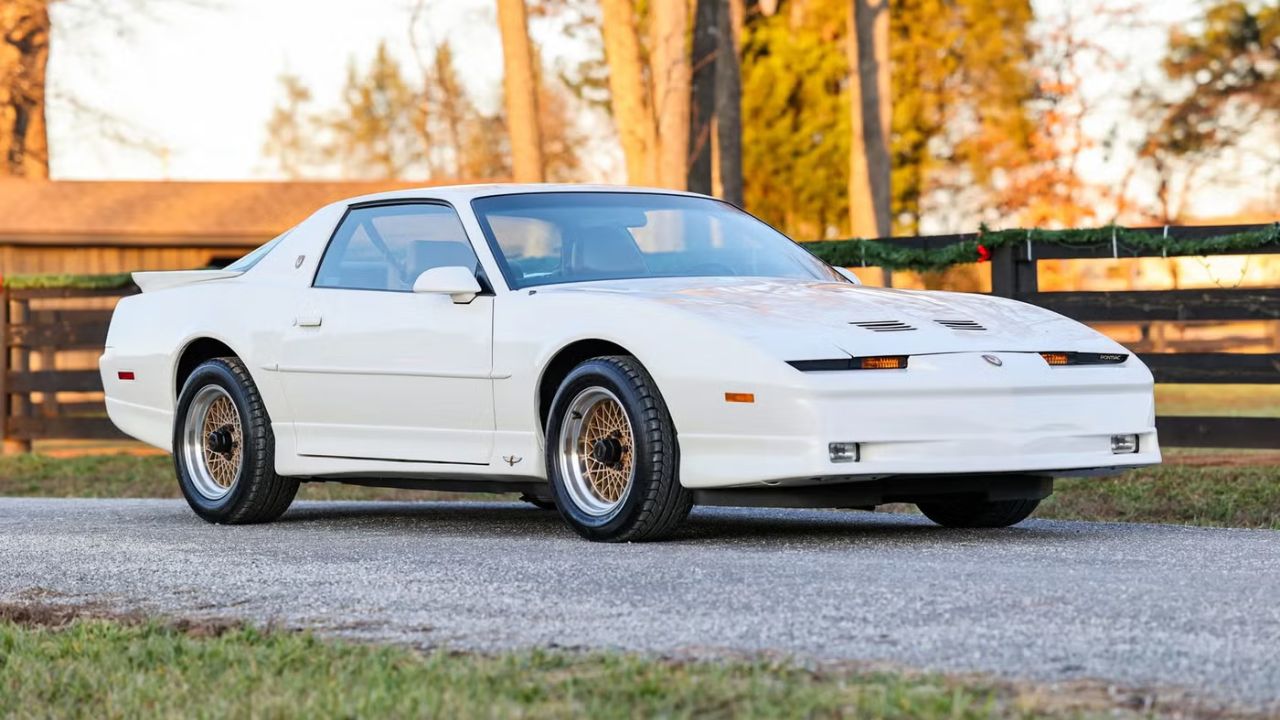
The 1989 Pontiac Turbo Trans Am has recently surged in collector interest as enthusiasts rediscover late-1980s performance cars that blended turbocharged technology with classic muscle car styling. Once overlooked in favor of earlier V8 legends, it is now gaining recognition as a rare, transitional machine from a time when American performance was reinventing itself.
Pontiac’s turbo experiment created a rare final-year performance icon
By the late 1980s, Pontiac was experimenting heavily with forced induction as emissions regulations tightened and traditional high-compression V8 power began to fade. The result was the Pontiac Turbo Trans Am, a limited-production performance variant that combined the sleek GTA-era Trans Am platform with a turbocharged V6 engine.
Instead of relying on large displacement, Pontiac leaned on turbo boost to deliver performance that felt modern for its time. The car’s styling still carried the aggressive Firebird identity, but underneath the hood it represented a shift in engineering philosophy. This combination of classic muscle aesthetics and emerging turbo technology is one of the main reasons collectors are now revisiting it with fresh interest.
The turbocharged V6 gave it a different kind of performance character
The Pontiac Turbo Trans Am used a turbocharged 3.8-liter V6 engine derived from Buick’s performance lineup, delivering strong low-end torque and surprisingly quick acceleration when boost came on. While it didn’t match the brute force of earlier big-block Trans Ams, its responsiveness made it feel advanced for its era.
In real-world driving, the turbo system created a distinct power delivery curve that set it apart from traditional V8 muscle cars. Enthusiasts now appreciate it as an early example of factory turbo performance in an American coupe, especially as modern performance cars increasingly rely on forced induction for efficiency and power balance.
Limited production and late-1980s styling drive collector demand
Part of the growing appeal of the Pontiac Turbo Trans Am comes from its relatively low production numbers compared to mainstream Firebird models. As a final-year turbocharged variant, it occupies a narrow historical window between classic muscle and modern performance engineering.
Its late-1980s design language—digital influences, aerodynamic tweaks, and T-top configurations—has also aged into a nostalgic aesthetic. Collectors who once ignored it are now viewing it as a time-capsule of GM experimentation, especially as clean, original examples become harder to find.
Rising appreciation for turbo-era classics is reshaping its value
Enthusiasts are increasingly recognizing that the Pontiac Turbo Trans Am represents an important transition in performance history. It marks the point where American manufacturers began shifting away from displacement-heavy engines toward turbocharged efficiency, a trend that defines modern performance cars today.
As a result, collector demand is rising not just for nostalgia, but for historical significance. The Turbo Trans Am is no longer seen as a compromise-era vehicle, but as an early blueprint for the turbocharged performance philosophy that dominates the automotive world now.
More from Fast Lane Only