GMC’s Typhoon arrived at a moment when sport-utility vehicles were still boxy workhorses, then rewrote expectations by pairing all-wheel-drive practicality with sports-car acceleration. I see its brief production run and cult following today as two sides of the same story, one that explains why clean examples now trade for serious money and why the truck still feels oddly modern more than three decades later.
From work truck roots to turbocharged experiment
Before the Typhoon, GMC’s identity was tied to pickups and commercial rigs, not quarter-mile times, which is why its early 1990s decision to build a turbocharged performance SUV still feels so radical. The project grew out of the Sonoma-based Syclone pickup, itself a limited-production all-wheel-drive rocket that proved there was a niche for factory-built trucks that could embarrass contemporary sports cars on the street and at the drag strip, a formula GMC then adapted to the compact Jimmy platform to create the Typhoon.
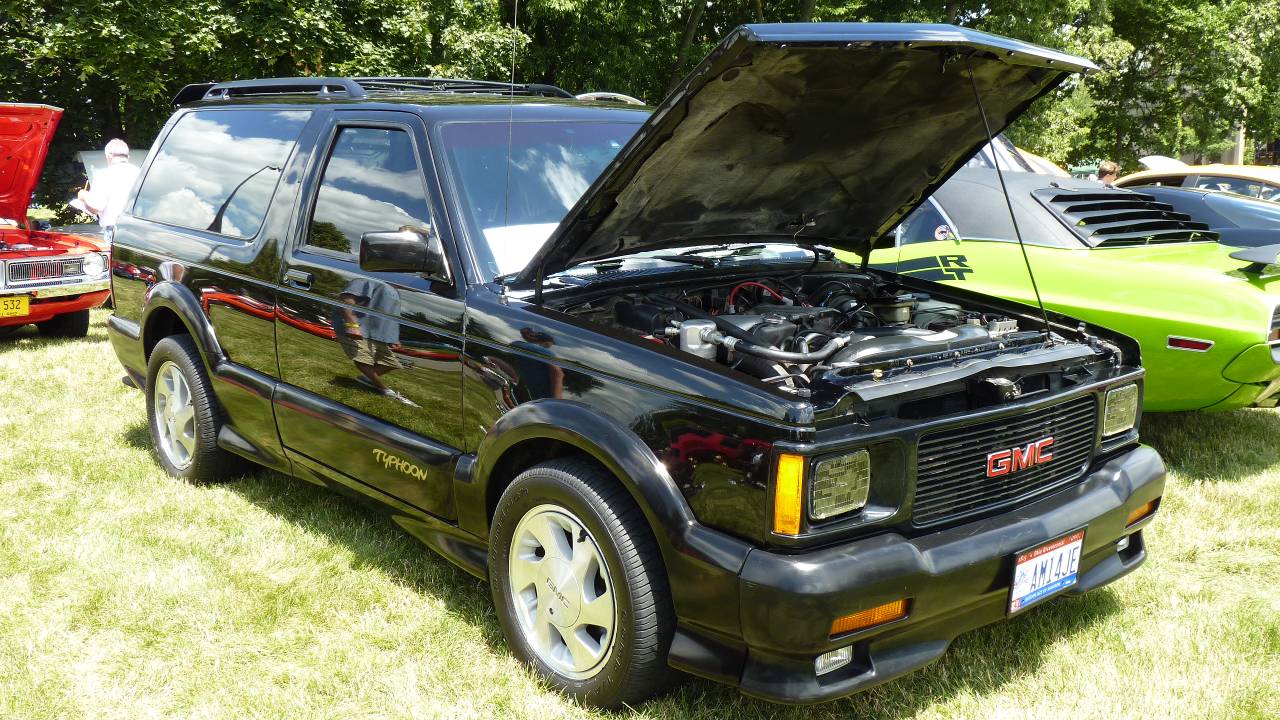
Under the hood, the Typhoon used a 4.3‑liter V6 fitted with a turbocharger and intercooler, feeding power through a 4-speed automatic and a full-time all-wheel-drive system that biased torque to the rear but could still claw for grip in poor conditions. Contemporary testing recorded 0–60 mph runs in the low 5‑second range and quarter-mile passes in the mid‑13s, performance that put this boxy two-door SUV in the same conversation as period Chevrolet Corvette and Porsche 911 models while still offering a usable cargo area and a rear seat.
How GMC built a super-SUV before the segment existed
What made the Typhoon so unusual was not just its speed but the way GMC wrapped that performance in a relatively refined package, effectively inventing the idea of a luxury performance SUV long before that label became common. The truck received a self-leveling rear suspension, body-colored cladding, and a more upscale interior with leather seating and extra sound insulation, which meant owners could commute in comfort during the week and still show up at the drag strip with a vehicle that ran with serious sports cars.
Production remained intentionally limited, with output measured in the low thousands over a short two-year run, which kept the Typhoon exclusive but also constrained its impact on GMC’s broader lineup. The company treated it as a halo project rather than a volume seller, using the SUV to showcase what its engineers could do with turbocharging and all-wheel drive, yet never fully committing to a second generation or a larger family of performance utilities that might have capitalized on the formula as the SUV market exploded later in the decade.
Why the Typhoon disappeared so quickly
The Typhoon’s disappearance after only a couple of model years reflected a mix of business realities and shifting corporate priorities rather than any lack of capability. Building a low-volume, heavily engineered specialty SUV was expensive, and the early 1990s recession, combined with tightening emissions and fuel-economy expectations, made it harder to justify a thirsty turbocharged performance model that sat far outside GMC’s core truck and fleet business.
At the same time, General Motors was wrestling with platform consolidation and cost-cutting, and the compact Jimmy architecture that underpinned the Typhoon was already on a path toward replacement. Instead of reengineering the turbocharged drivetrain for a new chassis, GMC allowed the program to sunset, leaving the Typhoon and its Syclone sibling as one-off experiments rather than the start of a sustained performance SUV lineage.
Performance numbers that still feel shocking
Even judged by today’s standards, the Typhoon’s acceleration remains startling, especially considering its early 1990s origin and relatively modest displacement. Period instrumented tests consistently showed the turbocharged 4.3‑liter V6 delivering around 280 horsepower and 360 pound-feet of torque, figures that, combined with all-wheel drive and a quick-shifting automatic, translated into launches that rivaled or beat many contemporary V8 muscle cars.
What stands out to me is how usable that performance was in everyday driving, because the Typhoon’s torque arrived low in the rev range and the all-wheel-drive system put it to the pavement without the wheelspin that plagued rear-drive performance cars of the era. That combination of real-world speed and all-weather traction foreshadowed the formula later adopted by European and Japanese manufacturers for their own high-performance crossovers, even if GMC never fully capitalized on the head start.
Collector status and current market values
Today, the Typhoon’s short production run, distinctive look, and still-impressive performance have combined to push it firmly into modern-classic territory, with values reflecting that shift. Clean, unmodified trucks with documented histories command a clear premium, and low-mileage examples in desirable colors such as black or the limited-run teal and white combinations often attract bidding that rivals or exceeds the prices of contemporary American sports cars from the same era.
Condition and originality drive the spread in the current market, with well-kept drivers typically trading for significantly less than concours-level trucks but still well above the values of ordinary early 1990s GMC Jimmy models. I see buyers paying up for factory-correct paint, intact cladding, original wheels, and unaltered engine hardware, while heavily modified or high-mileage Typhoons tend to lag, a pattern that underscores how much the truck’s appeal now rests on its status as a rare, historically important performance SUV rather than just a platform for tuning.