
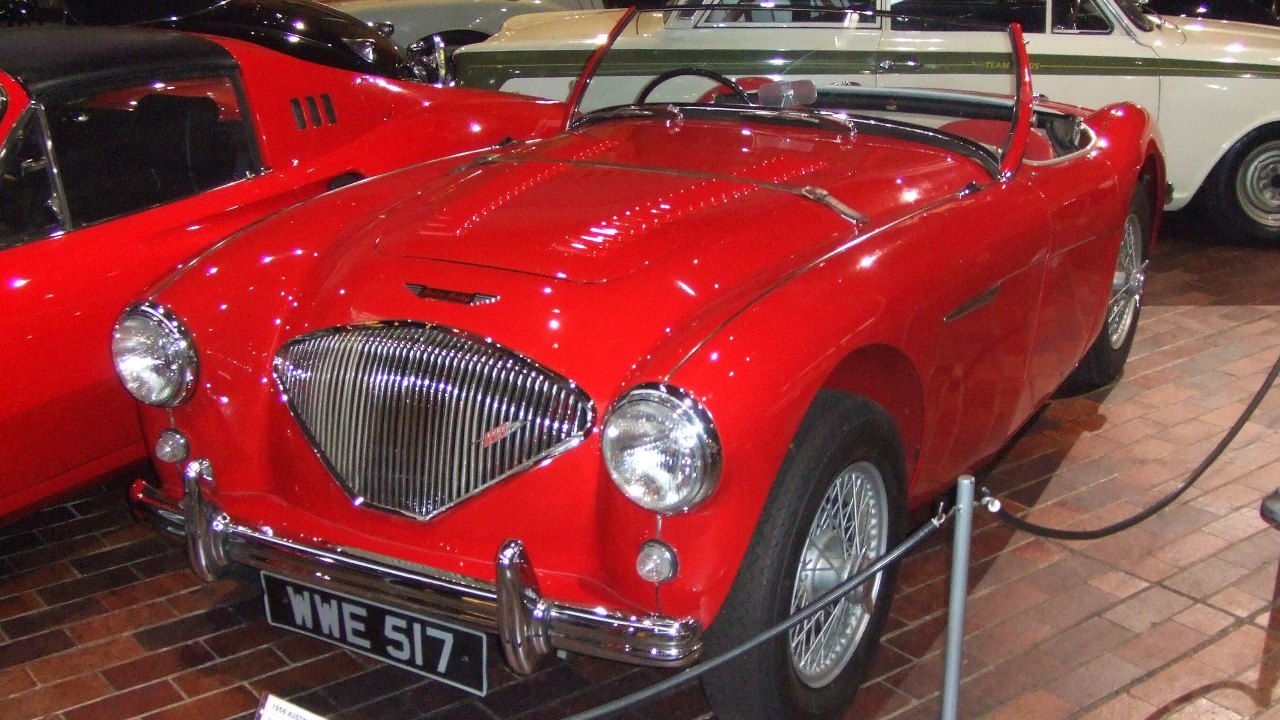
The 1956 Austin-Healey 100M arrived at a moment when British sports cars were expected to be charming, not transformative. By blending genuine competition hardware with road-going civility, it reset what buyers thought a relatively affordable two-seater could deliver. I see that leap in ambition as the reason this short‑run “Le Mans” variant still shapes expectations for how a factory hot rod should look, feel, and perform.
From racer to road car: how the 100M sharpened the 100/4
The Austin Healey 100 had already earned respect as a clean, fast roadster, but the 100M turned that foundation into something more focused. Rather than create an entirely new model, Austin Healey followed its full-competition 100S by offering an upgraded road car that borrowed heavily from the track. Period accounts describe the 100M as a bridge between the stripped racer and the standard BN2, keeping the graceful lines of the original while tightening every dynamic screw. Contemporary enthusiasts still regard the 100M version as perhaps the best combination of all the individual improvements that had been tried on the 100/4 platform, a verdict that underlines how thoroughly it redefined the car’s character.
Under the bonnet, the 100M package built on the standard BN2 engine and chassis rather than replacing them. The base 100/4 was already capable, but the 100M added a higher compression ratio, revised carburetion, and other tuning changes that lifted output beyond the regular car. Reporting on surviving examples notes that the 100M had many sporting improvements over the standard 100/4, making it a superior car in both straight‑line performance and responsiveness. That incremental approach, layering competition know‑how onto a familiar base, is what allowed the 100M to feel like a revelation without abandoning the usability that had made the original 100 so popular.
Le Mans pedigree and the “factory hot rod” idea
What truly raised expectations was not just extra power, but the way Austin Healey framed the 100M as a direct descendant of its endurance racers. The 100M “Le Mans” was introduced as a higher‑performance version of the Austin Healey 100, explicitly marketed as a road car infused with lessons from the 24‑hour circuit. Details like a louvered bonnet and a Le Mans‑specification leather strap were more than styling flourishes, they were visual proof that the car’s upgrades came from real competition work. By tying the 100M so closely to its racing program, the company invited buyers to expect race‑bred engineering in a showroom car, a promise that would become a template for later performance models across the industry.
This positioning also changed how enthusiasts thought about factory tuning versus aftermarket modification. Instead of leaving owners to chase performance through independent specialists, Austin Healey offered a coherent, warrantied package that delivered a sharper engine, improved breathing, and chassis tweaks in one integrated step. Sources on the 100M’s development emphasize that the factory kept scant records and that not all 100M packages were the same, in part because Healey converted some existing 100 models to meet demand. Even with that variability, the idea was clear: a manufacturer could sell a limited‑run, track‑inspired variant that felt meaningfully different from the base car while still being fully road legal and serviceable through normal channels. That concept, which I see echoed later in everything from homologation specials to modern “clubsport” trims, was crystallized in the 100M.
Scarcity, specification, and the problem of authenticity
The 100M’s impact on expectations was amplified by how few were built and how complex their specification turned out to be. It would end up that only 640 factory built 100M LeMans would be realized during the production run, a figure that instantly pushed the car into rarefied territory. To keep up with interest, Healey converted some existing 100 models using similar components, and dealers or independent garages sometimes replicated the upgrades as well. The factory kept scant records, and not all 100M packages were the same, which means that, even today, there is perhaps no model of the Austin-Healey range that is less understood or more misunderstood than this one. That fog of documentation has made originality a central, and sometimes contentious, part of the car’s story.
For collectors, the result is a market where specification and provenance can swing values dramatically. Guides to the model stress that the 100M “Le Mans” is highly prized by collectors and enthusiasts today, but they also warn that caveat emptor applies because of the blurred line between factory‑built cars, period conversions, and later recreations. I find that this uncertainty has, paradoxically, reinforced the 100M’s mystique. The difficulty of proving a car’s status has pushed owners and historians to scrutinize chassis numbers, build sheets, and period photographs with unusual intensity, turning the 100M into a case study in how limited‑run performance variants can challenge the usual assumptions about what counts as “original.” In doing so, it has influenced how the wider classic‑car world thinks about documentation, certification, and the value of factory records.

Driving experience and the new standard for usable performance
On the road, the 100M delivered a blend of speed and civility that set a new benchmark for its price bracket. The standard BN2 engine was up from 90b horsepower in the regular 100/4, and the 100M’s tuning pushed performance further, giving the car stronger acceleration and a more eager response throughout the rev range. Contemporary descriptions highlight how the car’s revised camshaft, carburetors, and ignition settings worked together, rather than feeling like bolt‑on modifications. The 100M also benefited from suspension and braking tweaks that made it more composed at higher speeds, so the extra power could be used with confidence rather than fear.
Crucially, these gains did not come at the expense of everyday usability. The 100M retained the folding windscreen that could drop down flat for competition or spirited driving, yet it still functioned as a practical roadster with weather gear and a comfortable cockpit. Enthusiasts today can see the BN2 and particularly the 100M version for what it is, perhaps the best combination of all the individual improvements that had been tried on the 100/4, preserving the graceful lines of the original while sharpening its responses. That balance, in my view, is what raised expectations for sports cars in this segment: buyers began to look for machines that could feel genuinely racy on a back road without punishing them on the commute home.
Legacy, restoration culture, and why the 100M still matters
Decades later, the 100M’s influence is visible not only in auction catalogs but in the way restoration specialists talk about it. The Austin Healey 100M is described as a rare and highly sought‑after model, known for its racing pedigree and distinctive performance upgrades. Stories of restored cars often emphasize how carefully the original specification has been researched and recreated, from engine internals to the smallest trim details, because the line between a true 100M and a converted 100/4 can be so fine. One account of a 1956 Austin Healey 100M restoration notes how the car was brought back from the wear and tear that comes with age, underscoring the lengths to which owners will go to preserve these machines.
That dedication reflects more than nostalgia. The 100M helped establish the idea that a manufacturer could produce a limited‑run, competition‑inspired variant that meaningfully altered the driving experience while remaining rooted in a mainstream model. Later performance badges, from homologation specials to track‑pack editions, follow a pattern that the 100M helped to define: modest production numbers, targeted mechanical upgrades, and visual cues that signal the difference to those who know what to look for. When I look at the 1956 Austin-Healey 100M today, I see not just a beautifully proportioned British roadster, but a turning point where expectations for what a factory sports car could be were permanently raised.
More from Fast Lane Only:



Leave a Reply