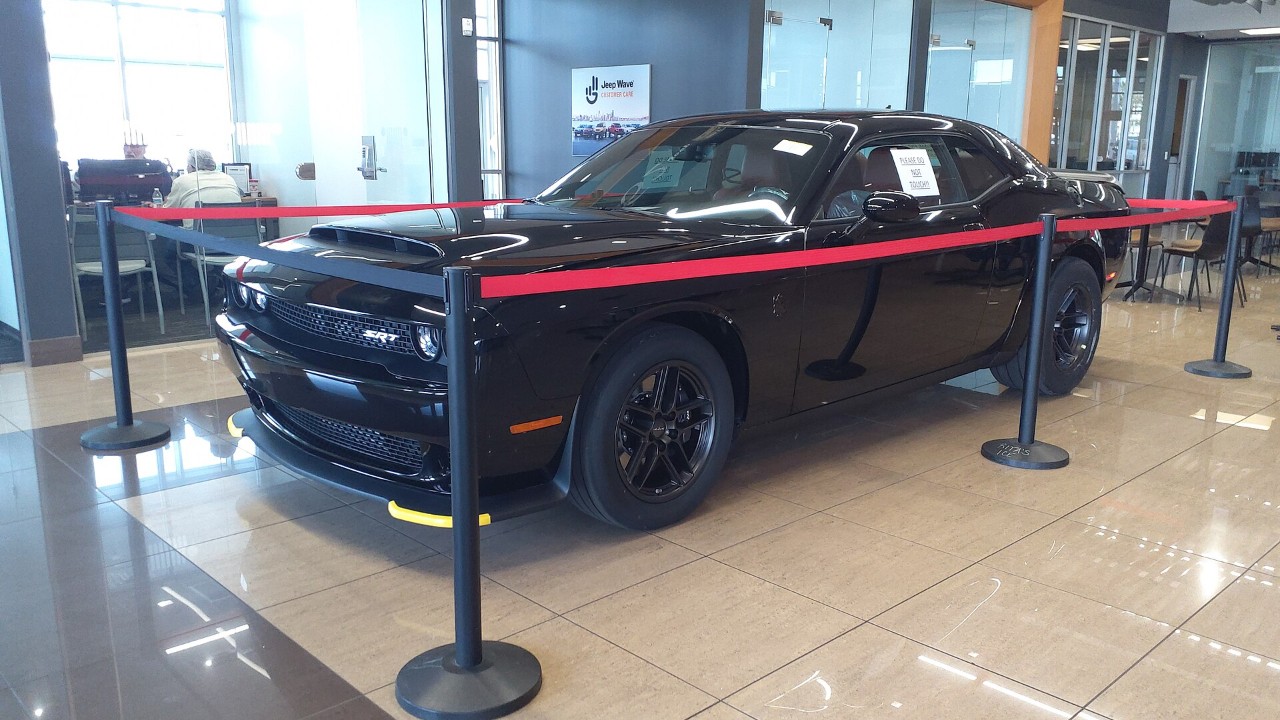
The 2018 Dodge Demon arrived as a factory car that treated the drag strip like its personal playground, and that was exactly the problem. It was so quick in stock form that the sport’s own rulebook suddenly looked out of date, and the National Hot Rod Association found itself cast as the villain in Dodge’s marketing story. I want to walk through how this one Challenger forced racing officials, engineers, and fans to rethink what “street legal” performance should really mean.
The day a showroom car ran a pro-level quarter mile
When Dodge pulled the wraps off the Demon, the headline number was not subtle: the company called it the Fastest quarter-mile car in the world that you could buy off a dealer lot. Under the hood sat a supercharged Hemi rated at 840 horsepower and 770 pounds-feet of torque, numbers that used to belong to tube-frame race cars, not something with air conditioning and a warranty. In testing at Gainesville Raceway in Florida, the NHRA, the National Hot Rod Association, certified the Demon’s quarter-mile performance, effectively blessing a showroom car that could run with purpose-built drag machines.
That certification was more than a bragging right, it was the spark that lit the controversy. Naturally the Demon’s performance numbers drew the attention of the Technical Services Department inside the sanctioning body, which is tasked with making sure anything that quick meets safety standards. The story that followed, about a car so fast it tripped its own rulebook, is what turned the Demon from a fast Challenger into a cultural flashpoint.
How the NHRA rulebook turned into a marketing script

On paper, the Demon’s “ban” came down to a simple rule that had been in place for years. The National Hot Rod Association required any car running 9.99-seconds or quicker in the quarter mile, or reaching a trap speed of 135 mph or greater, to have a roll cage and other race-grade safety gear. The Dodge Demon, incidentally, became the rare production car that could hit those numbers in stock trim, which meant it was officially “too fast for the drag strip” unless owners upgraded the safety equipment. That nuance got flattened into a viral talking point that the NHRA had banned the car outright, a claim that made for great memes but only told half the story.
Dodge leaned into that narrative with a wink. One ad that circulated widely was literally a copy of the NHRA violation letter, shared and dissected in places where fans quoted how Gray went on to explain the safety requirements for a car that quick. Commentators pointed out that the Demon was not uniquely targeted, it simply tripped an existing threshold that plenty of modified cars had already crossed. When I read deeper analyses that urged people to stop saying the 2018 Dodge Demon was banned from the dragstrip, the picture that emerged was less about a crackdown and more about a clever use of fine print as free advertising.
Blurring the line between street car and race car
What made the Demon different was how deliberately it straddled the boundary between daily driver and bracket racer. In official coverage, the Demon and its factory setup were described as blurring the NHRA’s lines between street and strip, because it arrived with drag radials, trans brake functions, and weight-saving options that looked more at home in a trailer than a showroom. Tim Kuniskis, Head of Passenger Car Brands, used a line that stuck with me, saying “We want to impress the NHRA more than the PTA,” a quote that captured how Dodge prioritized quarter-mile glory over school-run practicality and was highlighted in an NHRA feature.
At the same time, the car was engineered to thread the needle of compliance. Detailed breakdowns of the package noted that All of the required safety gear could be installed so the Demon could run legally under NHRA rules, which meant owners were not locked out of competition, they just had to treat the car like the race-capable machine it was. When I look at that balance, it feels less like Dodge pushed too far by accident and more like it intentionally parked the Demon right on the rulebook’s doorstep to force a conversation about what a modern muscle car should be allowed to do.
“Too fast for its own good” and the wheelie factor
Part of the Demon’s legend comes from the way it left the starting line. With the right prep, it could lift the front tires and carry a wheelie, a party trick that led one analysis to call it the world’s first muscle car that could pop a wheelie straight from the factory. That same breakdown framed the situation as “Too Fast For Its Own Good,” noting that the NHRA, the National Hot Rod Association, had effectively banned the Demon from competition unless it met the same safety standards as other nine-second cars. From a fan’s perspective, that tension between outrageous performance and regulatory limits is exactly what made the car feel rebellious.
Outside the marketing bubble, officials were careful to stress that the Demon was welcome on track once it complied with the same rules as everyone else. The NHRA’s own coverage of the car’s testing at Gainesville Raceway in Florida described how Naturally the Demon drew scrutiny from the Technical Services Department, not because it was a Dodge, but because any car running that quick had to be evaluated. When I stack those official explanations against the “banned” headlines, it is clear the phrase “too fast for its own good” was more about storytelling than any permanent exile from the drag strip.
From outlaw to rule-changer
The most interesting part of the Demon saga is what happened next. Over time, the NHRA adjusted its framework so that modern factory rockets could compete without turning into full tube-chassis race cars. A detailed rundown of the change explained that Model years 2014 and up were allowed to run down to nine seconds flat in the quarter, or 5.65 seconds in the eighth, without a full cage, as long as they met other safety criteria. That shift acknowledged that a new generation of production cars could hit numbers that once belonged only to purpose-built dragsters, and it gave owners a clearer path to enjoy that performance at sanctioned tracks.
Coverage of the specific update for the Demon noted that a New Rule Change Allows For New Wave Of Sub 10 Second Vehicles To Run In Competition, and that when the 2018 Dodge Challenger SRT Demon was first certified it ran a factory 9.65-second pass. That is exactly the kind of time that used to trigger an automatic “park it” from tech inspectors. Seeing the rulebook evolve to accommodate that performance makes it hard for me to argue that the Demon pushed too far; instead, it pushed just far enough to force the sport to modernize.
The Demon’s legacy and the next wave of factory drag monsters
The ripple effects of that moment are still visible in the cars that followed. A later model, the Dodge Demon 170, was so extreme that one analysis described how Dodge Demon 170 Specs Get It Exorcised From NHRA Drag Strips, again invoking the language of bans and violation letters. Another overview of factory cars that ran afoul of drag strip rules flatly stated that Dodge Was The First To Fall Foul Of This Rule, tracing the story back to 2017 when Dodge developed a special drag version of the Challenger that could not run legally without changes. When I connect those dots, the Demon looks less like an outlier and more like the first chapter in a broader shift toward factory-built quarter-mile weapons.
Even pop-culture explainers have tried to unpack why the car caused such a stir, from video breakdowns of the reason the Dodge Challenger SRT Demon was flagged by the NHRA to quick-hit summaries that ask Why Did the NHRA Ban the Dodge Demon. Some outlets still lean on the shorthand that it was “so fast the NHRA,” Yep, the National Hot Rod Association, banned it, while others remind readers that the Demon came with everything it needed to be made legal if owners were willing to treat it like the race car it really was. Looking back now, I see a car that did exactly what it set out to do: it embarrassed the PTA, impressed the NHRA, and forced everyone who cares about drag racing to decide how far is too far when the factory itself starts building nine-second street cars.
More from Fast Lane Only: