The 1958 Edsel Corsair arrived with the weight of an entire industry’s expectations on its fins. In the late 1950s, Detroit was convinced that bigger, flashier and more segmented lineups would keep American drivers trading up forever, and Ford poured money into a new marque meant to slot neatly into that logic. Instead, the Corsair became a case study in how even a well funded, technically competent car can be sunk when the economic winds shift and the culture moves on faster than the product plan.
When I look at the Edsel Corsair now, I see less a punchline and more a victim of timing, caught between a fading boom and a looming recession, between chrome heavy optimism and a public suddenly wary of excess. The car’s styling, pricing and marketing were all calibrated for a world that was already disappearing by the time the first examples rolled into showrooms.
The big bet that arrived a year too late
Ford did not treat Edsel as a side project, it treated it as a full scale assault on the mid priced market that sat between Ford and Mercury. The company Launched the brand with enormous expectations, backing it with the kind of resources usually reserved for a new full line division, and the Edsel Corsair was positioned as one of the more upscale offerings in that family. In period footage from Aug, you can feel how confident Detroit was that this new nameplate would reshape the American mid range, with the Corsair pitched as a modern, aspirational step up for families who had outgrown their basic sedans but were not ready for a luxury badge.
That confidence collided with macroeconomics. Historians later pointed out that the United States was sliding into a downturn just as the first Edsels reached dealers, and that the public’s appetite for ambitious new models shrank quickly as recession fears grew. One detailed look at the program notes that the problem, according to historians, was that the United States was entering a recession and buyers were suddenly less interested in the kind of novelty and risk offered by a new brand, a shift that hit the Edsel just as it came off the assembly line. Auto historians later argued that the Edsel was effectively doomed from the start because it launched into the teeth of a nationwide recession, with Auto experts stressing that the car arrived precisely when buyers were pulling back from big ticket purchases and focusing on value instead of flash.
A car styled for yesterday’s future
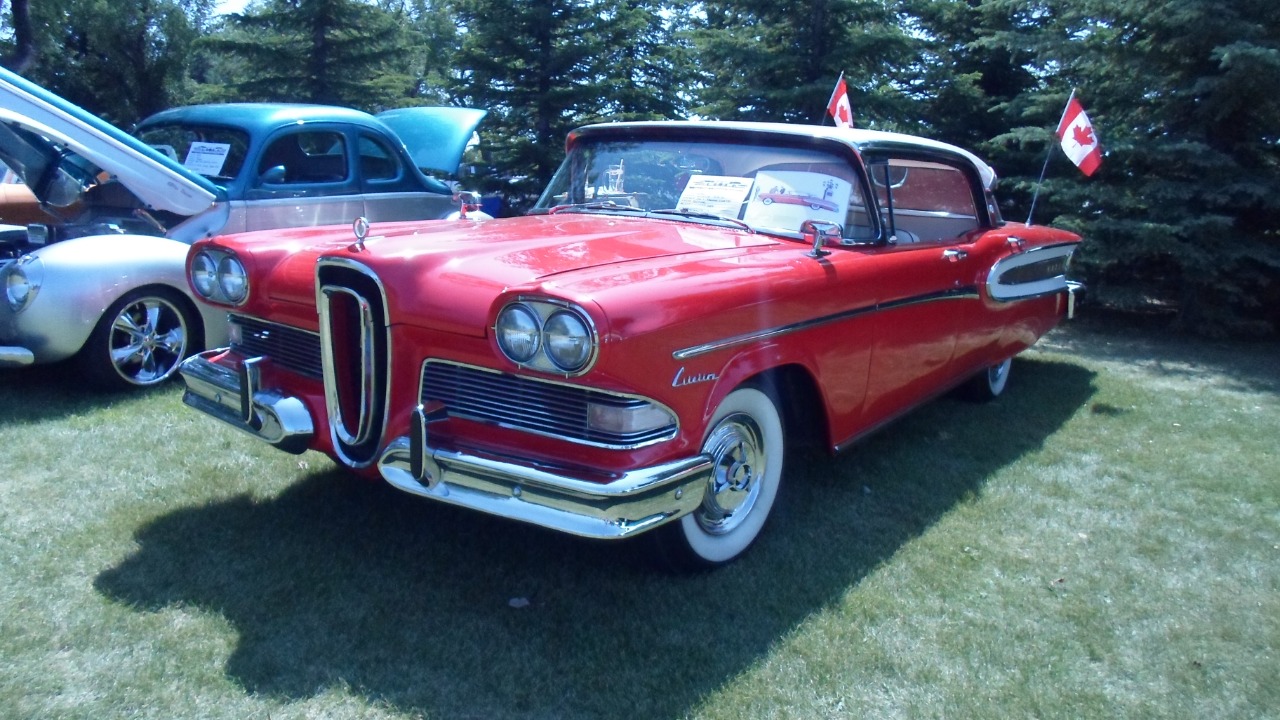
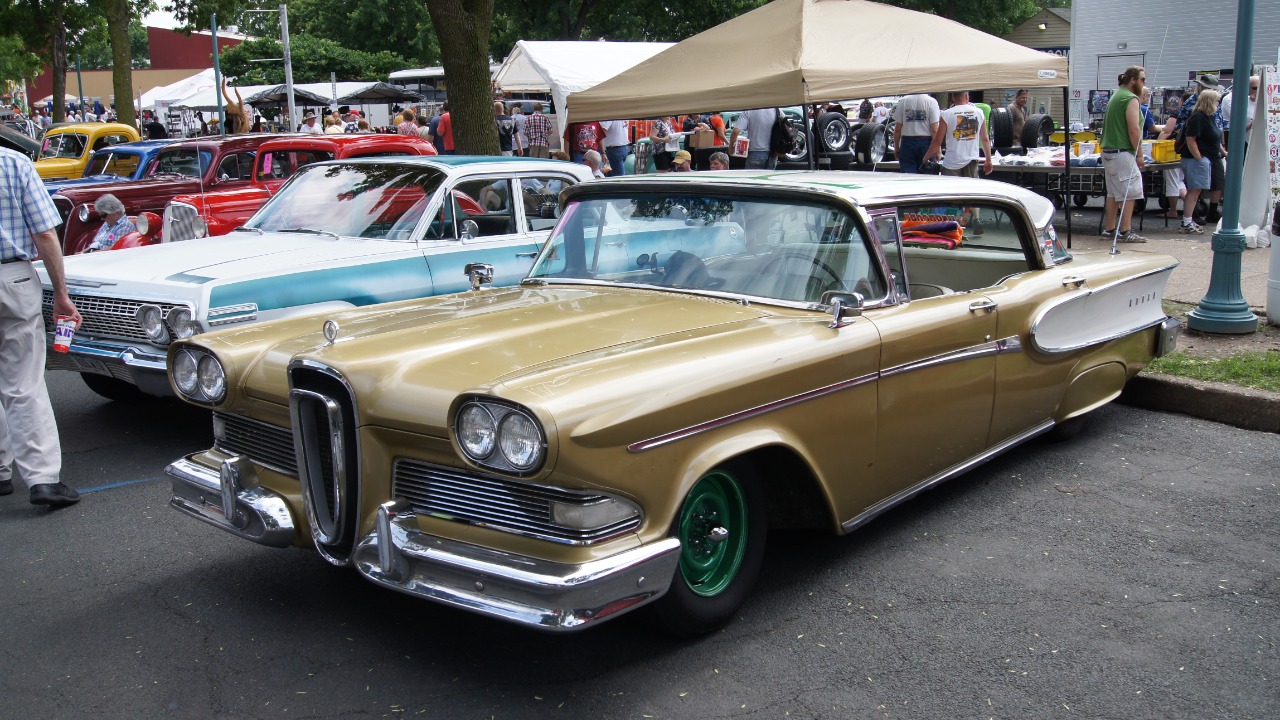
Even if the economy had cooperated, the 1958 Edsel Corsair was visually out of step with where the market was heading. Many vehicles of the late 1950s were already flirting with overwrought styling, but the Edsel pushed that tendency to an extreme, with a tall, vertical grille, heavy chrome and a dashboard that looked like a jet age control panel. One design history notes that Many vehicles of the late 1950’s suffered from overwrought styling and that the ’58 Edsel had the misfortune of being rolled out just before a later wave of cleaner, more restrained designs, a contrast that has been likened to the shock some people felt at the introduction of the Cybertruck, and that context makes the Corsair’s look feel even more like a product of a very specific moment in taste rather than a timeless shape.
Inside, the Corsair tried to sell a futuristic experience, with a steering wheel hub full of transmission buttons and a jet age inspired cockpit that looked impressive in brochures but could be fussy in daily use. Contemporary observers have described how Rather quickly, the 1958 Edsels earned a reputation for poor build quality and reliability, and that criticism extended to the Corsair’s complex interior hardware, which sometimes failed to live up to its promises once the car left the showroom. When I compare the Corsair’s ornate front end and busy dashboard to the cleaner lines that would define early 1960s full size cars, it is clear that the Edsel team was chasing a vision of the future that was already starting to feel dated by the time buyers saw the car in person, a mismatch that undercut the brand’s claim to be forward looking.
The grille that became a punchline
Styling misfires are one thing, but the Edsel’s front end became something harsher, a cultural joke that overshadowed the rest of the car. The company’s designers had been looking at the broad, horizontal grilles that dominated the market and, as one later account put it, Essentially, they looked at all the modern horizontal grills of the time and thought, let us do the opposite. Now that decision gave the Edsel Corsair its signature vertical opening, a shape that was meant to stand out in crowded traffic but instead drew ridicule and off color nicknames that stuck in the public imagination. The grille was supposed to be a bold brand marker, yet it quickly became shorthand for trying too hard.
That reaction is striking when you remember that Edsel’s most memorable design feature was its trademark “horsecollar” grille, which was distinct from that of other cars of the period and which some critics mocked as looking like an Oldsmobile sucking a lemon, a phrase that captured how forced the styling felt to skeptical eyes. I find it telling that even people who appreciate the Corsair’s mechanical virtues still tend to start their stories with that front end, because it shows how a single visual decision can define an entire product line. Once the grille became a late night punchline, it was difficult for the rest of the car to get a fair hearing, and the Edsel name itself became a byword for failure in a way that few other styling experiments ever have.
Quality problems in a hurry up launch
Under the skin, the Corsair shared much with other Ford products, which should have been a strength, but the way the program was executed turned that familiarity into a liability. The focus inside the company was on hurrying and making as many Edsels as possible, and some Edsels arrived at dealers with such shoddy build quality that mechanics had to work overtime just to make the cars presentable or even saleable. That kind of rushed launch left little room for the careful debugging that a brand new nameplate needed, and it meant that early buyers, the very people Ford needed as ambassadors, instead found themselves dealing with leaks, rattles and misaligned trim that did not match the marketing promises.
Those problems were magnified by the way the Corsair was positioned in the showroom. One detailed history of the 1959 Edsel Corsair and its dealers lists Some Major Reasons for Edsel, including Failure tied to Recession and Inflation, but it also notes how dealers struggled with warranty work and customer complaints that ate into already thin margins. By the end of 1958, Auto sales were down through most of the year and everyone was affected, and By the time the Edsel team might have hoped to correct early quality issues, the broader market had turned so sharply that even established brands like Nash were disappearing, leaving little patience for a newcomer that seemed to require extra care. In that environment, the Corsair’s teething troubles were not just an annoyance, they were a reason for buyers to walk across the street to a more familiar badge.
A mid priced car in a shrinking middle
The Edsel Corsair was conceived as a bridge between Ford and Mercury, part of a finely sliced ladder that assumed buyers would climb from basic transportation to more powerful and prestigious models as their incomes grew. From its origins in 1937, Mercury had been conceived as a bigger, more powerful Ford, and Mercury indeed found initial success in the marketplace by giving aspirational buyers a clear step up. The Corsair was meant to slot into that same logic, but by the time it arrived, the economic and competitive landscape had shifted, and the mid priced segment it targeted was being squeezed from both above and below, with value conscious shoppers sticking with cheaper Fords and status seekers jumping straight to established premium brands.
Auto historians have argued that Edsel was probably seen as an independent by some prospective customers, and independent car companies had a very tough time surviving in that period, which meant the Corsair carried the stigma of a risky choice even though it was backed by Ford. At the same time, Auto sales were down and the recession made buyers wary of experimenting with a new badge when they could choose proven models from existing lineups. When I look at the way the Corsair was priced and equipped, it feels like a car built for a middle class that was still there on paper but was behaving more cautiously in practice, trimming options and delaying purchases rather than rewarding a brand new nameplate for its ambition.
Hype, recession and the weight of expectations
Marketing did the Edsel Corsair no favors either. Ford’s own internal and external messaging built the car up as a revolution, with Aug era promotional films from Detroit promising that this American newcomer would change what drivers expected from a mid priced car. The campaign around the launch leaned heavily on the idea that the Edsel was not just another model but a whole new kind of automobile, a framing that raised expectations to a level that any real world product would have struggled to meet, especially one sharing platforms and components with existing cars.
In reality, Instead of delivering a transformative experience, the Corsair arrived as a mix of polarizing styling, quality issues, economic challenges and overhyped promises that combined to drag the 1958 Edsel Corsair toward its historic failure. Analysts who have revisited the launch argue that Poor Timing was central, noting that the timing of the Edsel’s debut could hardly have been worse, since it arrived just as the economy softened and buyers grew skeptical of the kind of novelty offered by a new brand. When I weigh those factors together, I see a car that might have been a modest success in a stronger economy with more restrained marketing, but that was crushed under the weight of its own hype once the recession hit and the narrative turned against it.
From fiasco to cult classic
Time has a way of softening reputations, and the Edsel Corsair is no exception. What was once a fresh failure is now a curiosity that draws crowds at shows, where people linger over the details that once repelled buyers, from the elaborate trim to the unusual dashboard. One retrospective on the 1958 Edsel Corsair notes that the car has become synonymous with the word failure, yet it also points out that the Corsair rode on a solid platform and had plenty of interior room, qualities that make surviving examples surprisingly usable for enthusiasts who are willing to embrace its quirks.
Today, when I see a Corsair parked on a show field, I am struck by how much it encapsulates its era, from the optimism of its launch to the abrupt chill of the recession that followed. Auto historians who revisit the story often mention how Auto enthusiasts now celebrate the Edsel’s 60th birthday with a kind of belated love, recognizing that while the car was a loser when launched, it has earned a second life as a rolling lesson in how product planning, styling and macroeconomics intersect. The Edsel Corsair For consignment listings that describe the car as a piece of history, and that invite buyers to Hold their preconceptions at the door, capture that shift perfectly: the timing that once doomed the Corsair now makes it a fascinating artifact of a very specific moment in American automotive ambition.