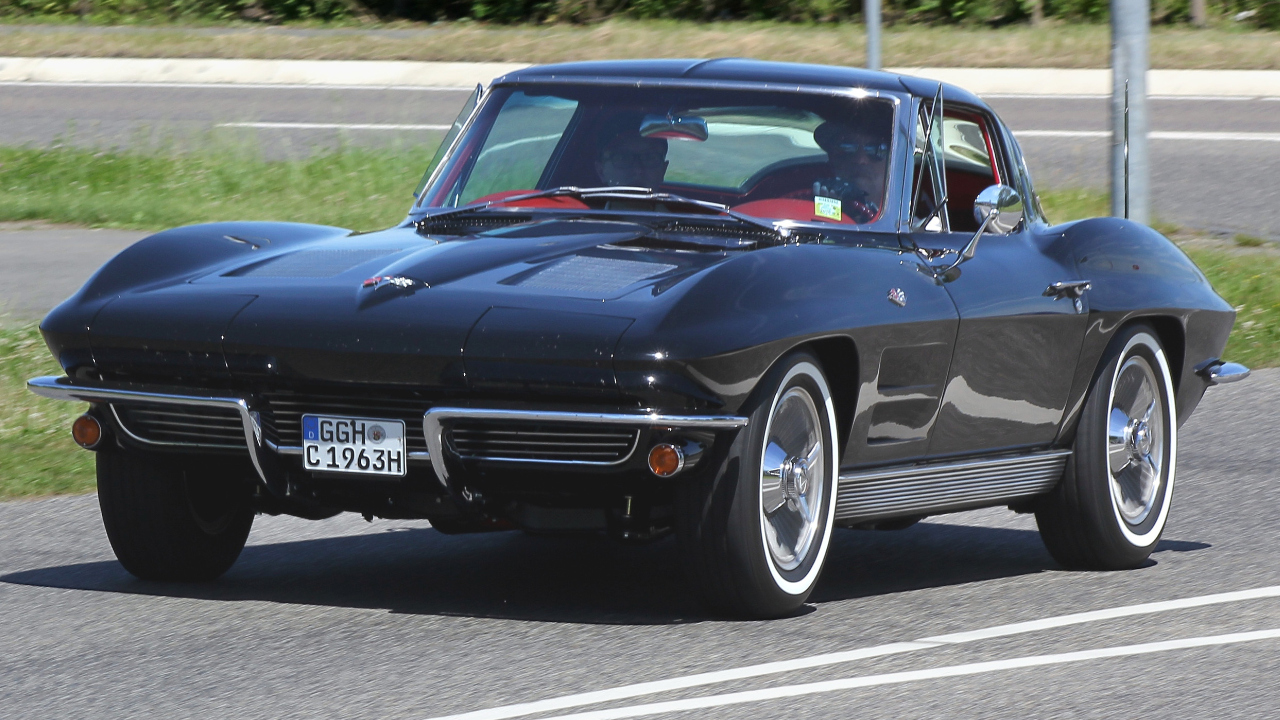
Automakers rarely gamble with their most important products.
When a vehicle becomes the face of a brand, manufacturers usually play it safe. Designers may introduce new styling details or updated technology, but truly radical decisions are often avoided. The risk of alienating buyers is simply too great.
Chevrolet ignored that logic in 1963.
The company was preparing to launch the second-generation Corvette, a car that would redefine America’s sports car. Expectations were enormous. The Corvette had already established itself as Chevrolet’s performance flagship, and the new model needed to compete with increasingly sophisticated European sports cars while maintaining its distinctly American character.
Instead of choosing a conservative design, Chevrolet approved one of the most daring styling features ever installed on a production automobile.
The split rear window.
Only available on the 1963 Corvette coupe, the design divided the rear glass into two sections separated by a vertical spine running down the center of the roofline. It was dramatic, unconventional, and immediately controversial.
Some people loved it.
Others questioned its practicality.
Yet more than sixty years later, the split-window Corvette remains one of the most celebrated American car designs ever created.
Its enduring appeal is a testament to Chevrolet’s willingness to take a risk when it mattered most.
The Corvette Needed a Fresh Start
By the early 1960s, Chevrolet understood that the Corvette needed to evolve.
The first-generation Corvette had established the nameplate and built a loyal following, but sports car design was changing rapidly. European manufacturers were introducing increasingly advanced machines, and American buyers were becoming more sophisticated in their expectations.
Chevrolet wanted the next Corvette to be a genuine world-class sports car.
The company wasn’t interested in simply refreshing the existing design.
It wanted something revolutionary.
The new Corvette would feature dramatic styling, improved engineering, and a level of performance capable of challenging respected competitors from around the world.
That ambition set the stage for one of the boldest design programs in Chevrolet history.
Bill Mitchell Wanted Something Extraordinary
Much of the second-generation Corvette’s appearance can be traced to the influence of Bill Mitchell.
Mitchell had succeeded the legendary Harley Earl as General Motors’ head of design and brought a different philosophy to the role. He favored clean, dramatic forms and often drew inspiration from racing cars and European grand touring machines.
One of the most important influences behind the 1963 Corvette was Mitchell’s personal racing-inspired concept known as the Sting Ray Racer.
The vehicle featured dramatic proportions and distinctive styling cues that would eventually find their way into the production Corvette.
Mitchell wanted the new car to look fast even when standing still.
The split window became part of that vision.
The Split Window Was Inspired by Racing Design
The famous rear window wasn’t created randomly.
Designers believed the divided rear glass reinforced the car’s sleek shape and highlighted the dramatic spine running down the center of the roof. The feature emphasized the Corvette’s flowing lines while giving the coupe a distinctive silhouette unlike anything else on American roads.
The design also reflected racing influences.
Several competition cars of the era incorporated similar visual themes, and Mitchell believed the split window added a sense of sophistication and exclusivity.
The result was striking.
From virtually any angle, the 1963 Corvette coupe looked unique.
No other production Chevrolet had ever featured anything remotely similar.
Chevrolet Approved the Unusual Idea
Perhaps the most remarkable aspect of the split-window story is that Chevrolet actually approved it.
Large corporations are often cautious. Designers frequently create bold concepts that become toned down before reaching production.
The Corvette could easily have followed that path.
Instead, Chevrolet allowed the design to move forward.
This decision required confidence.
The Corvette was not a niche experiment. It was Chevrolet’s flagship sports car and one of the company’s most visible products.
Approving such an unconventional feature demonstrated a willingness to prioritize design innovation over absolute practicality.
That choice remains admirable today.
The Coupe Became Instantly Recognizable
When the 1963 Corvette debuted, people immediately noticed the split rear window.
The feature transformed the coupe into something unforgettable.
Many cars possess attractive styling.
Far fewer become instantly recognizable from a single design element.
The split window accomplished exactly that.
Even casual observers who know little about automotive history can often identify a 1963 Corvette coupe from the rear. The divided glass became a visual signature that separated the car from every competitor.
In marketing terms, the design was incredibly effective.
The Corvette stood out.
And standing out matters.
Critics Questioned Rear Visibility
Not everyone embraced the split window.
One of the most common criticisms involved rearward visibility.
The center divider inevitably created a blind spot directly behind the vehicle. Some owners and reviewers complained that the design sacrificed practicality for appearance.
From a purely functional perspective, they had a point.
A single piece of glass would have provided a clearer view.
The controversy generated debate almost immediately.
Was the split window worth the compromise?
Enthusiasts and journalists discussed the issue extensively.
Chevrolet soon found itself balancing artistic vision against customer feedback.
The Design Lasted Only One Year
Ironically, one reason the split-window Corvette became so famous is because it disappeared so quickly.
For 1964, Chevrolet replaced the divided rear glass with a single rear window. The change improved visibility and addressed complaints from owners.
As a result, the split-window configuration existed for only a single model year.
That limited production run transformed the design into an instant rarity.
Had Chevrolet continued building split-window Corvettes for several years, the feature might not seem nearly as special today.
Instead, the one-year-only status elevated its significance.
Collectors immediately understand they are looking at something unique.
The Sting Ray Was Revolutionary Beyond the Window
While the split window receives most of the attention, it’s important to remember that the entire 1963 Corvette was groundbreaking.
The second-generation Corvette introduced an all-new design, improved chassis engineering, and available independent rear suspension.
These advances dramatically improved handling and overall performance.
The Corvette wasn’t merely beautiful.
It was capable.
The split window became the most visible symbol of a much broader transformation.
Chevrolet had reinvented its sports car from the ground up.
The result changed perceptions of what an American performance car could be.
Collectors Elevated It to Legend Status
Over time, the split-window Corvette achieved legendary status among collectors.
The combination of stunning styling, historical significance, and one-year-only production created extraordinary demand.
Today, 1963 split-window coupes are among the most desirable Corvettes ever built.
Collectors view them as rolling works of art.
The cars represent a rare moment when a manufacturer prioritized bold design over conventional thinking.
That willingness to take risks continues to resonate.
Enthusiasts appreciate the courage behind the decision.
It Became a Symbol of Automotive Design
Few automotive design features achieve lasting cultural recognition.
The split window accomplished exactly that.
The image appears regularly in books, magazines, posters, and automotive museums. It has become one of the defining visual elements of American car design.
The feature’s influence extends beyond the Corvette itself.
Designers often cite the 1963 coupe as an example of how a single styling decision can transform an entire vehicle.
The split window demonstrates the power of originality.
It proves that memorable design often requires taking chances.
Chevrolet Chose Style Over Safety
Looking back, Chevrolet’s decision appears especially bold because the company knowingly accepted criticism in pursuit of a stronger visual statement.
The split window wasn’t the most practical solution.
It wasn’t the easiest choice.
It was simply the most beautiful.
Automotive history is filled with safe decisions that nobody remembers.
The split window represents the opposite.
It was controversial.
It was imperfect.
And it became unforgettable.
The Risk That Paid Off
The 1963 Corvette split-window remains one of Chevrolet’s boldest decisions because it placed design excellence above convention.
At a time when many manufacturers would have chosen the safer path, Chevrolet approved a feature that immediately distinguished its flagship sports car from everything else on the road.
The design lasted only a year, but its impact has endured for more than six decades.
Today, the split-window Corvette is celebrated not because it was practical, but because it was daring.
It represents a moment when Chevrolet trusted its designers, embraced creativity, and produced one of the most iconic automobiles in American history.
Few risks age this well.
This one became a legend.
More from Fast Lane Only