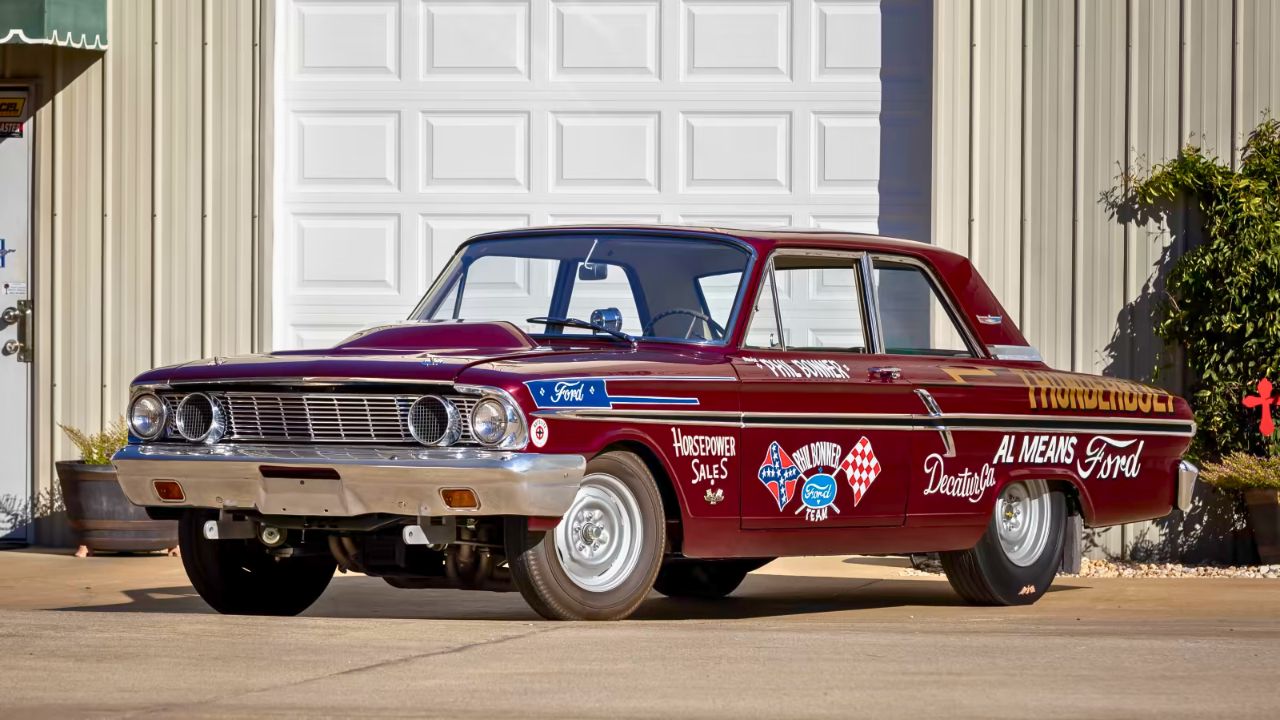
The 1964 Ford Thunderbolt was one of the most extreme factory-built performance cars of the muscle car era. While most high-performance models attempted to balance speed with everyday usability, the Thunderbolt barely pretended to be a street car. It was created with a single goal in mind: winning drag races.
To achieve that objective, Ford engineers stripped away nearly every unnecessary comfort feature they could. Sound insulation disappeared. Luxury options were eliminated. Lightweight materials replaced heavier components. Even basic conveniences that buyers expected in a production car were sacrificed.
The result was a machine that looked like a midsize Ford Fairlane but performed like a purpose-built race car. More than sixty years later, the Thunderbolt remains one of the most legendary examples of a manufacturer prioritizing speed above all else.
Ford Was Locked in a Horsepower War
During the early 1960s, Detroit’s automakers were heavily involved in drag racing competition. Victories at the drag strip translated into showroom credibility, and manufacturers were eager to prove their engineering superiority.
Ford found itself battling rivals from General Motors, Chrysler, and other brands in an increasingly intense performance arms race.
At the same time, new racing regulations limited what modifications could be made to competition vehicles. To remain competitive, manufacturers began producing special high-performance models that qualified as production cars under National Hot Rod Association (NHRA) rules.
The Thunderbolt was Ford’s answer.
Built to Dominate Super Stock Racing
Rather than creating a performance version of an existing model, Ford essentially built a race car that happened to carry a vehicle identification number.
The Thunderbolt was based on the lightweight two-door Fairlane sedan, chosen because its compact size offered a significant weight advantage over larger Ford models.
Engineers then installed Ford’s massive 427 cubic-inch High-Riser V8, one of the most powerful engines available from the company at the time.
With horsepower estimates often exceeding official factory ratings, the combination produced staggering acceleration.
Every design decision centered on maximizing quarter-mile performance.
Weight Reduction Became the Priority
One of the simplest ways to improve acceleration is to reduce weight, and Ford pursued this strategy aggressively.
The Thunderbolt received lightweight fiberglass front fenders, hood, front bumper, and trunk lid. Plexiglass replaced some conventional glass components. Engineers relocated the battery to the trunk to improve weight distribution and traction during launches.
Numerous parts that added weight without improving performance were removed entirely.
The goal was straightforward: make the car as light as possible while remaining eligible for competition.
Comfort Features Were Considered Unnecessary
Because the Thunderbolt was intended primarily for racing, comfort received very little attention.
Many examples were delivered without radios, heaters, armrests, sun visors, and other amenities commonly found in production cars. Sound-deadening materials were minimized or eliminated to save additional weight.
The interior was intentionally basic. Drivers received only what was necessary to operate the vehicle effectively.
Ford understood that Thunderbolt buyers were racers first and consumers second. Few customers purchasing one of these rare machines cared about luxury features when the primary objective was reaching the finish line ahead of the competition.
Even the Heating System Was Removed
One of the most famous examples of the Thunderbolt’s extreme focus involved the heater system.
Since a heater added weight and served no purpose on a race car, Ford eliminated it from most Thunderbolts. To satisfy regulations requiring some form of windshield defrosting capability, engineers installed a simple solution that redirected warm air from the engine compartment.
It was not elegant, but it met requirements while keeping weight to a minimum.
This kind of creative thinking appeared throughout the vehicle.
Performance Justified the Sacrifices
The Thunderbolt’s stripped-down design produced extraordinary results.
Contemporary road tests and drag strip performances demonstrated just how effective Ford’s approach had been. Many Thunderbolts recorded quarter-mile times in the low 11-second range, astonishing performance for a factory-produced vehicle in 1964.
The car quickly established itself as one of the most dominant competitors in Super Stock racing.
Its success validated Ford’s decision to prioritize speed over comfort.
For racers, every missing convenience translated into a faster elapsed time.
Production Numbers Stayed Small
Because the Thunderbolt was designed specifically to satisfy racing homologation requirements, Ford never intended it to become a high-volume production model.
Only approximately 100 examples were built, enough to qualify the car for competition while keeping development costs manageable.
Each vehicle was essentially a specialized performance tool rather than a mainstream consumer product.
This limited production run contributed to the Thunderbolt’s legendary status and rarity today.
A Lasting Motorsport Legacy
The Thunderbolt’s impact extended far beyond its brief production run.
Its dominance on drag strips helped strengthen Ford’s performance reputation during a critical period in automotive history. The car demonstrated what could be achieved when engineers were allowed to focus entirely on performance without worrying about comfort, convenience, or mass-market appeal.
Many enthusiasts consider the Thunderbolt one of the purest factory drag racers ever offered to the public.
Its uncompromising nature remains a major part of its appeal.
A Collector’s Dream
Today, genuine Thunderbolts are among the most valuable and sought-after American performance cars.
Their rarity, racing pedigree, and historical significance make them prized additions to elite collections. Surviving examples regularly command six-figure prices, and exceptional cars can sell for much more.
Collectors appreciate the Thunderbolt not only for its performance but also for what it represents: an era when automakers were willing to build race-focused machines with almost no regard for comfort.
Conclusion
The 1964 Ford Thunderbolt skipped comfort features because Ford’s engineers viewed every unnecessary pound as an obstacle to performance. Built to dominate NHRA Super Stock competition, the car sacrificed radios, heaters, sound insulation, and numerous other conveniences in the pursuit of maximum speed.
The strategy worked brilliantly. By focusing almost entirely on weight reduction and quarter-mile performance, Ford created one of the most successful factory drag racers ever produced. More than six decades later, the Thunderbolt remains a symbol of an era when winning races mattered far more than creature comforts.
More from Fast Lane Only