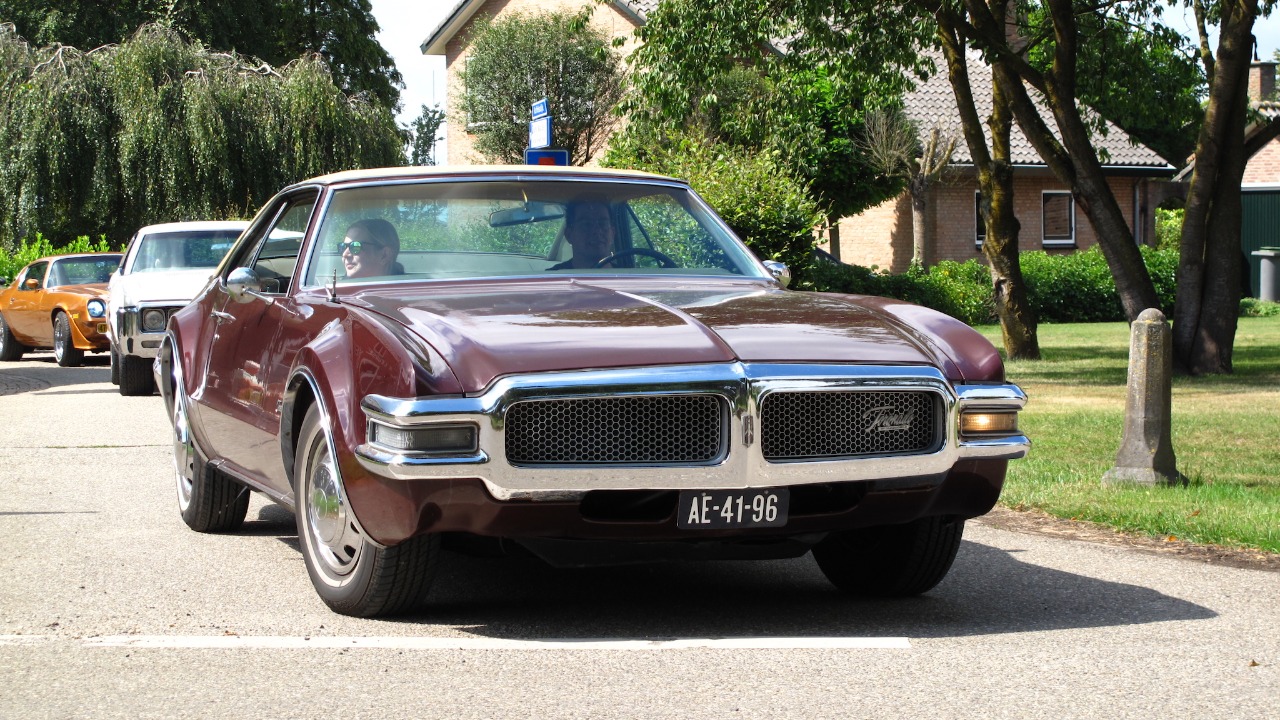
By the late 1960s, most American luxury cars followed a familiar recipe: big V8 up front, power to the rear wheels, and styling that signaled status from a block away. The 1968 Oldsmobile Toronado didn’t ignore that formula so much as rewrite key parts of it. It looked like a personal luxury coupe, but underneath it carried engineering choices that made it stand apart then—and still make it a bit of an oddball now.
Front-wheel drive in a land of rear-wheel drive
The Toronado’s defining quirk was front-wheel drive, a layout that was rare in American cars of the era and almost unheard of in large, powerful luxury coupes. Oldsmobile had introduced the Toronado with this configuration for 1966, and the 1968 model kept that core identity. At a time when “premium” often meant conservative mechanicals, the Toronado asked buyers to accept something genuinely different.
Front-wheel drive changed how the car packaged its mechanical parts and how it behaved on the road. With power going to the front, it eliminated the long driveshaft and rear differential typical of big coupes, which influenced interior space and underbody layout. It also meant the driving feel didn’t match what many American luxury buyers expected, especially under hard acceleration or on slippery roads.
The Unitized Power Package and a very specific challenge
Making front-wheel drive work with a large-displacement V8 wasn’t a simple parts-bin exercise. Oldsmobile used what it called the Unitized Power Package, pairing a big engine with a transmission and final drive designed to send power forward. That setup required specialized engineering to handle torque and durability demands that smaller front-drive cars didn’t face.
The result was a powertrain concept that felt more like a technological statement than a marketing gimmick. While the broader market didn’t rush to copy it, the Toronado proved the idea could be made viable in a full-size American coupe. That alone kept it in a category of its own among luxury-oriented domestic cars.
A personal luxury coupe that didn’t drive like its rivals
In the late ’60s, personal luxury coupes were about smoothness, presence, and effortless speed, and the Toronado delivered those traits while taking a different route to get there. Rivals generally leaned on rear-wheel-drive dynamics and a familiar balance. The Toronado’s front-drive layout altered weight distribution and traction characteristics in ways drivers could feel.
That difference was part of the appeal for some owners and a point of hesitation for others. For buyers used to the way large rear-drive cars settled into a turn or stepped away from a stoplight, the Toronado offered a distinct flavor. It wasn’t necessarily better in every situation, but it was unmistakably not the same.
Design that telegraphed “modern,” not “traditional”
The Toronado’s styling also helped cement its unusual reputation. It didn’t rely on the same formal cues that defined many luxury cars of the period, such as upright rooflines and conventional proportions. Instead, it leaned into a long-hood, sleek-roof personal-coupe look that emphasized motion and modernity.
Even without getting lost in trim-by-trim differences, the broader impression is clear: this was a car that wanted to look advanced. That visual ambition matched the engineering story underneath. For a buyer who wanted something different from the typical prestige coupe silhouette, it stood out quickly.
Oldsmobile’s positioning: upscale, but willing to experiment
Oldsmobile sat in a particular place in GM’s lineup—more upscale than Chevrolet and Pontiac in many buyers’ minds, but not as tradition-bound as Cadillac. The Toronado fit that niche well because it offered luxury-car size and comfort while also serving as a technical showcase. It was a reminder that “luxury” in the American sense didn’t always mean playing it safe.
That corporate context matters because it helps explain why the Toronado existed at all. A more conservative brand might not have risked introducing such a layout in a big coupe, especially when the established formula sold well. Oldsmobile had room to be bold, and the Toronado was one of the boldest bets it made.
Comfort and cruising remained central
Despite the engineering headline, the Toronado was still aimed at people who wanted a comfortable, confident long-distance car. These were big, well-equipped coupes built for American roads and American travel habits. The front-wheel-drive setup didn’t turn it into a sports car; it simply made the underlying approach to luxury less predictable.
That blend of traditional comfort with unconventional hardware is a big reason it remains memorable. Plenty of cars are comfortable, and plenty are quirky, but it’s rarer to find one that’s both in a mainstream luxury context. The Toronado managed to be soothing and strange at the same time.
Why it stayed unusual instead of starting a trend
If the concept worked, it’s fair to ask why it didn’t reshape the luxury market overnight. Part of the answer is inertia: rear-wheel drive was familiar, widely supported, and aligned with how Detroit had built big cars for decades. Tooling, service knowledge, and buyer expectations all favored the status quo.
There was also the reality that front-wheel drive in a large, powerful coupe brings its own compromises. Engineers can manage those tradeoffs, but they can’t erase them, and other manufacturers may have decided the benefits weren’t worth rethinking an entire platform. The Toronado didn’t fail so much as remain a specialized solution in a market that didn’t demand it.
Its legacy is the confidence to be different
Today, the 1968 Toronado is often remembered less for any single specification and more for the idea it represented. It was a luxury-oriented American coupe that took a real engineering detour, not a mild variation on the usual theme. That willingness to diverge is what makes it easy to talk about decades later.
It also highlights a moment when American manufacturers were willing to put genuinely unconventional technology into aspirational cars. Even among other distinctive late-’60s luxury coupes, the Toronado’s layout keeps it in its own lane. For anyone who likes their classics with a side of mechanical curiosity, it’s hard not to respect that.
More from Fast Lane Only
- Unboxing the WWII Jeep in a Crate
- 15 rare Chevys collectors are quietly buying
- 10 underrated V8s still worth hunting down
- Police notice this before you even roll window down
*Research for this article included AI assistance, with all final content reviewed by human editors.