The 1969 Dodge Daytona was not styled to look wild in a showroom. It was shaped to slice through the air at nearly 200 miles per hour on high-banked ovals, even if that meant a nose like a battering ram and a rear wing that towered over the roofline. The car existed because Dodge decided that, for a brief and radical moment, pure aerodynamic speed mattered more than convention, comfort, or even long-term rule stability.
From pretty loser to “Something had to be done”
By the late 1960s, Dodge had a problem that horsepower alone could not fix. Its sleek new 68 Charger looked like a winner in the showroom, but at high speed the recessed grille and tunneled rear window turned the body into a brick that trapped air and made the car unstable on the banking. One period account flatly notes that Something had to be done from Dodge’s point of view, because Its Charger was fast in a straight line yet extremely hard to handle in the dirty air of a NASCAR pack. The company could keep adding power, but as one later wind tunnel test put it, horsepower can only get you so far when you are fighting the wind.
That realization pushed Dodge toward a mindset that was closer to aerospace than to traditional Detroit styling. Engineers began to treat the Charger’s body as a problem in airflow management rather than chrome and curves, a shift that would eventually produce the Daytona’s pointed nose, flush backlight, and towering rear wing. When a later test compared a standard Charger to the Daytona, the modified car showed less drag, less front end lift, and more downforce than the regular Charger, confirming that the radical shape was not a gimmick but a functional solution to a high speed stability crisis.
How wind tunnels and a Missile Division reshaped a stock car
Once Dodge committed to solving the airflow problem, it leaned on tools and expertise that were unusual for a stock car program at the time. The company took the Charger body into a wind tunnel and began systematically reshaping it, using data rather than guesswork to decide how sharp the nose should be and how the rear window should meet the decklid. One later account of the Plymouth Superbird notes that Dodge had made history creating this aero package using data gathered from a wind tunnel, and that the company was the first Amer manufacturer to apply that level of aerodynamic science to a NASCAR-bound production car. The result was a front end that traded the Charger’s recessed grille for a long, pointed nose cone that cut through the air instead of scooping it.
Inside Chrysler, the effort drew on a culture that already understood high speed airflow. Fans still repeat the line that “And Chrysler Had a Missile Division,” a nod to the engineers who had worked on rockets and then turned their attention to race cars. In enthusiast retellings like The Charger Daytona and Plymouth Super Bird Story on a NASCAR forum, that Missile Division connection is treated as more than a joke, it is shorthand for the way Chrysler applied aerospace thinking to stock car shapes. The Daytona’s smoothed body, faired-in backlight, and carefully sized wing were not the product of a stylist’s sketchpad, they were the output of engineers who treated the car like a low flying projectile that had to stay stable in turbulent air.
The Wing Cars and that towering spoiler
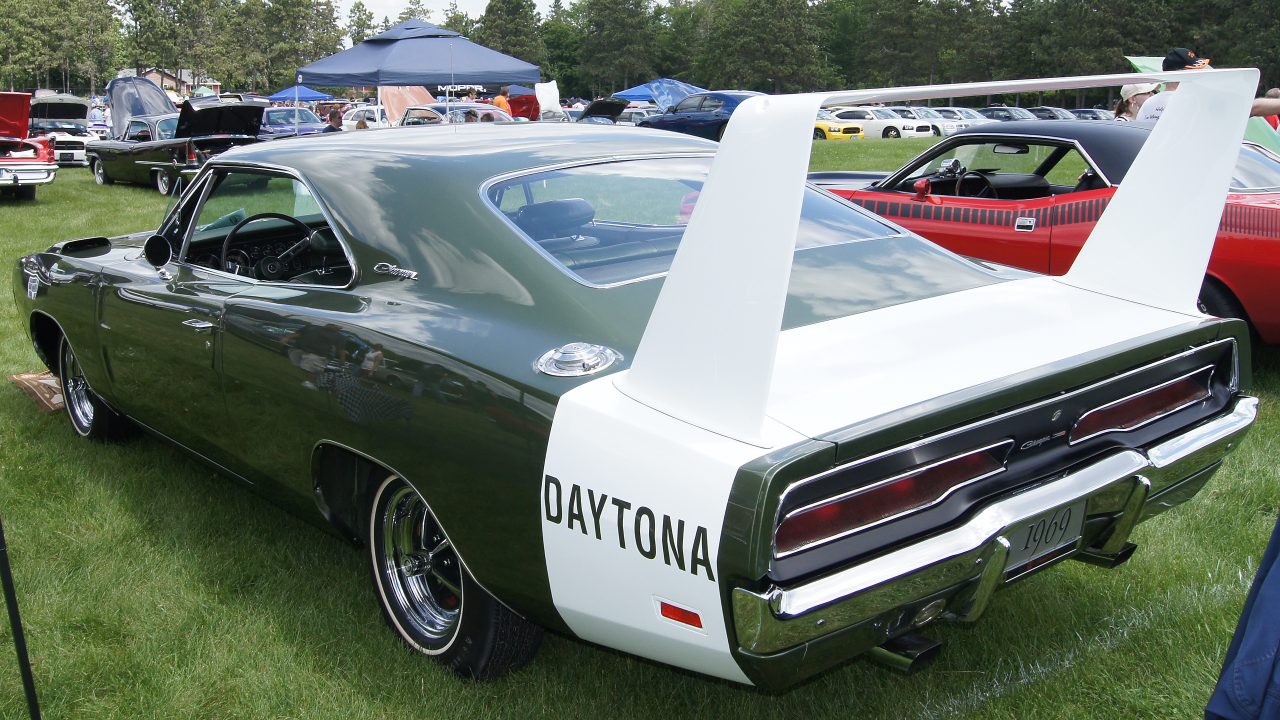
The most visible symbol of Dodge’s aerodynamic obsession was the rear wing that turned the Daytona into one of Chrysler’s famous Wing Cars. These machines earned the nickname because the huge wing towers over the back ends of the cars, visually overwhelming the rest of the bodywork. On the 1969 Dodge Daytona, the spoiler was not a decorative flourish, it was a carefully sized airfoil designed to plant the rear tires at speeds that made conventional muscle cars feel nervous and light. Later analysis of the Daytona’s aerodynamics compared to a modern Charger Hellcat found that the Daytona generated more downforce with less drag than the regular Charger, a balance that depended heavily on that rear wing.
Period measurements underline how extreme the hardware really was. One heritage account describes the huge rear wing as measuring some 58 inches across and sitting 23.5 inches off the decklid, dimensions that put the top of the airfoil nearly at an adult’s shoulder height. Another explanation of why the 1969 Dodge Charger Daytona’s spoiler is so tall notes that the height was not about show, it was about getting the wing up into cleaner air above the turbulent flow coming off the roof and rear quarters instead of the rear quarters alone. By lifting the airfoil into that smoother stream, engineers could generate consistent downforce without adding a massive amount of drag, which was exactly what a high speed oval racer needed.
From wind tunnel to Super Speedway domination
The payoff for all that wind tunnel time and those outlandish shapes came when the Daytona reached the track. On the high banks of Talladega, the car’s pointed nose and tall wing turned raw horsepower into stable, repeatable speed. A detailed retelling of why NASCAR later banned the car opens with a scene at Talladega Super Speedway, where Charlie Glattsbach, identified in that account as Glattsbach, drops the hammer on a qualifying lap that left officials and rivals staring at the stopwatch. The Daytona’s ability to hold the racing line at speeds that had previously pushed cars toward the wall was exactly what Dodge had designed it to do.
Other narratives about the car’s competition life emphasize how alien it looked even as it delivered results. One video essay describes how the car looks like something a kid would draw after watching too many cartoons, while noting that NASCAR officials were watching nervously as the Daytona’s speed numbers climbed. Another calls the machine a 1969 Dodge Charger Day with a rear wing nearly as tall as an adult’s shoulders, underlining how far the design had strayed from the stock silhouettes fans were used to. Yet when the Daytona was tested in a modern wind tunnel alongside a contemporary Dodge Charger SRT Hellcat, the data backed up the period impressions, After months of work, the Dodge Charger Daytona showed that its slippery shape and wing package still delivered serious aerodynamic efficiency compared with a far newer sedan.
Too fast for the rulebook, but a lasting aero legacy
The Daytona’s success created a problem for NASCAR’s rule makers. The car, along with its corporate sibling the Plymouth Superbird, was so effective at turning power into speed that it threatened to turn races into a contest of who could afford the most advanced aero program rather than who had the best driver and engine. The official record on the Dodge Charger Daytona notes that Because of their exceptional speed and performance, NASCAR subsequently changed the rule book, effectively banning all four of the so called aero warriors by the end of 1970. In other words, the very purity of the Daytona’s aerodynamic focus, the thing that made it so fast, also made it politically untenable in a series that still wanted its cars to look and behave like showroom models.
Yet the ideas that shaped the Daytona did not disappear when the rules closed in. The Plymouth Superbird carried the same basic aero package into another season, and later histories of that car point out that Dodge had made history with its wind tunnel work and its status as the first Amer manufacturer to chase maximum downforce and efficiency so openly on a stock car. Even outside NASCAR, builders took lessons from the Wing Cars, shaving drip rails and smoothing body seams on brick shaped street machines in search of a little less drag, as one account of a heavily modified 1966 Coronet 500 notes when it begins, Even though the car is a bit brick-shaped, advances in aerodynamics were achieved with subtle body changes. The 1969 Dodge Daytona may have been too single minded in its pursuit of pure aerodynamic speed for a long life in competition, but its towering wing and sharp nose proved that in the battle against the air, shape can matter more than sheer power.
More from Fast Lane Only: