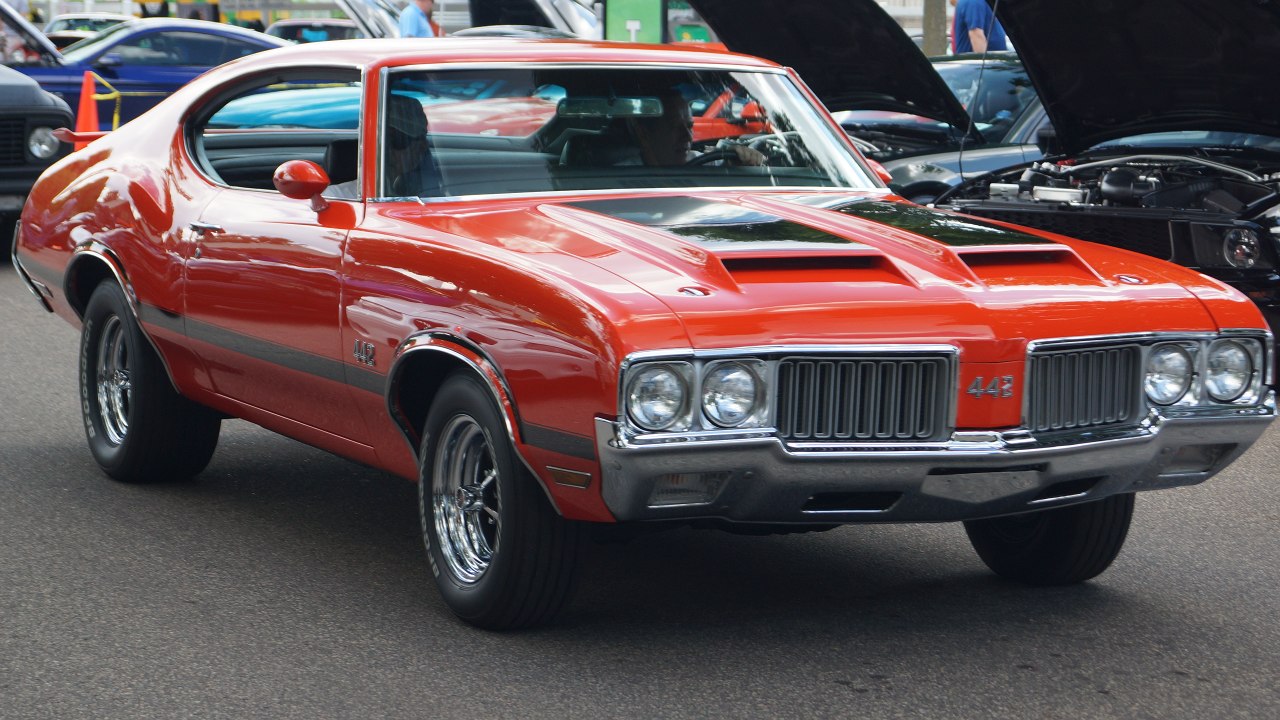
The 1970 Oldsmobile 442 occupies a rare place in muscle car history, a machine that still silences a parking lot the moment its badge comes into view. Its mix of brutal acceleration, understated luxury, and technical sophistication has given it a reputation that has only grown stronger with time, even as many of its rivals have faded into nostalgia pieces.
More than half a century later, enthusiasts and collectors continue to treat the 1970 442 as a benchmark for what an American performance car can be. It represents the moment Oldsmobile pushed beyond the usual straight-line bravado and created a muscle car that could impress both at the drag strip and in the country club driveway.
The peak of Oldsmobile performance
By 1970, Oldsmobile had reached what many consider the high point of its performance development, and the 442 sat at the center of that achievement. General Motors had lifted its internal limit on engine displacement in intermediate cars, ending the unofficial cap at 400 cubic inches, which opened the door for Oldsmobile engineers to install far larger powerplants in the midsize Cutlass-based 442. That change allowed the division to move beyond earlier constraints and fully join the escalating horsepower race that defined the era.
With the new freedom, Oldsmobile equipped the 1970 442 with a massive 455 cubic inch V8, a configuration that period documentation describes as the pinnacle of the brand’s muscle car output. The model’s status as a second generation evolution of the Cutlass platform meant it could combine this new level of power with a more refined chassis and styling package, raising the bar in the ongoing competition among Detroit’s performance divisions. In that context, the 1970 442 was not simply another option in a crowded field, it was Oldsmobile’s definitive statement about what its performance cars could deliver.
Power that still intimidates
The respect commanded by the 1970 Oldsmobile 442 begins under the hood, where the numbers remain impressive even by modern standards. Period specifications describe a standard 400-cubic-inch V8 rated at 330 horsepower and 440 lb-ft of torque, already enough to place the car among the stronger muscle machines of its day. The move to the 455 cubic inch engine pushed things further, with one widely cited configuration rated at 365 horsepower and a towering 500 lb-ft of torque, figures that still read like a challenge to contemporary performance cars.
For buyers who wanted the most aggressive setup, Oldsmobile offered the W-30 performance package on the 442, a combination that raised output to as much as 370 horsepower from the 455 V8. Factory literature and enthusiast accounts describe the W-30 as “Built for” serious performance, with upgrades that turned the car into one of the most feared street machines of its era. The availability of both manual and automatic Transmission options meant the 442 could be tailored to drag racers or boulevard cruisers alike, reinforcing its reputation as a car that could dominate in a straight line while still functioning as a daily driver.
More than brute force: the “gentleman’s hot rod”
What sets the 1970 Oldsmobile 442 apart from many of its contemporaries is the way it blended that power with a level of refinement that enthusiasts still single out. Oldsmobile was widely regarded as the luxury brand within General Motors, and commentary on the 442 often notes that “They” did not build cars that felt cheap or crude. One enthusiast comparison that places the 1970 Chevelle SS 454 alongside the 442 W-30 goes so far as to call the Chevrolet a legend, “But the Oldsmobile” a masterpiece, underscoring how the 442’s more upscale interior, detailed trim, and composed road manners elevated it beyond a simple drag-strip special.
That combination of civility and speed has led some observers to describe the Oldsmobile 442 as “Most underrated muscle car of that era” and “the gentleman’s hot rod,” a car that could impress both performance purists and those who valued comfort and style. Comments from owners and admirers, such as Sharon King’s succinct “Beautiful 442!!!” capture the enduring appeal of its proportions and detailing. The Oldsmobile Cutlass 442 is frequently cited as one of the most legendary muscle cars of the 1960s and 1970s precisely because it married raw power with refined styling, a balance that continues to resonate with modern collectors who want more than a stripped-down racer.
A name and heritage that still resonate
The 442 badge itself carries a weight that helps explain the model’s lasting prestige. The designation originally referred to a four-barrel carburetor, a four-speed manual transmission, and dual exhaust, a formula that signaled serious intent even before the hood was opened. Enthusiast histories of the 4-4-2 lineage emphasize that this meaning remained part of the car’s identity even as Oldsmobile later offered different transmission options, and the name continued to evoke the original high performance specification. References to the 4-4-2 as a famous performance name within the division highlight how Oldsmobile leaned on that heritage whenever it needed to draw attention to its most capable models.
By 1970, the Oldsmobile Cutlass 442 had become a second generation model that built on this reputation, and contemporary descriptions of the car stress how it raised the bar in the muscle car horsepower race. The 442 name appeared not only on coupes and convertibles but also on rarer variants such as the Olds Vista Cruiser 442, a wagon that enthusiasts note was equipped with a 4 speed manual shift with 4 Barrel and dual exhaust. That breadth of application reinforced the idea that 442 signified a performance standard rather than a single body style, and it helped cement the badge as one of the most recognizable in American muscle car history.
Rarity, value, and enduring status
The market’s treatment of the 1970 Oldsmobile 442 offers a concrete measure of the respect it still commands. Valuation guides indicate that a 1970 Oldsmobile 4-4-2 in good condition with average specification typically brings around $49,350, a figure that reflects strong demand relative to many other period intermediates. Special versions, particularly those equipped with the W-30 package, can reach far higher prices, as illustrated by auction results where a well documented 1970 Oldsmobile 442 W-30 has crossed the block for six-figure sums. That same W-30 combination is described as a relatively low production model, with “Price and Rarity” notes citing about 2,574 units, a scarcity that naturally supports higher valuations.
Enthusiast groups and heritage collections consistently describe the 1970 Oldsmobile 442 as a classic muscle car that blends power, style, and performance, making it one of the standout models in the horsepower wars of the early 1970s. The car is often labeled one of the most powerful and respected muscle cars of its era, and modern builds that start with a 442 shell and add contemporary hardware, such as LS7 swaps and upgraded suspensions, show how the platform continues to serve as a foundation for serious performance projects. That ongoing relevance, combined with its documented rarity and strong pricing, explains why the sight of a 1970 442 still prompts instant recognition and deference among those who know what it represents.
More from Fast Lane Only