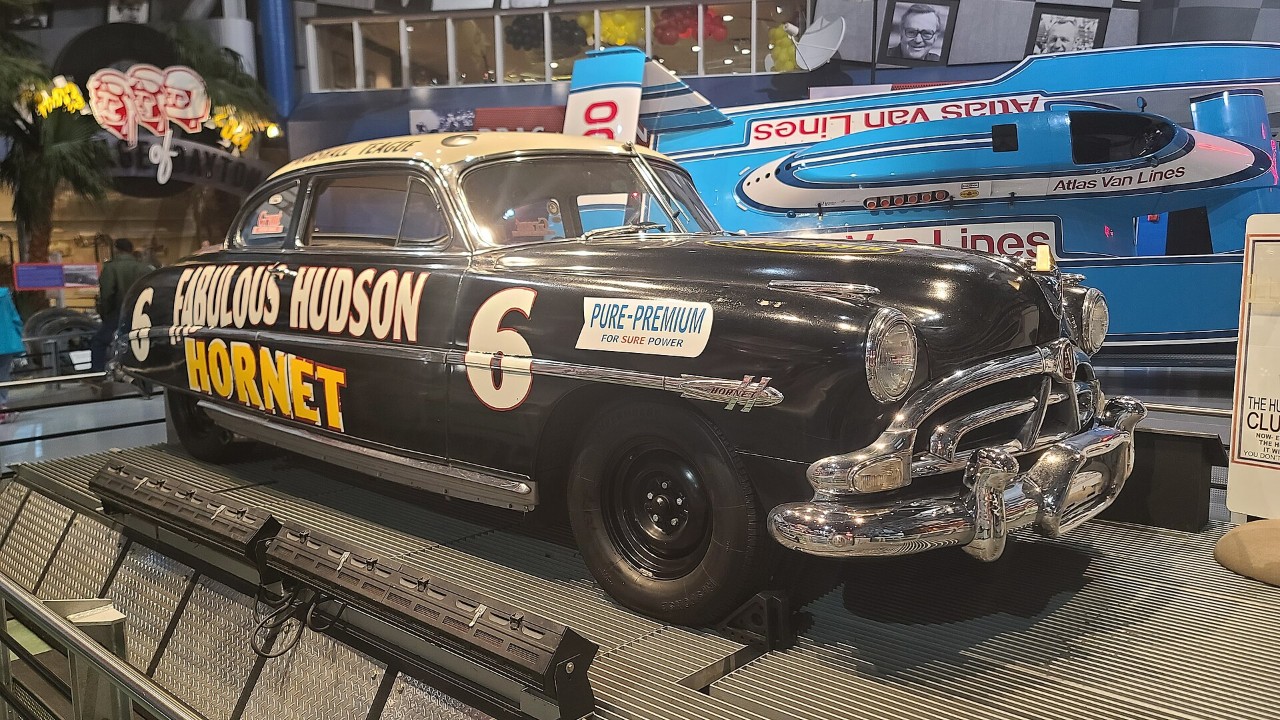
In 1952, Hudson Hornets won 27 of the 34 races on NASCAR’s top series. The 1952 Hudson Hornet did it with a big six-cylinder engine. That works out to a winning rate of 79.4 percent, and it remains the brand’s best season.
Hudson sold the idea with a simple slogan: “Win on Sunday, Sell on Monday.” For a few seasons in the early 1950s, its six and its low-slung body backed that up.
Here’s what made the car work, who drove it, and how the run ended.
What made the 1952 Hudson Hornet fast
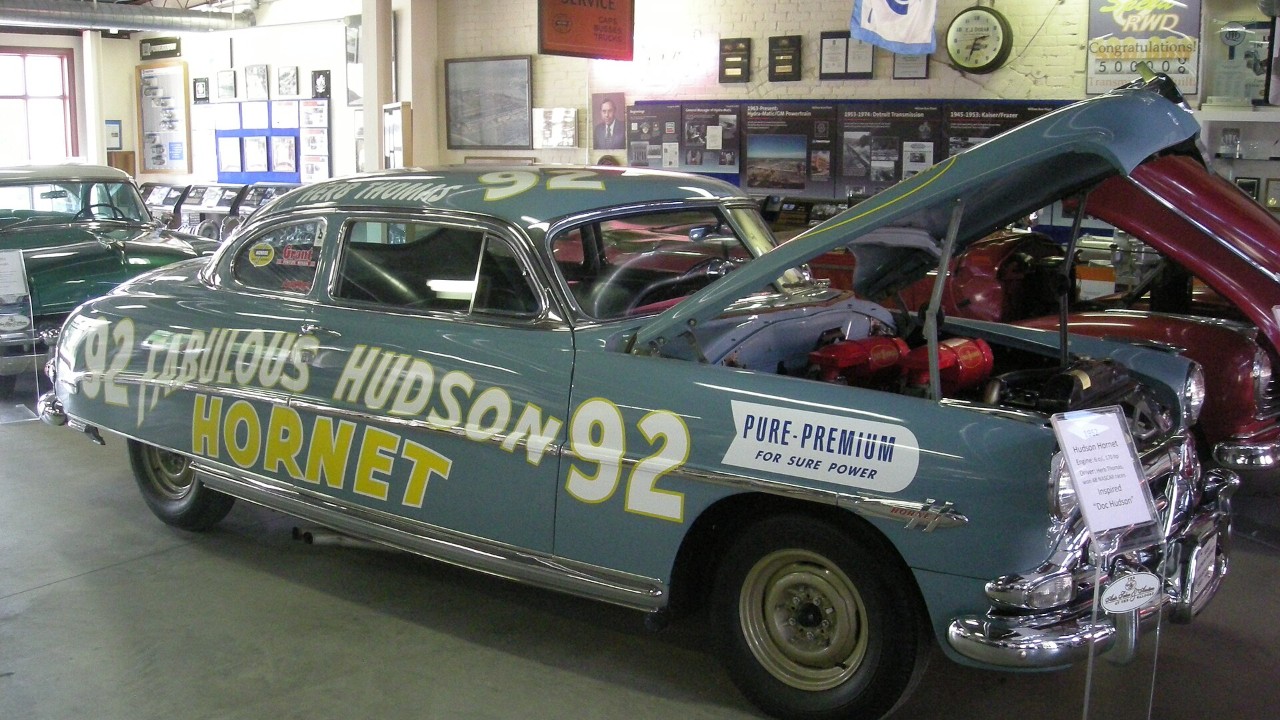
To begin with, the Hornet debuted for 1951. According to Hagerty, Hudson took the 262-cubic-inch six from the Commodore and enlarged it to 308 cubic inches. With a two-barrel carburetor, it made 145 horsepower and 275 lb-ft of torque.
Then Hudson turned up the wick. For 1952, Hagerty says, the Twin-H option added dual single-barrel carburetors and raised output to 170 horsepower. Later, the 7-X package pushed it to 210 horsepower. The Simeone Foundation Automotive Museum gives the same 145, 170 and 210 figures. It also calls the L-head six “the largest six-cylinder engine in the world” in its day.
In addition, the body helped as much as the engine. Hudson’s “step-down” design recessed the floor pan, so riders stepped down into the car. As a result, the Hornet sat low. The NASCAR Hall of Fame describes the racing Hudsons as lightweight cars with a low center of gravity.
How the wins piled up
First, the momentum started in 1951. Hagerty says Hudsons won 12 of the 41 races that year, including the season-opening Grand National at Daytona. Marshall Teague took that Daytona Beach & Road Course win, according to the NASCAR Hall of Fame.
Then came 1952. The Hall says Hornets won the first six races of the year and 11 of the first 12. Bill Blair finally broke that streak in an Oldsmobile at Lakewood Speedway. Between early June and early July, Hudson drivers also won seven in a row. By season’s end, the 1952 Hudson Hornet count stood at 27 wins in 34 races.
Season openers became a Hudson habit, too. From 1951 to 1955, Hornets won the opening race four times, the Hall says. The only exception was Lee Petty’s 1953 win in a Dodge at West Palm Beach.
After that, the pace held for two more years. The Simeone museum lists 22 wins in 37 races for 1953 and 17 in 37 for 1954. Hagerty, likewise, counts 39 more victories over those two seasons.
The drivers behind the Fabulous Hudson Hornet
Of course, several drivers carried the Hudson name. Teague’s No. 6 car wore the “Fabulous Hudson Hornet” name, Hagerty says. According to the NASCAR Hall of Fame, Teague made 19 Cup starts in 1951 and 1952 and won seven, all in a Hudson. The Simeone museum adds that he won 14 AAA races in his Hornet.
In fact, Teague also helped bring the factory in. The Hall credits him with drawing Hudson Motor Car Co. into NASCAR. By the Hall’s account, Hudson became the first manufacturer to publicly support racing in the series.
Above all, Herb Thomas became the star. He won NASCAR titles in 1951 and 1953, making him the series’ first two-time champion, according to the Hall’s profile of his career. He also ran a Hudson bearing the “Fabulous Hudson Hornet” name from 1951 to 1954.
His numbers hold up even now. The Hall credits Thomas with 48 premier-series wins in 228 starts, about 21 percent of the races he entered. That winning percentage remains a NASCAR record, according to the Hall. In addition, he became the first three-time winner of the Southern 500 at Darlington, and he won 12 races in both 1953 and 1954.
Meanwhile, the 1952 title went to Tim Flock. The Hall says he won it in a Hornet owned by Ted Chester. Dick Rathmann also won 13 races for Hudson, and Flock won 10, by the Hall’s count.
Titles, totals and the end of the line
Hudson won the NASCAR manufacturers’ championship in 1952, 1953 and 1954, according to the Hall. Its “Fabulous Hudson Hornets” history puts Hudson’s total at 79 premier-series wins from 1951 to 1955. Herb Thomas alone scored 39 of them, according to the Hall’s profile of his career.
However, the race wins could not save the company. The Hall notes that Hudson merged with Nash-Kelvinator in 1954 to form American Motors Corp. After that, the 1955 Hudsons were essentially rebadged Nash models, it says.
Today, the car lives on in another way as well. Pixar’s Doc Hudson, voiced by Paul Newman in “Cars,” drew on Herb Thomas’s career, the Hall says. Hudson production itself ended on June 25, 1957.
More from Fast Lane Only
- Unboxing the WWII Jeep in a Crate
- 15 rare Chevys collectors are quietly buying
- 10 underrated V8s still worth hunting down
- Police notice this before you even roll window down
This article was created with the help of AI and was reviewed and edited by Fast Lane Only editors before publication.