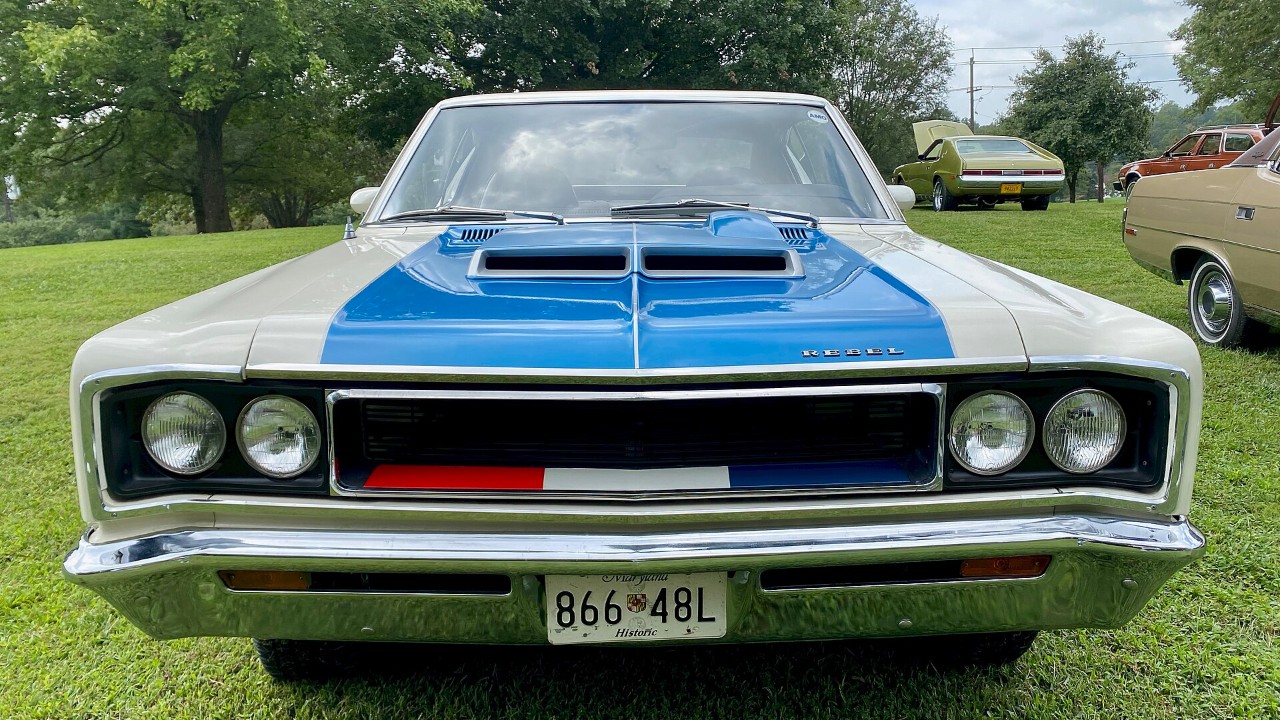
The 1970 Rebel Machine was AMC’s midsize muscle car, and its most famous gauge sat outside the cabin. The Rebel Machine hood tachometer rode on the back of a big ram-air scoop, facing the driver through the windshield. Under that scoop, AMC fitted a 390-cubic-inch V8 rated at 340 horsepower.
The car lasted one model year. Even so, AMC marketed it as a car that could beat many Big Three muscle cars. It was built on the midsize Rebel two-door.
It also came from an unusual partnership. Hurst helped develop it, although AMC built it, and the two stories often get blurred.
How Hurst and AMC built the Machine
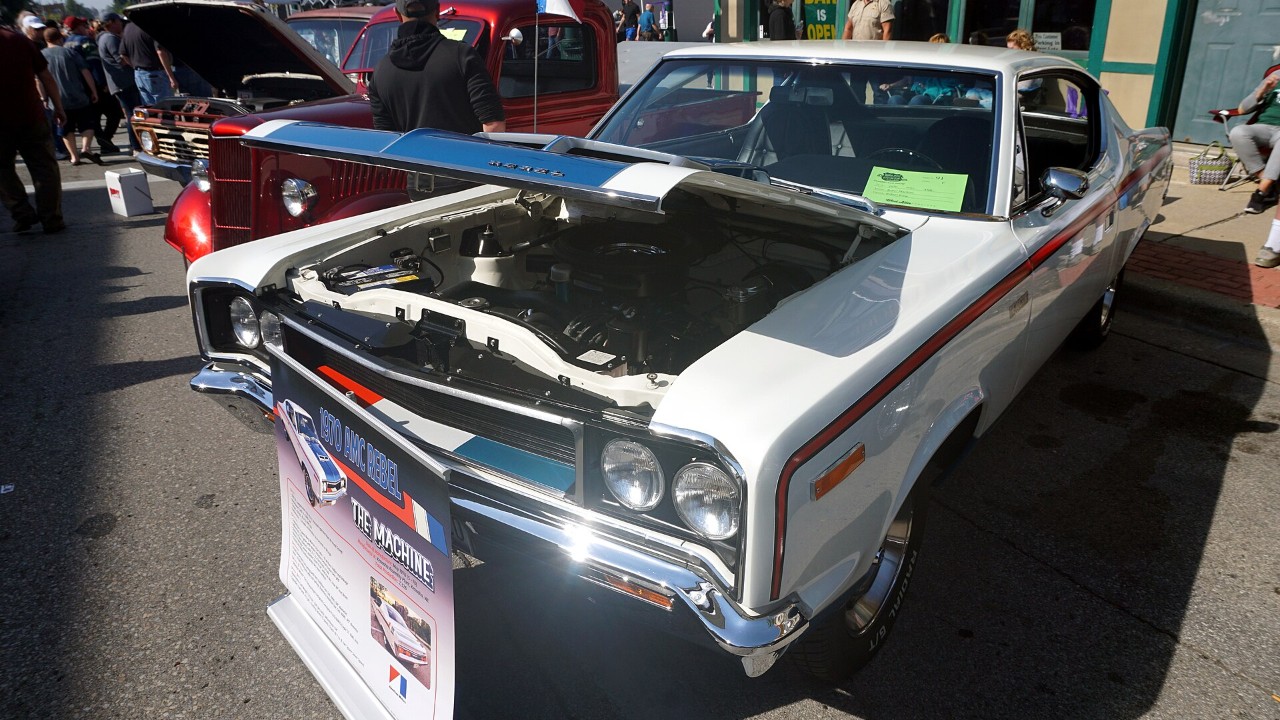
According to Silodrome, the Machine was the result of a collaboration between Hurst Performance Research, led by vice president David L. Landrith, and American Motors. However, Wikipedia’s AMC Rebel entry notes that, unlike the earlier SC/Rambler, there was no official connection between the two companies once production began.
Wikipedia says development started in June 1968 with a black, stripe-free 1969 Rebel coupe. Then AMC introduced the production car on October 25, 1969. Wikipedia places that debut in Dallas, at the NHRA World Championship Drag Race Finals.
Hurst’s name did stay on one standard part. Every four-speed car got a Borg-Warner T-10 gearbox with a Hurst floor shifter, according to Mac’s Motor City Garage.
The Rebel Machine hood tachometer
The scoop is the detail people remember. Wikipedia describes a large ram-air hood scoop painted Electric Blue, with a big tachometer set in a raised fairing at its rear edge. Because the dial faced backward, the driver could read it through the glass.
Mac’s Motor City Garage calls it an 8,000-rpm tachometer mounted out on the hood. Wikipedia adds a production detail: early scoops were fiberglass, while scoops installed after January 1, 1970, were injection-molded and of higher quality.
As a result, the Rebel Machine hood tachometer put engine speed in the driver’s line of sight. There was no need to glance down at the dash.
The 340-hp 390 V8
Wikipedia lists the Machine’s 390 V8 at 340 horsepower at 5,100 rpm and 430 lb-ft of torque at 3,600 rpm. Silodrome gives the same 340 hp and 430 lb-ft. Wikipedia also calls it the most powerful engine AMC offered in a regular production car.
The 390 ran 10.0:1 compression, so it needed premium fuel, as both Mac’s and Wikipedia note. A single four-barrel carburetor fed it. Mac’s adds one nuance worth knowing: it ties the 340-hp rating to the cold-air setup and lists 325 hp without it.
The chassis got serious parts too. For example, Mac’s and Wikipedia both say the rear used station-wagon leaf springs, which gave the car a nose-down rake. Meanwhile, the standard four-speed came with a 3.54:1 rear axle, according to both sources.
Red, white and blue, then a choice
The first 1,000 cars wore a red, white and blue graphics package, according to Mac’s Motor City Garage. Wikipedia describes the standard car as white with a blue hood stripe. Silodrome also counts 1,000 cars in that scheme. After that, Mac’s says buyers could order regular Rebel colors with a satin black hood insert.
Wikipedia adds that the original trim became a $75 option after the first 1,000 units. In addition, the standard 15×7-inch steel “Machine” wheels wore Goodyear Polyglas E60x15 white-letter tires.
Inside the Rebel Machine
The cabin matched the paint. According to Wikipedia, the standard interior was black, with bucket seats and a center armrest trimmed in red, white and blue vinyl.
A few cars broke the pattern. For example, Wikipedia records three Frost White cars with a flat-black hood and at least three in a shade called “Big Bad Green.” Meanwhile, Mac’s Motor City Garage lists a 114-inch wheelbase and heavy-duty springs, shocks and brakes.
Wikipedia adds two more details. Power disc brakes came standard, and the scoop’s tachometer came from the same supplier other makers used, with different dial faces.
Price, speed and production
The base price was $3,475, according to both Mac’s Motor City Garage and Wikipedia. Options added up quickly, though. For instance, Wikipedia lists air conditioning at $380 and an automatic transmission at $188. It also lists cruise control at $60 and a tilt steering wheel at $45.
The car backed up the scoop at the strip. At the Dallas press day, four bone-stock cars ran mid-14-second quarter miles, Wikipedia reports. Similarly, Mac’s cites magazine road tests with times in the mid-14-second range. Wikipedia also notes a factory rating of 10.7 pounds per horsepower, which put the Machine in NHRA’s F-Stock class.
Then the run ended after 1970. Mac’s Motor City Garage puts the total at 2,326 cars, “experts say,” and Silodrome and Wikipedia’s summary give the same 2,326 Rebel Machines for the single model year.
More from Fast Lane Only
- Unboxing the WWII Jeep in a Crate
- 15 rare Chevys collectors are quietly buying
- 10 underrated V8s still worth hunting down
- Police notice this before you even roll window down
This article was created with the help of AI and was reviewed and edited by Fast Lane Only editors before publication.