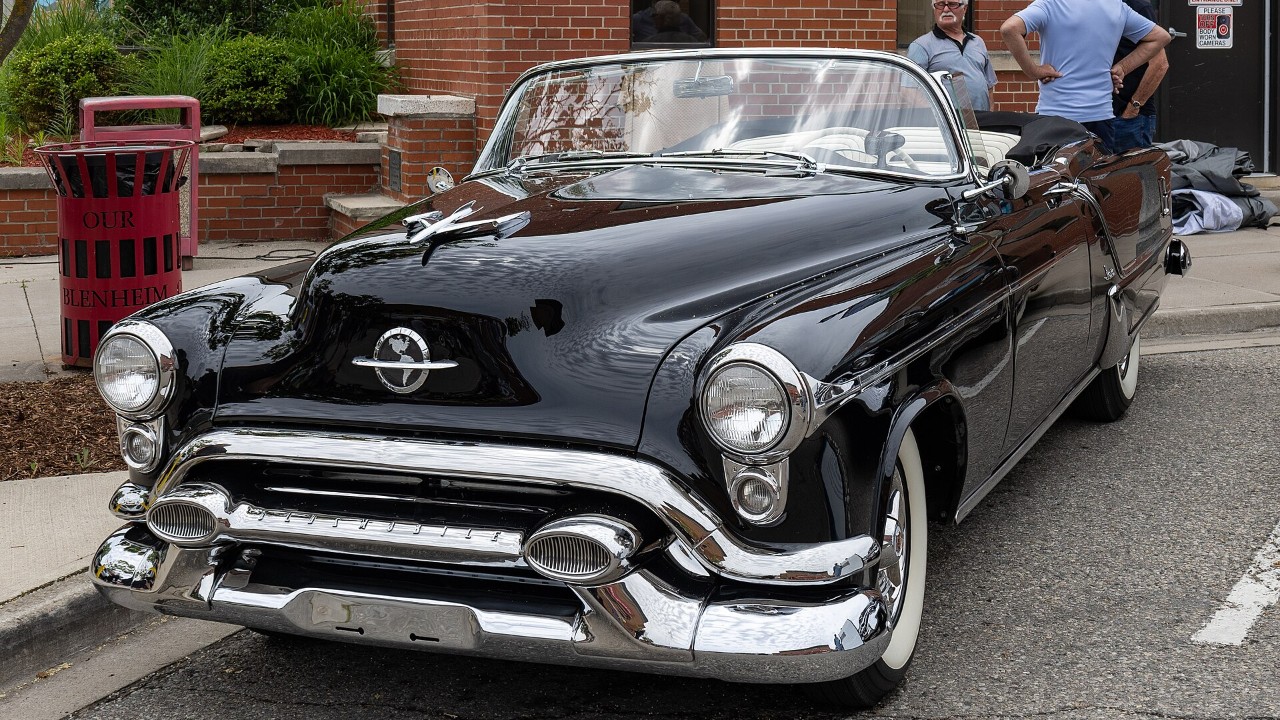
The 1953 Oldsmobile Fiesta cost $5,715 at a time when a standard Ninety-Eight convertible cost $2,963. Oldsmobile built only 458, all as 1953 models. It was one of three limited-production GM convertibles that year, and it was the most exclusive of the trio.
The Fiesta sat alongside the Cadillac Eldorado and the Buick Roadmaster Skylark. All three were also expensive showpieces. Their real job was to pull buyers into showrooms, where most would leave in a cheaper car.
That plan explains the price. Nearly every Oldsmobile option came standard, along with a lower windshield and styling few other cars shared.
Why the 1953 Oldsmobile Fiesta cost so much
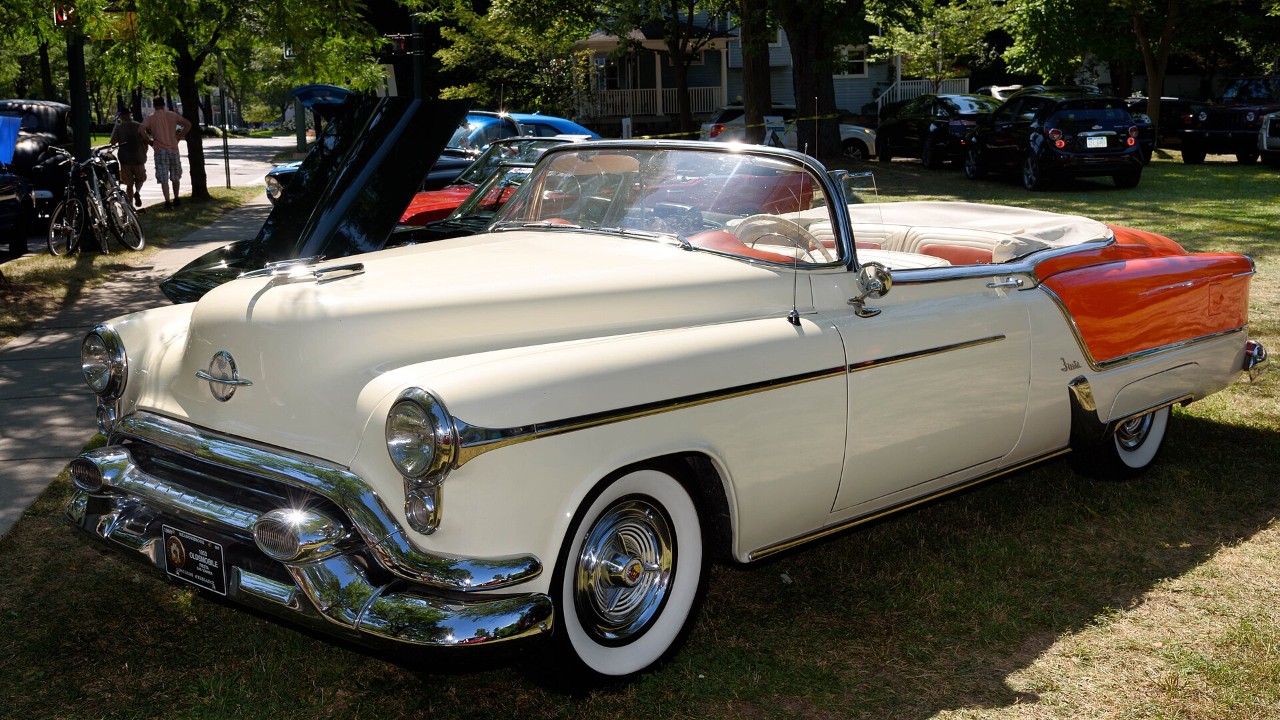
Above all, the price gap is the headline number. Over-Drive Magazine’s 1953 Oldsmobile fact sheet lists the Fiesta at $5,715 against $2,963 for a standard 98 convertible. That works out to about 1.9 times the price. Oldsmobile also built 7,521 standard 98 convertibles that year, against only 458 Fiestas.
In fact, even other luxury convertibles looked cheap next to it. According to Mac’s Motor City Garage, a Cadillac 62 convertible cost $1,600 less than the Fiesta. In a column for the Times Colonist, motoring historian Bill Vance put the price near $6,000. That was more than $2,500 above the regular top-of-the-line Oldsmobiles, he wrote.
The equipment list also helps explain it. Vance lists Hydra-Matic, power brakes and power steering, plus a power top, windows and seat. He also cites a “Wonder Bar” signal-seeking radio with a foot-operated station changer, a power antenna and a new 12-volt electrical system. Over-Drive says nearly every Oldsmobile option was standard, except air conditioning.
The Panoramic windshield and spinner wheel covers
However, the most visible change was the glass. Mac’s Motor City Garage says Harley Earl, GM’s design chief, developed the Panoramic windshield with Libbey-Owens-Ford. It was wraparound glass, a first for the Fiesta and the Eldorado, while the Skylark kept conventional glass.
The windshield also sat three inches lower than the standard 98’s. With the top up, that gave the car what Mac’s calls a “West Coast chopped look.” Vance adds that the curved glass required a modified instrument panel, a lower top, and new doors and windows.
Then there were the wheel covers. The Fiesta’s three-bar spinners became favorites with 1950s custom builders, and accessory makers sold copies. As a result, Mac’s notes, the three-bar covers on many lead sleds today are still called Fiesta spinners.
The Rocket V8 under the hood
Power came from Oldsmobile’s Rocket V8. Mac’s Motor City Garage lists it at 303 cubic inches and 170 horsepower, five more than other Oldsmobiles. However, Vance’s column gives the displacement as 304 cubic inches, so the sources differ by one inch.
In turn, the extra power came from compression. Over-Drive says the Fiesta ran an 8.5:1 ratio against 8.1:1 for the standard engine, which made 165 horsepower. It also lists a four-speed Hydra-Matic and a faster rear axle ratio.
Transmission supply nearly became a problem. An August 12, 1953 fire destroyed GM’s Hydra-Matic plant, according to Over-Drive. Mac’s says about 23,000 Oldsmobiles got Buick Dynaflow units instead. Yet no Fiesta has turned up with a Dynaflow, so Fiestas appear to have had priority for Hydra-Matics.
How the 1953 Oldsmobile Fiesta compared with Eldorado and Skylark
Among the three GM showpieces, the Fiesta was the scarcest. According to Vance, Cadillac built 532 Eldorados and Buick built 1,690 Skylarks in 1953. Only Buick kept its car for 1954.
Vance also says Oldsmobile assembled the Fiesta in Lansing, Michigan, as a mid-year model introduced in spring 1953. The custom work made it nearly hand-built. He adds that the divisions likely did not profit, with Oldsmobile probably losing the most.
Even so, its ideas spread. The wraparound windshield, the body dip behind the doors and the spinner covers moved onto standard Oldsmobiles and other GM cars, Vance writes. Mac’s notes that wraparound glass eventually reached GM trucks as well.
What a 1953 Fiesta brings today
Mac’s Motor City Garage says relatively few Fiestas survive. At the Mecum Monterey sale in August 2011, the car pictured in its story drew a high bid of $130,000.
By comparison, a completed sale is easier to pin down. RM Sotheby’s sold an Alpine White over Turquoise Fiesta, chassis 539M38668, for $80,300 at its Auburn Fall auction in 2019.
More from Fast Lane Only
- Unboxing the WWII Jeep in a Crate
- 15 rare Chevys collectors are quietly buying
- 10 underrated V8s still worth hunting down
- Police notice this before you even roll window down
This article was created with the help of AI and was reviewed and edited by Fast Lane Only editors before publication.