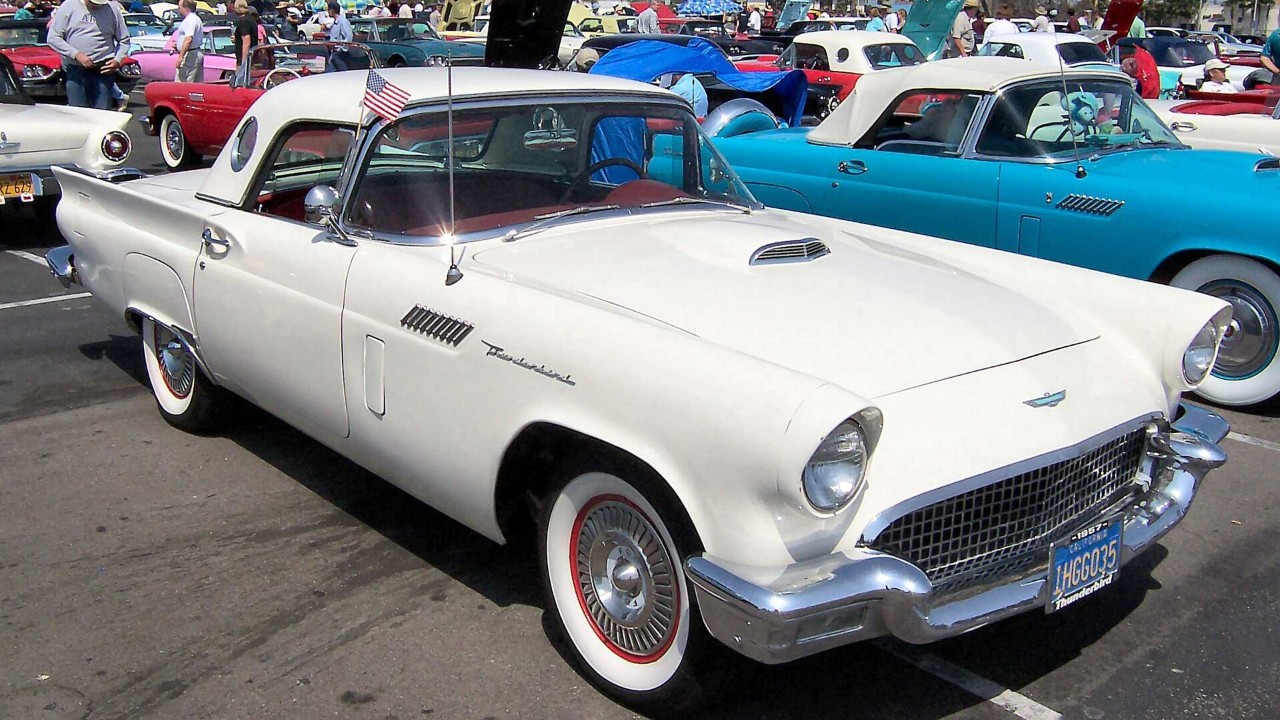
Ford built 21,380 Thunderbirds for 1957, and only about 200 of them left the factory as a Thunderbird F-code. That letter at the start of the serial number meant a supercharged 312 V8. It works out to fewer than one car in every hundred, and Ford built it with stock car racing in mind.
The F-code is also hard to count exactly, because the references give slightly different totals. However, they all land in the same small range. They also agree on the hardware and on why it existed.
Here is what the F-code package was, how Ford rated it, why NASCAR mattered, and why the exact count is still argued over. Each figure below comes from auction catalog essays, a collector magazine profile and an Old Cars Weekly history.
What the F in a Thunderbird F-code means
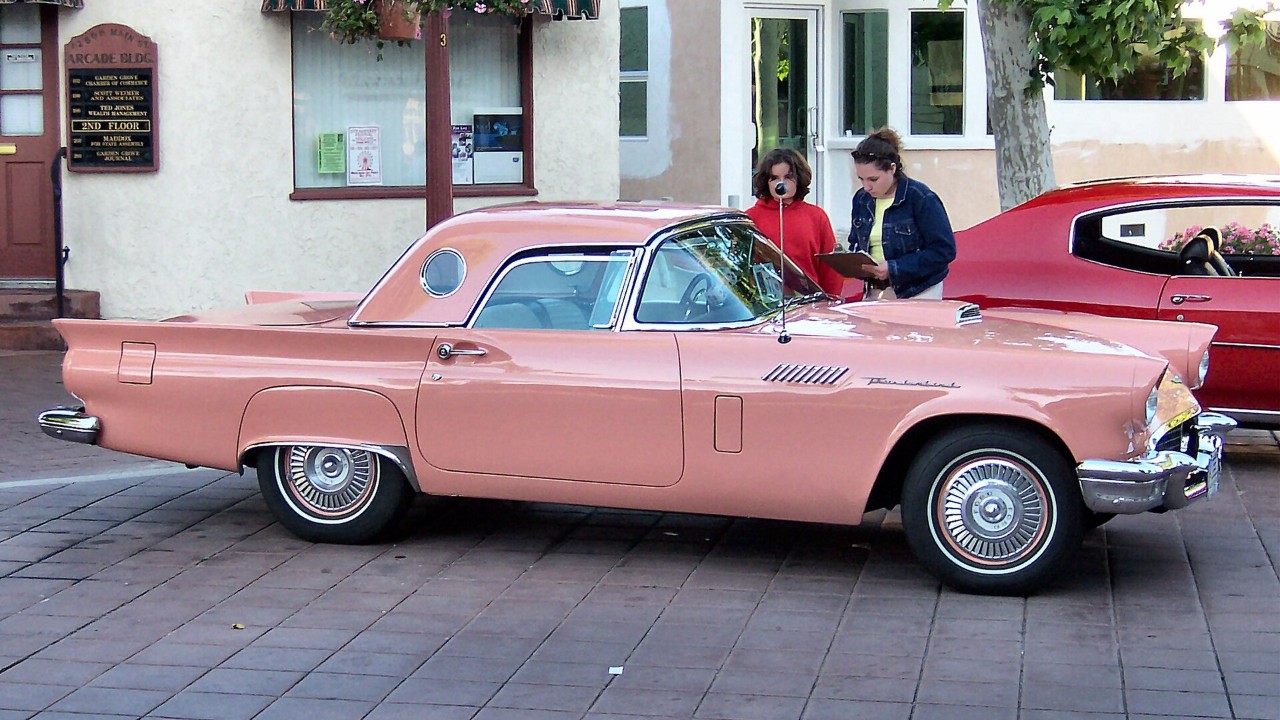
The code comes from the serial number. According to the RM Sotheby’s catalog essay for a 2023 Amelia Island lot, the F-code name comes from the first character of the chassis number. That car’s number begins F7FH, for example.
The F stood for the factory supercharged engine. A second RM Sotheby’s essay says the letter “signified the presence of a supercharger.” It adds that Ford introduced a supercharger option for its passenger cars that year.
Other codes shared the same block. In his Old Cars Weekly history, John Gunnell describes the D-code as a 312 cubic-inch V8 with a four-barrel carburetor. He also says 15 D-code cars got Paxton-McCulloch superchargers.
The Paxton-McCulloch supercharger
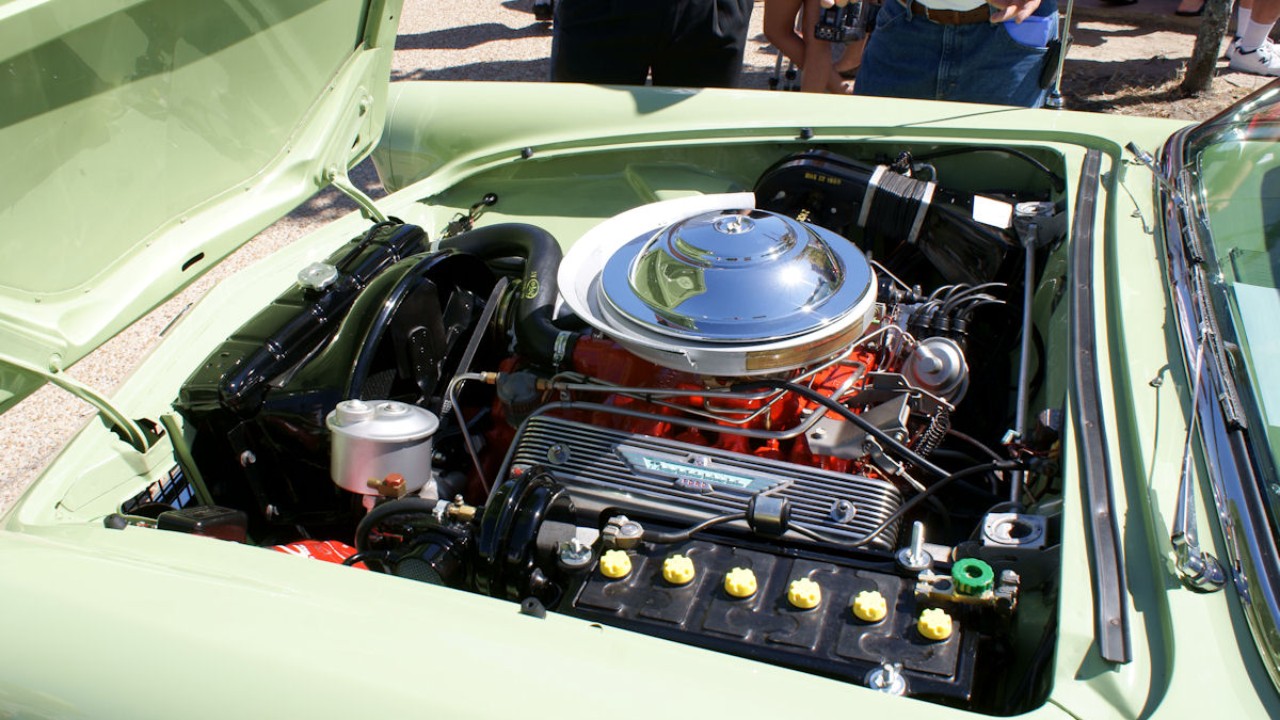
The F-code engine started as the same 312 with a four-barrel carburetor. Then Ford added a Paxton McCulloch VR57 supercharger, according to Old Cars Weekly. RM Sotheby’s describes it as a McCulloch/Paxton VR57 centrifugal supercharger.
A centrifugal supercharger is a belt-driven fan that pushes extra air into the engine. To handle that boost, Old Cars Weekly says a special cylinder head cut compression to 8.5:1. The drive also differed by transmission: F-code cars used a single belt with automatics and two belts with manual gearboxes.
The option was not cheap. RM Sotheby’s says it added more than 10 percent to the Thunderbird’s base price. Meanwhile, Old Cars Weekly gives a $340 factory invoice price for the F engine.
A rating that looked conservative
Ford rated the engine at 300 horsepower. Both RM Sotheby’s essays give that figure, and a Sports Car Market profile describes the engine as a supercharged 312 rated at 300 horsepower.
Not everyone believed it. The Amelia Island essay calls the car “questionably factory-rated at 300 horsepower.” It says period tests and Paxton Products itself put the figure closer to 400.
Old Cars Weekly offers a more modest view. In Gunnell’s history, ratings “with fine-tuning ranged from 325 to 340” horsepower. In other words, the real output depended on who measured it and how the car was set up.
Built with NASCAR in mind
The supercharger had a racing job. Old Cars Weekly says the first 15 production supercharged Thunderbirds were reportedly built in January 1957 to homologate the engine for NASCAR. Homologation means building enough road cars to make a part legal in competition.
Sports Car Market gives the same motive from another angle. It says Ford used the engine “to counter Chevrolet’s fuel-injected Black Widows in NASCAR.” It also notes the supercharged engine went into a handful of 1957 Fairlane 500 sedans.
Regular production came a bit later. According to Old Cars Weekly, production of the 196 F engines began in spring 1957.
How many Thunderbird F-code cars were built
The totals vary, but only a little. RM Sotheby’s Amelia Island essay says “only about 200” of the 21,380 cars had the F-code package, or “less than one percent of total production.” Its earlier essay says supercharged cars “were said to number somewhere between 208 and 211.” Sports Car Market, by comparison, calls one car “one of only 212 examples.”
Old Cars Weekly explains why the numbers drift. It calls the “official” total of 211 superchargers across the D and F series “an approximation.” It also says some F-letter cars no longer have their blower, and dealers could add or remove superchargers.
Even at the high end, 212 cars is less than 1 percent of 21,380. So whichever count a reader trusts, the F-code stays under 1 percent of 1957 Thunderbird production.
What an F-code brings today
Auction results give a sense of what that scarcity means today. Sports Car Market reports that a Flame Red 1957 F-code, which originally listed for $4,815.13, sold as Lot 386 at Barrett-Jackson’s Palm Beach auction on April 9, 2016. The price was $193,900, including buyer’s premium.
More from Fast Lane Only
- Unboxing the WWII Jeep in a Crate
- 15 rare Chevys collectors are quietly buying
- 10 underrated V8s still worth hunting down
- Police notice this before you even roll window down
This article was created with the help of AI and was reviewed and edited by Fast Lane Only editors before publication.