The 1987 Ferrari F40 arrived as a statement that speed, not comfort, would set the agenda. Built to mark Ferrari’s 40th anniversary and signed off by Enzo Ferrari himself, it stripped away luxury to chase lap times and top speed with a single-minded focus. Nearly four decades later, it still feels like the first truly no-compromise Ferrari created purely to go as fast as possible.
When I look at the F40 today, I see more than a poster car from the late eighties. I see a turning point where Ferrari stopped trying to balance civility with performance and instead built a road‑legal machine that behaved like a racing prototype with number plates. That clarity of purpose is why the car still looms so large in the imagination of enthusiasts and engineers alike.
Enzo’s last word on what a Ferrari should be
The F40 was conceived as a celebration of Ferrari’s 40 years, but it also became Enzo Ferrari’s final signed approval on a road car, a last word on what his name on a badge should mean. Rather than commission a grand touring coupe with leather and wood, he backed a raw berlinetta that looked and felt closer to a Group B refugee than a boulevard cruiser, a choice that immediately set it apart from the more rounded 1980s supercar crowd. In period and in hindsight, that decision turned the car into an instant legend, with its raw performance, aggressive design and uncompromising character still described as the qualities that made it an icon from the moment it appeared.
That sense of purpose is why enthusiasts still talk about the F40 as the purest expression of the brand’s performance instincts. Contemporary accounts describe how, once the turbos kicked in, acceleration was ferocious and the car demanded total concentration from the person behind the wheel, a far cry from the more forgiving behavior of later models. It is no coincidence that detailed histories still frame it as the last car personally approved by Enzo, and as a machine whose legend rests on being one of the most legendary supercars ever built, a status underlined in modern tributes that call it an icon of automotive history and celebrate how it continues to captivate drivers at full power through sources like Sep and enthusiast clips from Oct.
Design without comfort: a body shaped by speed
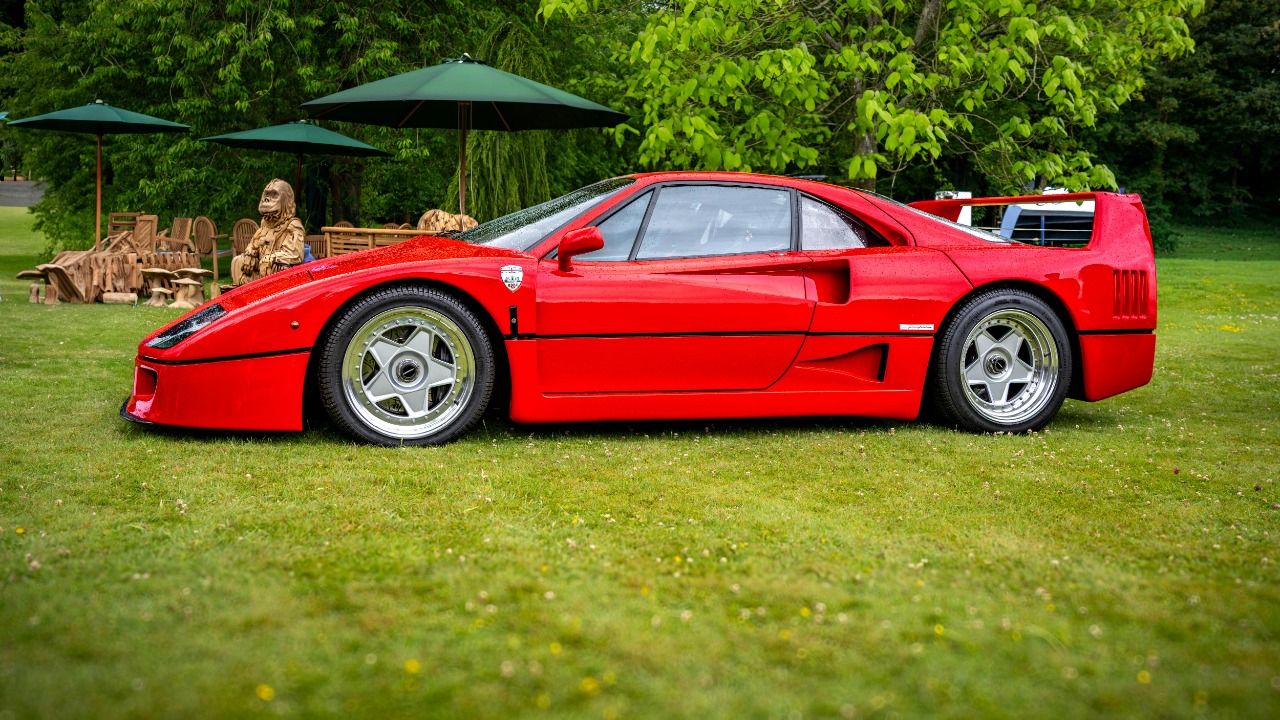
Walk around an F40 and it is obvious that comfort barely made the brief. The cabin is a sparse shell of exposed composites, thin carpeting and simple bucket seats, with no power steering, no ABS and no traction control to soften the experience. Even the door pulls are simple straps, a reminder that every gram saved helped the car accelerate, brake and change direction more quickly. That stripped interior matches the exterior, where the vast rear wing, NACA ducts and slatted engine cover all serve airflow and cooling first, aesthetics second.
Ferrari’s own description of the car highlights how the bodywork was built from lightweight materials to deliver top-level performance, with the claimed top speed listed at 324 km per hour, a figure that placed it at the sharp end of the supercar pack. Contemporary reflections note how the carbon-Kevlar weave is visible under the paint, a visual cue that the structure itself is doing the work rather than hiding behind thick layers of finish, something enthusiasts still point out when they talk about seeing the carbon-Kevlar weave through it in pieces like Jun. The result is a car that looks like a wind tunnel sketch brought to life, its proportions dictated by cooling needs and high‑speed stability rather than fashion.
A brutal powertrain that defined “no compromise”
If the body is uncompromising, the powertrain is even more so. Under the rear deck of the F40 sat a 2.9-liter twin-turbocharged V8 engine, a compact but ferocious unit that delivered race-car levels of thrust in a package that still met road regulations. Technical breakdowns describe how this engine produced an impressive power output and could launch the car from rest to highway speeds in just a few seconds, with one detailed specification sheet listing 0 to 100 km/h in 3.8 seconds. That same focus on forced induction appears in other technical tables that describe the Drivetrain layout and list the Engine and Brakes specifications, including an Engine described as a 2.9-liter Twin Turbocharged V‑8 with chain-driven camshafts.
On paper, that hardware translated into numbers that still command respect. Period testing and later analysis talk about a factory top-speed claim that made the car a genuine 200‑mph machine, with one detailed comparison noting that the factory’s 201-mph top-speed claim seemed entirely reasonable. Independent performance databases list the 1987 Ferrari F40’s sprint from 0 to 60 mph in 4.2 seconds, and also detail how the car’s 0 to 60 mph and 0 to 100 km/h times stack up against its peers. Another deep dive into its character notes that Below 3,500 rpm the car felt almost docile, with the twin IHI turbochargers sitting quietly until boost built and Then delivered a sudden, explosive surge toward a quoted top speed of 201 mph.
Driving experience: turbo lag, ferocity and focus
Numbers only tell part of the story, because what really sets the F40 apart is how it feels when those turbos wake up. Writers who have driven the car after years in modern supercars talk about how extraordinary the turbo lag is compared with today’s seamless power delivery, and how the car goes from relatively calm to utterly feral in a narrow slice of the rev range. That on‑off character demands anticipation and mechanical sympathy, forcing the driver to think several seconds ahead rather than simply matting the throttle and letting electronics sort things out.
Owners and testers alike describe the steering as heavy at low speeds but alive once the car is moving, with every ripple of the road and every shift in grip transmitted directly through the wheel and seat. One evocative account notes that the F40’s cabin is loud, hot and busy, yet that is exactly what makes it so engaging, because there is nothing between the driver and the car. Modern tributes on social media echo this sentiment, with posts explaining that the Ferrari F40 remains one of the most uncompromising expressions of performance ever conceived and praising how The Ferrari still forges a direct connection between the driver and the car at full power, a theme repeated in another celebration that calls The Ferrari F40 one of the most uncompromising expressions of performance ever conceived.
Why the F40 still feels modern in a digital age
In an era of hybrid hypercars and configurable driving modes, it might seem odd that a car with no driver aids and a bare-bones interior still commands such attention. Yet that is precisely why the F40 feels so relevant: it offers an experience that modern machinery, for all its speed, rarely matches. With a dry weight quoted in specialist analyses as being low enough to help it reach a top speed of 201 mph, and with power figures like the 478 hp output of the 3‑liter V8 highlighted by collections that describe it as a no compromise old-school Ferrari, the car still measures up impressively against contemporary performance benchmarks. The engineer Nicola Materazzi is credited in those same accounts with prioritizing the design of a superlative engine above all else, a philosophy that modern powertrain teams continue to admire.
That focus on speed at the expense of comfort is also why the F40 continues to dominate enthusiast feeds and anniversary posts. One widely shared tribute explains that it was unveiled in 1987 to celebrate Ferrari’s 40th anniversary and emphasizes that it arrived without power steering, ABS or traction control, a reminder that the car was engineered with a singular goal in mind, as highlighted in a post from Oct. Another enthusiast account simply calls it one of the most legendary supercars ever built and an icon of automotive history, language that captures why, even in a digital age, the F40 still feels like the benchmark for what a no‑compromise Ferrari built for speed should be.
More from Fast Lane Only: