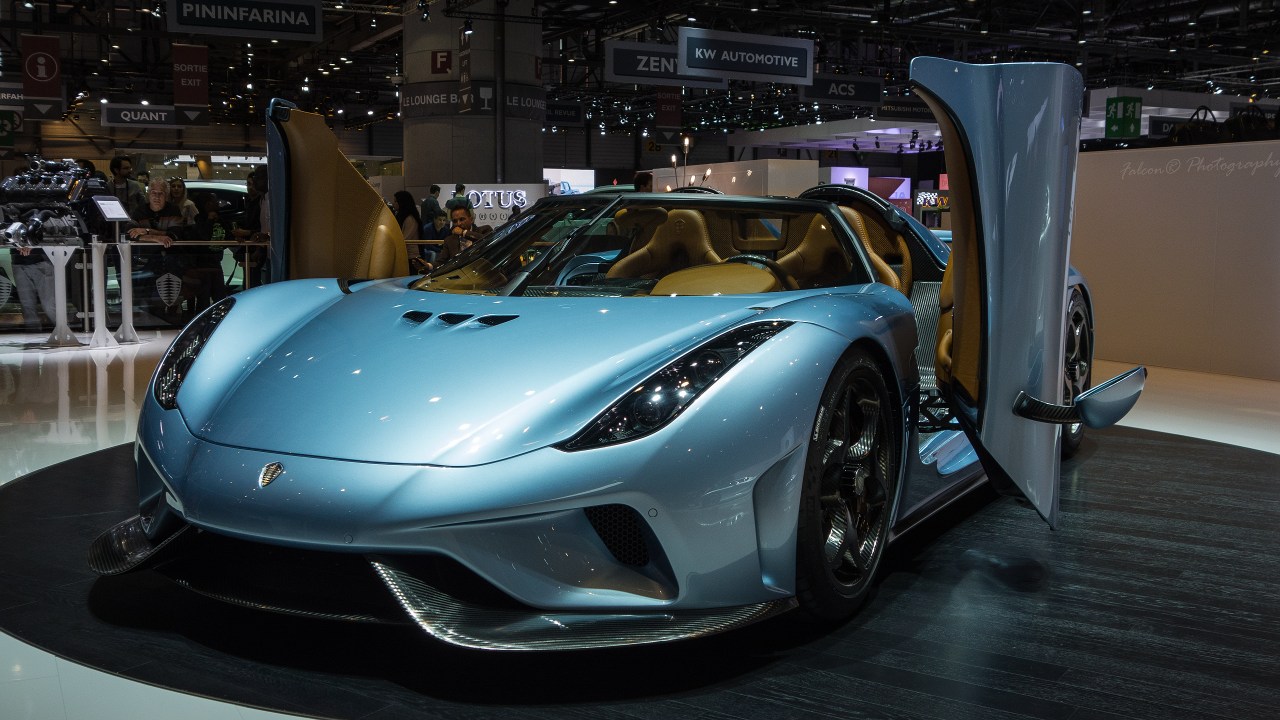
The 2015 Koenigsegg Regera arrived as a hypercar that refused to play by the usual rules, trading a conventional multi‑gear transmission for a radical direct‑drive hybrid system. Instead of chasing lap times with ever more ratios and software modes, it set out to prove that a single mechanical path from engine to wheels, supported by powerful electric motors, could be both faster and more refined. It was the first production hypercar to turn that kind of drivetrain “trickery” into a road‑legal reality, and it did so with numbers and engineering choices that still look audacious today.
From Tesla inspiration to Swedish megacar reality
The Regera story starts with a moment of curiosity rather than a blank sheet of paper. Koenigsegg founder Christian von Koenigsegg bought a Tesla Model S P85+ and was struck by how instantly and smoothly it delivered torque without any gear changes. That experience pushed him to rethink how a combustion‑engined hypercar could put power to the road, and he began working on a system that would bypass the traditional gearbox entirely. According to Koenigsegg’s own account of the car’s conception, he then invented a layout that connects the crankshaft directly to the output shaft, with electric assistance filling in the gaps where a conventional transmission would normally operate.
That idea became the Koenigsegg Regera, a low‑volume “Megacar” positioned as a more luxurious counterpart to the brand’s track‑leaning models. Official material from Koenigsegg Chicago describes The Regera as “a new Era,” explicitly calling it a luxury Megacar alternative rather than a stripped‑out racer. The car debuted at the Geneva Motor Show as The Koenigsegg Regera with Koenigsegg Direct Drive at its core, signaling that the company saw this drivetrain not as a one‑off experiment but as a defining technology for its next chapter.
Koenigsegg Direct Drive: how a hypercar runs without gears
At the heart of the Regera is Koenigsegg Direct Drive, often shortened to KDD, a system that replaces a traditional gearbox with a single fixed mechanical connection and a sophisticated hybrid package. Instead of multiple ratios, the car uses one 5.0‑litre twin‑turbocharged V8 engine and a set of electric motors to cover the full speed range. Technical explainers on Koenigsegg Direct Drive describe how the V8 is coupled directly to the rear axle through a hydraulic coupling, while the electric motors provide torque at low speeds and help smooth the transition as the combustion engine takes over more of the work.
The result is a car that behaves almost like an electric vehicle from a standstill, then gradually blends in the V8 as speed rises. Reporting on early drives notes that at speeds below about 30 mph the Regera operates mostly in electric‑dominated mode, with additional motors mounted at each of the rear wheels to provide traction and torque vectoring. That layout, described in detail in a first look at the Regera, allows the car to pull away smoothly and powerfully from standstill without the need for a multitude of gears or a variable transmission. A later technical breakdown of Koenigsegg’s direct drive transmission emphasizes that this approach avoids the inherent energy losses of conventional gearsets while still letting the car accelerate hard and cruise at huge speeds.
Hybrid powertrain numbers that still shock
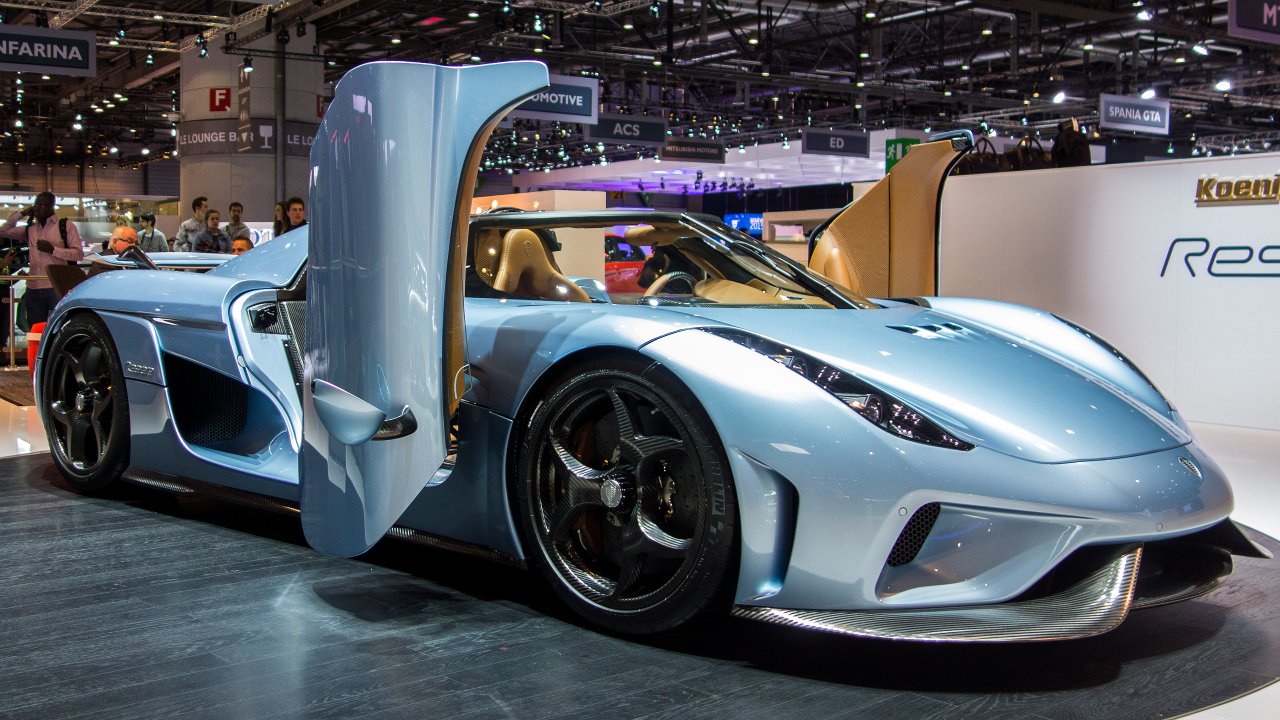
For all its cleverness, KDD would not matter much if the Regera’s powertrain did not deliver outrageous performance, and the numbers remain startling. Official REGERA SPECIFICATIONS list “1500 HP Total Output,” combining the twin‑turbo V8 with the hybrid system, alongside “700 HP Electric‑only output” and an “800 Volt Battery.” That battery operates at a voltage level more commonly associated with cutting‑edge EVs, and it feeds the rear‑mounted electric motors that handle low‑speed duties and torque fill. The same specification sheet quotes “1590 Kg Curb weight” and “1280 Nm Max Torque,” figures that underline how aggressively Koenigsegg chased both power and lightness in a car that also carries a sizable battery pack.
Independent performance databases back up the sense that this is a hypercar operating in rarefied territory. One detailed Koenigsegg Regera spec sheet lists the “Price in Europe” at “€1,900,000,” placing it firmly in the ultra‑exclusive bracket even by supercar standards. That same data set categorizes the Koenigsegg Regera as a high‑performance “Car” with acceleration and top‑speed figures that align with its 1500 horsepower headline. Koenigsegg’s own promotional material invites enthusiasts to “Discover the groundbreaking engineering and exceptional performance” of the Koenigsegg Regera and to “Experience its unique hybrid powertrain and design,” underlining that the company sees the hybrid system not as a compliance feature but as the centerpiece of the car’s identity.
Design, luxury and the ‘Ghost’ twist
While the drivetrain grabs most of the attention, the Regera’s design and cabin were shaped to support its role as a more relaxed, grand‑touring Megacar. Official descriptions of the Koenigsegg Regera emphasize a luxurious interior, with the brand noting that the car is “specifically designed to be a luxury Megacar alternative” rather than a stripped‑back track tool. The interior of the Regera is described in the specifications as a place where comfort and technology sit alongside the extreme performance numbers, and the car’s curb weight of 1590 Kg reflects the inclusion of amenities that many track‑focused rivals would leave out.
On the outside, the Regera’s shape is familiar Koenigsegg, but with details that hint at its dual personality as both a brutal performance machine and a high‑speed cruiser. Some cars were offered with a “Ghost” package, referenced in the Regera’s table of contents, which added aerodynamic and visual tweaks to sharpen the car’s presence. Images of the Koenigsegg Regera with “Ghost” package show more aggressive aero elements that sit on top of the already dramatic bodywork. Even with those additions, the underlying design still has to accommodate the packaging demands of the hybrid system, including the 800 Volt Battery and rear‑mounted motors, which makes the Regera’s relatively low curb weight and clean proportions more impressive.
Why the Regera’s direct drive still matters
A decade after its debut, the Regera’s direct‑drive approach looks less like a curiosity and more like an early glimpse of where high‑end performance engineering was heading. By using electric motors to handle low‑speed torque and fill in for missing gears, Koenigsegg anticipated the broader industry shift toward powerful hybrid systems that treat combustion engines as part of a larger powertrain, not the sole star. The company’s own invitation to Discover the Regera’s engineering and to Experience its hybrid powertrain underscores that this was meant as a proof of concept for a new way of thinking about speed and refinement.
From a driving perspective, the absence of gear changes gives the Regera a character that stands apart from other hypercars of its era. Technical explainers on How the Koenigsegg Regera drives without a gearbox describe how the engine revolutions begin to match road speed as the hydraulic coupling locks up, creating a direct, almost locomotive feel at high speed. Combined with the 1500 HP Total Output and 700 HP Electric‑only output listed in the official SPECIFICATIONS, that gives the Regera a blend of relentless acceleration and smoothness that few rivals can match. In an era when many performance cars still rely on ever more complex multi‑gear transmissions, the 2015 Koenigsegg Regera stands out as the first hypercar that dared to delete the gearbox entirely and let direct‑drive trickery, backed by serious hybrid muscle, do the talking.
More from Fast Lane Only: