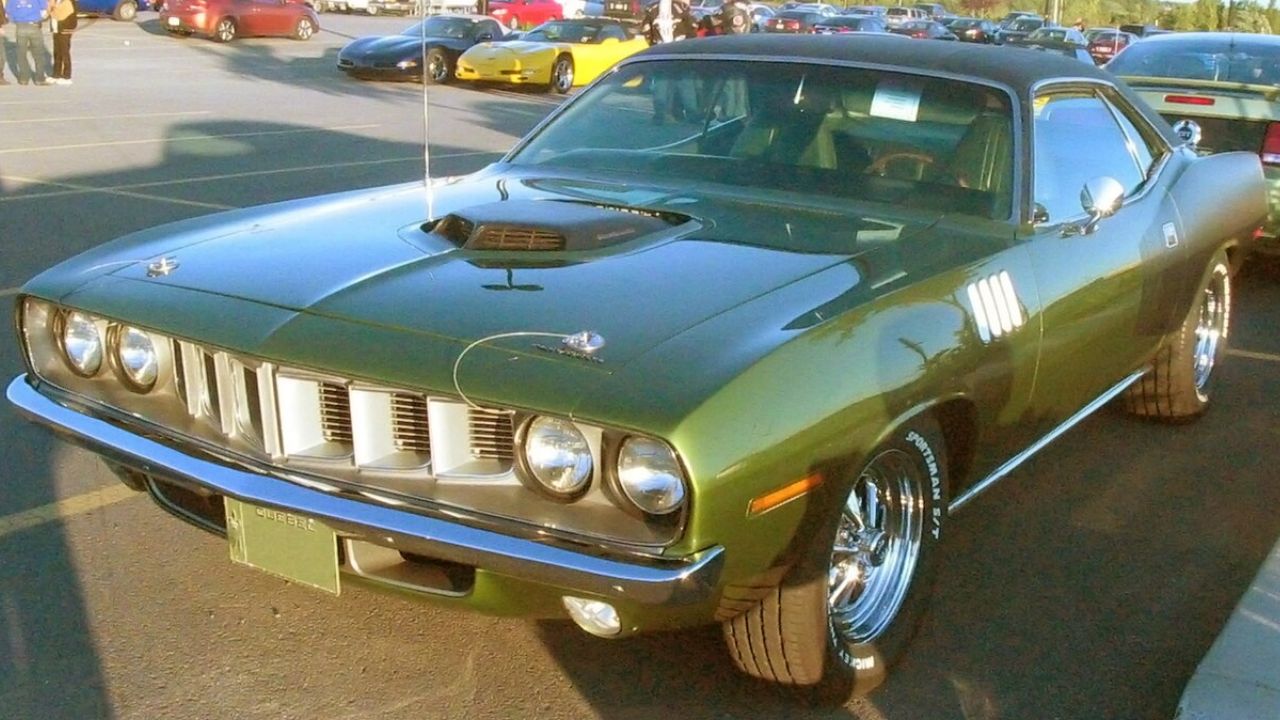
The car looked like the kind of find people daydream about: a 1971 Plymouth Barracuda with glossy paint, a tough stance, and a seller who seemed prepared. There was even a folder of paperwork ready to go, the sort of thing that usually calms nerves and seals deals. But as the buyer stood there flipping pages and walking slow circles around the car, a nagging feeling kept bubbling up.
It wasn’t dramatic at first—more like the quiet voice you hear when you’re about to order something expensive online and notice the reviews are “a little too perfect.” Everything checked out, but it didn’t. And in the world of classic muscle, that tiny disconnect can mean the difference between a dream car and an expensive lesson.
The paperwork was impressive—almost too impressive
The seller had the usual basics: a title, registration history, and a stack of receipts that suggested years of care. There were printed pages listing options and specifications, plus a couple of photos that showed the car in earlier stages of restoration. On the surface, it was the kind of documentation buyers are told to look for.
But the buyer noticed something odd: the paperwork felt like it had been assembled to tell a story, not record one. Receipts weren’t in a consistent timeline, and a few key items you’d expect on a long-term ownership file were missing—like older service records, insurance cards, or anything that showed the car’s life before the restoration. It wasn’t proof of anything by itself, but it was enough to make the buyer slow down.
A 1971 Barracuda is a magnet for “creative” builds
There’s a reason this particular model sets off alarms for experienced shoppers. Real 1971 ’Cuda cars are valuable, and certain trims and engines can send prices into the stratosphere. That value attracts honest restorations, sure, but it also attracts clones, re-bodies, and “tribute” cars that sometimes get advertised with fuzzy language.
To be clear, clones and tributes aren’t automatically bad. Plenty of them are beautifully built and a blast to drive. The trouble starts when the car is priced—or presented—as something rarer than it really is, with paperwork that sounds official but doesn’t actually tie the story together.
The details on the car didn’t match the story on the page
The buyer began noticing small mismatches. The option list suggested one thing, but the car wore different trim. The interior had pieces that looked newer than the rest, as if they’d been swapped recently to match a higher-spec look. Even the placement of a badge and the style of a few fasteners seemed off compared to what the buyer expected for the year.
None of this screamed “fraud” on its own—restorations often involve parts mixing, and plenty of cars get updated over decades. But when you’re being told the car is “numbers-matching” or “factory-correct,” details matter. A Barracuda can be a jigsaw puzzle, and the pieces should at least look like they came from the same box.
The VIN and fender tag questions started piling up
The buyer asked to take a closer look at the VIN and any tags used to identify the car’s original configuration. That’s where things got tense. The seller didn’t refuse outright, but there was hesitation—an “oh, it’s hard to see,” or “I’d rather not mess with it,” kind of vibe.
On Mopars from this era, details like VIN plates, fender tags, and stampings can make or break the car’s identity. Buyers often look for signs of tampering: odd rivets, mismatched fonts, plates that look too new, or paint lines that suggest something was removed and reattached. The buyer didn’t claim to be an expert, but the reluctance alone raised the stakes.
When receipts don’t connect to a specific car, they’re just paper
One of the strangest moments came when the buyer started reading the receipts more carefully. Some invoices listed parts, but not a VIN. Others referenced a shop name without any identifying information tying the work to this exact Barracuda. A few had vague descriptions like “engine work” or “body labor,” with no part numbers or photos.
That doesn’t mean the work didn’t happen. It just means the receipts can’t prove it happened to this car. In the classic-car world, paperwork can be like a trophy shelf: impressive to look at, but it doesn’t automatically prove the car won the race you think it did.
A quick inspection revealed “fresh” fixes in suspicious places
The buyer brought a flashlight and did what a lot of smart shoppers do: looked underneath, inside the trunk, and along seams where panels meet. The underside was clean—almost showroom clean—which can be great, or can mean it was recently undercoated to hide old repairs. In a couple areas, the texture looked newer than the rest, like it had been applied to smooth over something.
There were also signs of recent touch-ups around areas that often matter on these cars: near identification tags, around the firewall, and along edges where factory spot welds might tell a story. Again, not a smoking gun. But when your gut already feels uneasy, “not a smoking gun” becomes “why is there even a gun on the table?”
The seller’s language got slippery when the questions got specific
At first, the seller talked confidently: “It’s all there,” “It’s documented,” “It’s the real deal.” But as the buyer asked more detailed questions—who did the engine build, what block casting numbers were present, what the original color was—answers turned vague. The story shifted from certainty to suggestion.
The buyer noticed a pattern: broad claims came quickly, specifics came slowly. That’s not always a red flag, but it can be. People who genuinely know a car’s history usually have a consistent narrative, even if they don’t know every last detail.
What experienced buyers say to do next
After stepping back, the buyer decided not to make an on-the-spot commitment, even though the car was tempting. That’s often the hardest part, because classic cars are emotional purchases. The shine, the sound, the “I might never see another one like this” feeling—it’s real, and sellers know it.
Enthusiasts and inspectors often recommend a few practical next steps in situations like this: get a third-party pre-purchase inspection, verify VIN and stampings against known references, and use a marque expert if the price is serious. It’s also smart to ask for documentation that ties directly to the car—photos during restoration, old titles, and receipts that include identifying details. If the seller is honest, they’ll usually welcome the chance to prove it.
A great Barracuda can still be a great Barracuda—just priced honestly
The buyer didn’t walk away because the car was “bad.” The buyer walked away because the car’s identity felt unsettled, and the paperwork didn’t calm that feeling the way it should have. A beautifully built ’Cuda tribute can be worth good money and deliver all the muscle-car joy someone wants, as long as it’s sold as what it is.
In the end, the buyer said the folder of paperwork was the thing that made the situation feel stranger, not safer. It’s a good reminder that documents aren’t the same as verification. Sometimes the smartest move is the simplest one: trust your eyes, ask one more question, and if your instincts keep tapping your shoulder, listen.
More from Fast Lane Only