The 1968 Hemi Dart was not a show car or a marketing fantasy. It was a bare‑bones factory drag weapon that could run low‑11‑second quarter miles straight off a transporter with nothing more than tuning and slicks. Built in tiny numbers and aimed squarely at NHRA Super Stock competition, it turned a compact commuter into one of the quickest production‑based cars Detroit ever sold.
That combination of sanctioned factory engineering, brutal acceleration, and extreme rarity has turned the Hemi Dart into a legend. It also captures a brief moment when automakers were willing to bend their own rulebooks to dominate the drag strip, even if it meant creating cars that had almost nothing in common with what most customers drove home.
What happened
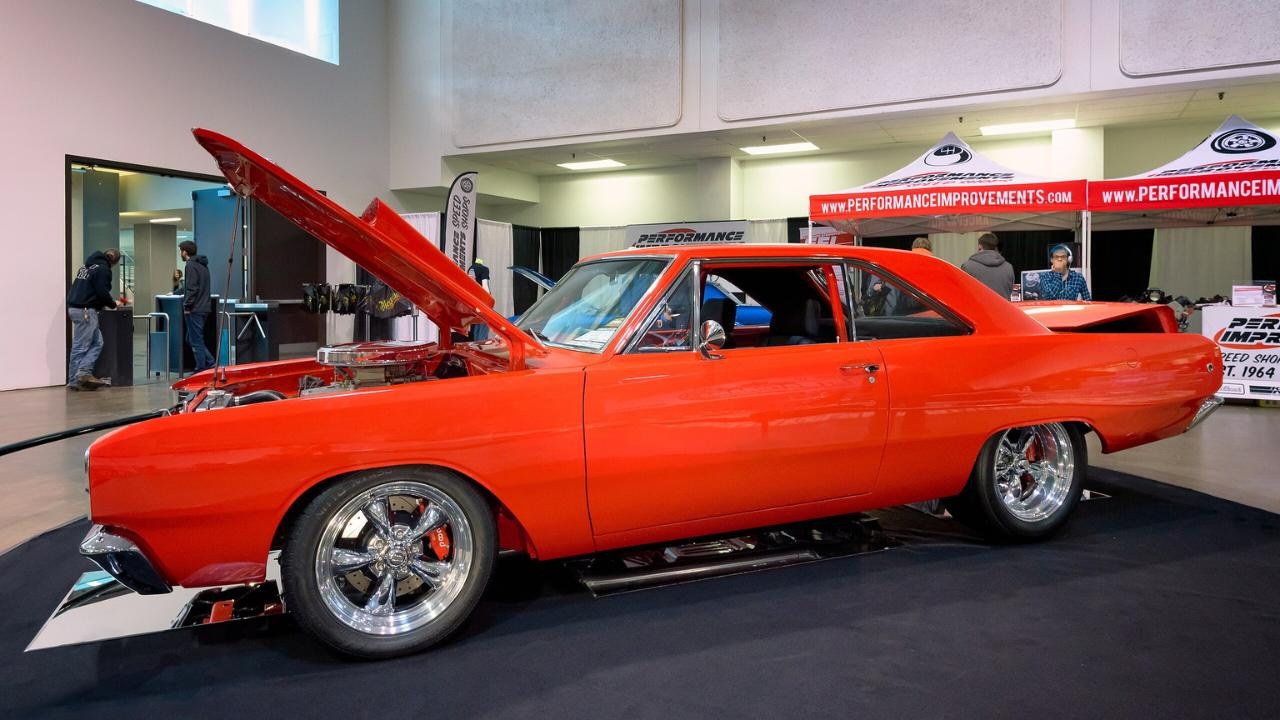
Dodge took the ordinary 1968 Dart two‑door sedan and turned it into a purpose‑built drag car by installing the 426 cubic inch Street Hemi race engine, then stripping almost everything that did not help it get down the quarter mile. The program produced an estimated 80 or so Hemi Darts, a figure that makes it one of the rarest 60s Dodge models with a factory 426 Hemi engine.
At the core of the package was the 426 cubic inch V8 with hemispherical combustion chambers, a cross‑ram intake, and dual four‑barrel carburetors. In showroom trim the Street Hemi was nominally rated at 425 horsepower, but the drag‑oriented tune in the Hemi Dart pushed real output far higher. The engine used high compression pistons, aggressive camshaft profiles, and heavy‑duty internals that could live at sustained high rpm.
To fit the big Hemi into the compact A‑body engine bay, Dodge engineers reworked the front structure and used a revised K‑member. They replaced the exhaust manifolds with headers, and the battery moved to the trunk to improve weight distribution. The cars were assembled as incomplete vehicles at the Hamtramck plant, then shipped to an outside contractor that finished the engine installation and race preparation.
Weight reduction was just as aggressive as the powertrain. The Hemi Dart used fiberglass front fenders and a fiberglass hood with a functional scoop that fed cool air to the carburetors. Side glass was replaced with thin pieces and lighter mechanisms, and some cars used fixed rear windows instead of roll‑downs. Inside, sound deadening, rear seats, and much of the trim were deleted or minimized. The result was a car that weighed several hundred pounds less than a typical big‑block B‑body while carrying a more potent engine.
Transmission choices reflected the drag strip focus. Many Hemi Darts left with the TorqueFlite automatic paired with a high‑stall converter and a manual valvebody, which allowed the driver to control shifts without a clutch. Others used a heavy‑duty four‑speed with a Hurst shifter and a steep rear axle ratio. In either case, the drivetrain was tailored for explosive launches and strong mid‑range pull rather than top speed or highway comfort.
On paper, Dodge still had to present the Hemi Dart as a production car. In practice, it was closer to a factory‑sanctioned race chassis. The cars carried VINs, could be titled, and technically remained street legal, but most buyers were racers who towed them to the track. Interiors were sparse, paint quality could be rough, and panel alignment often took a back seat to getting the next car finished for competition.
Out of the box, with proper tuning and race tires, Hemi Darts recorded quarter‑mile times in the low 11‑second range at trap speeds that rivaled full‑on drag machines. Period accounts describe cars running in the 11.0 to 11.2 second bracket at more than 120 miles per hour, with only minor changes such as jetting, timing, and open exhaust. For a factory‑delivered package tied to a regular production model, that performance was extraordinary.
The Hemi Dart program did not exist in isolation. It was part of a broader push by Dodge and Plymouth to dominate NHRA Super Stock categories with lightweight, overpowered compacts. Sister cars such as the Hemi Barracuda followed the same formula of big engine, light body, and minimal concessions to comfort. Together they gave Chrysler a strong presence in sanctioned drag racing and helped cement the Hemi’s reputation.
Why it matters
The 1968 Hemi Dart matters first as a benchmark for what a manufacturer was willing to build in order to win on Sunday. It illustrates how far Detroit’s performance wars had escalated by the late 1960s, when marketing departments and engineering teams aligned around the idea that dominating NHRA classes would sell more cars in showrooms.
Most muscle cars of the period balanced performance with some level of practicality. Big‑block intermediates such as the Dodge Coronet R/T or Plymouth GTX still carried full interiors, sound insulation, and options lists that included air conditioning and power accessories. The Hemi Dart abandoned that balance. It prioritized elapsed time over everything else, even basic comfort, which is why its quarter‑mile numbers were so far ahead of more civilized performance models.
That focus explains why the car arrived from the factory essentially pre‑qualified for Super Stock competition. Racers did not need to spend months fabricating mounts or swapping engines. Instead, they could order a Hemi Dart, add safety equipment, adjust suspension settings, and go racing. The car blurred the line between production vehicle and turn‑key race car at a time when sanctioning bodies still required a connection to a regular model.
The low‑11‑second capability also reframed expectations for what a “factory” car could do. Even decades later, many modern performance cars struggle to match those quarter‑mile times without electronic launch control and advanced tire technology. The Hemi Dart achieved them with leaf springs, bias‑ply slicks, and carburetors, underscoring how effective the weight reduction and powertrain choices were.
Rarity adds another layer of significance. With production limited to roughly eighty units, the Hemi Dart sits in the same conversation as other ultra‑scarce factory specials of the era. Collectors value that scarcity, but for historians it highlights how these cars functioned as homologation tools rather than mass‑market products. They existed because rulebooks demanded some tie to a production line, not because Dodge expected to fill suburban driveways with fiberglass‑fendered Darts.
The car’s stripped character also offers a window into the mindset of Chrysler’s performance engineers. Details such as acid‑dipped body panels, minimal seam sealer, and lightweight components reveal a willingness to push right up to the edge of what was acceptable for a street‑titled car. That approach foreshadowed later factory race programs in Pro Stock and other categories, where the production link became more symbolic than practical.
From a cultural standpoint, the Hemi Dart has become a touchstone for drag racing enthusiasts. Surviving examples appear at nostalgia events, often still running in Super Stock trim, and serve as rolling history lessons on how the sport evolved. The cars show younger fans that long before modern crate engines and track‑ready packages, manufacturers were already building near‑race‑spec machines for customers who knew exactly what they wanted.
The car also casts a long shadow over modern performance programs. When Dodge introduced contemporary drag‑focused models such as the Challenger Demon and Challenger Super Stock, the company drew on the same formula: extreme power, weight‑saving measures, and a focus on quarter‑mile times over lap records. Those modern cars are more refined and safer, but their mission traces directly back to what the Hemi Dart attempted in 1968.
In the collector market, the Hemi Dart’s combination of rarity, provenance, and performance has driven values into territory that reflects its status as a blue‑chip muscle car. Documented cars with original drivetrains and race history command premium prices at auction, and even tribute builds attract attention because the original run was so small. That financial reality reinforces how the car’s legend has grown far beyond its initial purpose as a tool for winning trophies.
There is also an engineering legacy. The Hemi Dart program demonstrated that starting with a smaller, lighter platform could yield better acceleration than simply adding more power to a heavier car. That lesson influenced later compact performance models across the industry, even outside drag racing, as engineers recognized that weight reduction could be just as effective as horsepower in improving real‑world speed.
What to watch next
Interest in factory drag specials has been rising as collectors look beyond mainstream muscle cars. The Hemi Dart sits at the center of that trend, and its trajectory hints at where the market and the hobby might go next. As more enthusiasts learn about the car’s backstory, demand for accurate restorations and historically correct race builds is likely to grow.
One area to watch is how surviving cars are preserved. Some owners keep their Hemi Darts in period‑correct Super Stock trim, complete with sponsor decals and race patina. Others pursue concours‑level restorations that highlight the odd mix of rough factory workmanship and exotic components. The tension between preserving race history and chasing perfection will shape how these cars appear at major shows and events.
Another trend involves high‑quality replicas and continuation builds. Because original Hemi Darts are so scarce and valuable, many enthusiasts choose to create clones using standard 1968 Darts as foundations, then adding Hemi engines, fiberglass panels, and correct interior deletions. These builds allow drivers to experience the brutal performance of the original concept without risking a seven‑figure artifact every time they stage at the tree.
On the racing side, nostalgia Super Stock and Factory Appearing Stock Tire classes provide a stage where Hemi Darts can still compete. As rules evolve, organizers will continue to balance authenticity with safety and performance. That may influence how original cars are modified or preserved, particularly when it comes to roll cages, modern fuel systems, and updated safety gear that can alter the car’s appearance but protect its driver.
There is also ongoing interest in documenting the exact production details of the Hemi Dart program. Because the cars were built in such small numbers and involved outside contractors, records are sometimes incomplete or inconsistent. Researchers and marque experts continue to track VINs, build sheets, and race histories to create a clearer picture of how many cars were produced, how they were configured, and where they ended up.
Manufacturers are paying attention to this enthusiasm. Modern performance divisions see how much attention cars like the Hemi Dart receive at auctions and events, and they recognize the marketing value of limited‑run, track‑oriented specials. Future drag‑focused models, whether powered by internal combustion engines or electric motors, are likely to borrow ideas from the Hemi Dart playbook, such as aggressive weight reduction, specialized drivetrains, and packages that arrive ready for sanctioned competition.
Regulatory and environmental pressures will shape how far those future programs can go. Safety standards, emissions rules, and noise limits are far stricter than they were in the late 1960s. That reality makes the Hemi Dart feel even more like a product of its time, a car that could only have existed in a brief window when manufacturers had wide latitude to build extreme machines for a small group of dedicated racers.
More from Fast Lane Only