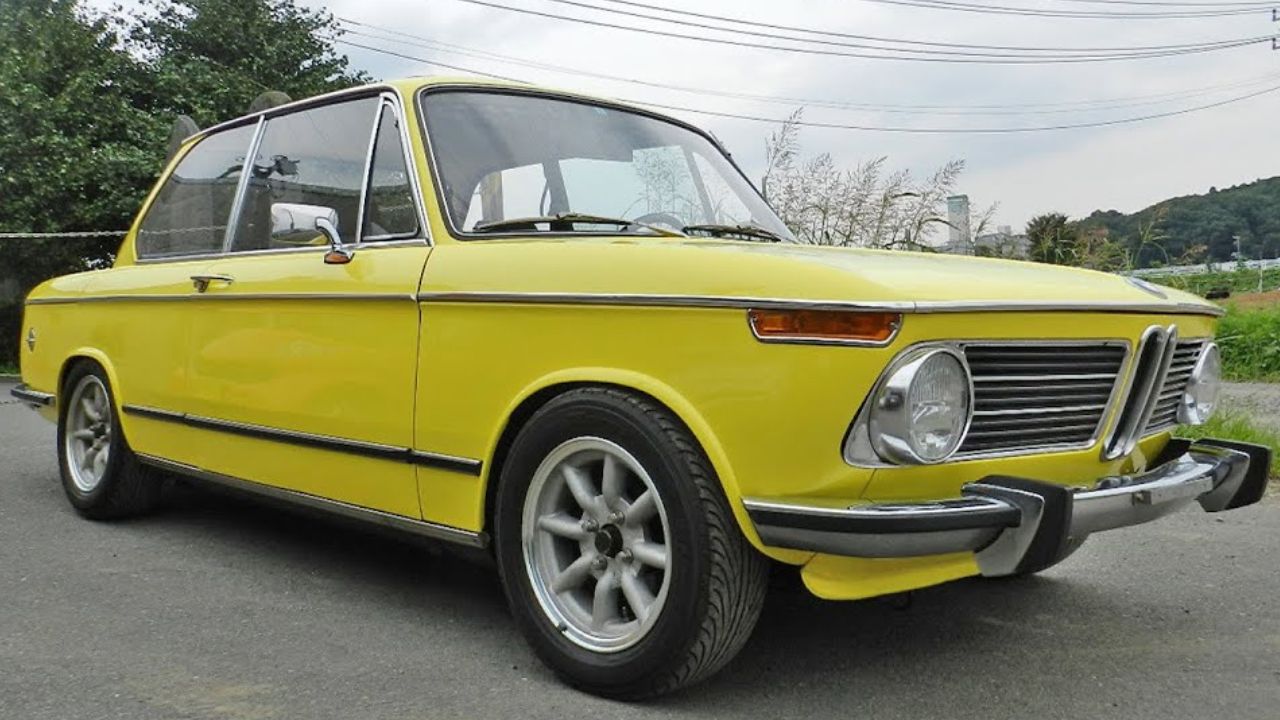
The 1971 BMW 2002tii did not arrive as the loudest or most powerful compact sports sedan of its era, yet it quietly redefined what “balanced performance” meant in the early 1970s. While American muscle cars were chasing displacement and straight-line dominance, BMW was refining a very different philosophy—one built around precision, agility, and everyday usability.
As part of the broader BMW “Neue Klasse” legacy, the 2002tii became a defining model that helped establish the brand’s global performance identity. It was not simply a faster version of a compact sedan; it was a carefully engineered machine that demonstrated how power, weight, and chassis tuning could work together to create a new kind of driving experience.
Over time, the 2002tii has come to represent a turning point in automotive history—one where performance was no longer measured only in horsepower, but in how naturally a car could respond to its driver.
What happened
By the early 1970s, BMW had already begun reshaping its identity through the success of the “Neue Klasse” platform, which introduced modern engineering principles to compact European sedans. The 2002 series, derived from this platform, became one of the most important models in BMW’s evolution.
Within that lineup, the 2002tii stood at the top of the performance hierarchy. The “tii” designation referred to “Touring International Injection,” highlighting its use of mechanical fuel injection—an advanced feature at the time that set it apart from carbureted competitors.
Under the hood, the 2002tii used a 2.0-liter inline-four engine equipped with Kugelfischer mechanical fuel injection. This system allowed for more precise fuel delivery compared to traditional carburetors, improving throttle response and overall efficiency. The engine produced approximately 130 horsepower, a modest figure by American V8 standards but highly competitive in the lightweight European sports sedan category.
More importantly than raw output, the engine delivered its power in a smooth and predictable curve. This made the car feel responsive at nearly any engine speed, a trait that contributed significantly to its balanced character.
The engine was paired with a close-ratio 4-speed manual transmission, reinforcing the car’s driver-focused design. Gear changes were direct and mechanical, allowing drivers to stay engaged with the engine’s power band. Unlike larger performance cars that relied on torque to mask gearing gaps, the 2002tii required active driver participation.
The chassis design played an equally important role in shaping the car’s identity. Built on a shortened version of the Neue Klasse platform, the 2002tii featured a relatively lightweight body structure. This low mass was central to its performance philosophy, as it allowed the modestly powered engine to deliver strong real-world acceleration.
Suspension tuning favored precision over comfort. MacPherson struts in the front and a semi-independent rear setup provided stability while maintaining responsiveness. BMW engineers prioritized predictable handling behavior, ensuring that the car remained composed during aggressive driving without becoming difficult to control.
Steering was another standout feature. The system was unassisted in most configurations, delivering direct feedback from the road surface. This mechanical connection between driver and chassis became one of the defining characteristics of early BMW performance cars.
Styling for the 2002tii remained understated but purposeful. The compact two-door sedan body featured clean lines, a short wheelbase, and subtle performance cues. Unlike more flamboyant sports cars of the era, the 2002tii avoided aggressive styling in favor of functional simplicity.
Inside, the cabin reflected BMW’s focus on driver orientation. The dashboard layout was straightforward, with clearly visible gauges and controls positioned for ease of use. While not luxurious by modern standards, the interior emphasized ergonomics and clarity over decoration.
Despite its relatively small size and modest engine output, the 2002tii quickly earned a reputation for outperforming expectations. Its combination of light weight, responsive engine, and precise chassis tuning allowed it to compete with larger and more powerful vehicles in real-world driving scenarios.
Why it matter
The 1971 BMW 2002tii matters because it helped establish a new definition of performance that would influence decades of automotive development. Rather than focusing solely on horsepower or straight-line speed, BMW demonstrated that balance between power, weight, and handling could produce a more engaging and usable driving experience.
This philosophy became a cornerstone of BMW’s identity. The 2002tii showed that a compact sedan could deliver genuine performance without relying on large-displacement engines or excessive weight. Instead, it emphasized efficiency, responsiveness, and driver involvement.
At a time when many manufacturers were pursuing increasingly powerful engines, BMW took a different approach. The 2002tii’s relatively small 2.0-liter engine would have been considered modest in isolation, but when paired with a lightweight chassis, it delivered performance that felt far greater than its specifications suggested.
This relationship between power and weight became one of the most important lessons in performance engineering. It demonstrated that reducing mass could be just as effective as increasing horsepower when it came to improving real-world speed and agility.
The use of mechanical fuel injection was another key factor in the car’s significance. While not as advanced as modern electronic systems, it represented a major step forward in precision fueling at the time. The improved throttle response gave drivers a more immediate connection to the engine, enhancing the sense of control.
Within BMW’s broader lineup, the 2002tii served as a bridge between economy-focused compact cars and more serious performance models. It helped establish the brand’s reputation for producing driver-oriented vehicles that balanced practicality with enthusiasm.
Its influence extended beyond BMW itself. The success of the 2002tii encouraged other manufacturers to explore similar formulas, combining smaller engines with refined chassis tuning rather than relying solely on displacement increases.
Today, the model is often cited as one of the foundational vehicles in the development of the modern sports sedan. Its principles can be seen in countless later designs that prioritize handling and balance over brute force.
What to watch next
Interest in the 2002tii continues to grow as collectors and enthusiasts seek out vehicles that emphasize driving engagement over raw power. Its historical significance and relatively limited production numbers contribute to its increasing value in the classic car market.
Future appreciation is likely to focus on originality, particularly in examples that retain their factory mechanical fuel injection systems. Properly maintained drivetrains and period-correct components will play a major role in long-term value.
At the same time, modified versions remain popular among drivers who want to preserve the spirit of the car while improving usability. Upgraded suspension components, modern braking systems, and careful engine tuning allow the platform to remain relevant in contemporary driving conditions.
Parts availability remains relatively strong due to BMW’s longstanding support for classic models, though specialized fuel injection components may become more difficult to source over time.
As automotive media continues to highlight the origins of modern sports sedans, the 2002tii is expected to receive further recognition as one of the most influential compact performance cars ever built.
More From Fast Lane Only: